
Person
Isaac
EYE-zakOld Testament · about 2066–1886 BC · Hebrew for "he laughs"
The son God promised to Abraham and Sarah when they were far too old for children, offered on Mount Moriah and spared. Quiet and peaceable, he carried the covenant from Abraham to Jacob.
- Family
- Son of Abraham and Sarah; half-brother of Ishmael. Married Rebekah; twin sons Esau and Jacob
- Known for
- The ram on Mount Moriah, the wells at Gerar, blessing the wrong son
- Meaning
- "He laughs": Abraham and Sarah both laughed at the promise (Genesis 17:17; Genesis 18:12)
- Died
- At Mamre near Hebron, aged 180; buried in the cave of Machpelah (Genesis 35:27–29)
His life
Isaac was born when his father was a hundred and his mother ninety, twenty-five years after God first promised Abraham a son (Genesis 21:1–5). His name remembers the laughter of disbelief and then of joy (Genesis 21:6). When Ishmael mocked at the feast for his weaning, Sarah had Hagar and her son sent away, and God confirmed that the promised line ran through Isaac (Genesis 21:9–12).
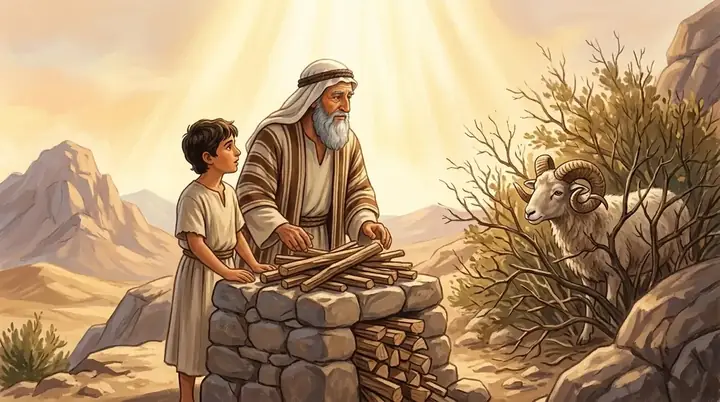
Then God tested Abraham: "Take now thy son, thine only son Isaac, whom thou lovest", and offer him on a mountain in Moriah (Genesis 22:2). Isaac carried the wood, asked where the lamb was, and let himself be bound on the altar. The knife was raised before the angel stopped it, and a ram caught in a thicket died in his place (Genesis 22:9–13).
At forty he married Rebekah, whom Abraham's servant found at the well in Haran, and he loved her (Genesis 24). She was barren for twenty years; Isaac prayed, and she bore twins, Esau and Jacob (Genesis 25:20–26). In a famine Isaac went to Gerar, where God renewed every promise made to Abraham (Genesis 26:2–5). There he repeated his father's old lie that his wife was his sister (Genesis 26:7–11). He grew rich, reopened his father's wells, and when the herdsmen of Gerar quarrelled over them he simply moved on and dug again, until at Rehoboth there was room (Genesis 26:12–22). King Abimelech came to make peace with him at Beersheba (Genesis 26:26–31).
What went wrong
Isaac loved Esau for his hunting, while Rebekah loved Jacob (Genesis 25:28). Old and nearly blind, he meant to give Esau the firstborn's blessing against God's word that the elder would serve the younger. Jacob, dressed in his brother's clothes, deceived him and took it, and Isaac "trembled very exceedingly" but would not take it back (Genesis 27). He then blessed Jacob knowingly and sent him to Haran (Genesis 28:1–4). He lived to see Jacob return and died at 180, buried by both his sons (Genesis 35:27–29).
What to learn
Isaac is the least dramatic of the patriarchs: he dug wells, kept the peace, prayed for his wife and meditated in the fields at evening (Genesis 24:63). Hebrews lists him among the faithful for blessing his sons "concerning things to come" (Hebrews 11:20). God calls himself "the God of Abraham, the God of Isaac, and the God of Jacob" (Exodus 3:6), which Jesus took as proof that Isaac still lives (Matthew 22:32).
Points to Christ
A father offering his only, beloved son on a hill near Jerusalem, the son carrying the wood up the slope, and a substitute dying in his place: the church has always seen in Genesis 22 a picture of the cross. Paul calls believers "as Isaac was, the children of promise", born not by human effort but by God's word (Galatians 4:28).
Key verses
- Genesis 21:1–7
And the Lord visited Sarah as he had said, and the Lord did unto Sarah as he had spoken. For Sarah conceived, and bare Abraham a son in his old age, at the set time of which God had spoken to him. And Abraham called the name of his son that was born unto him, whom Sarah bare to him, Isaac. …
- Genesis 22:1–14
And it came to pass after these things, that God did tempt Abraham, and said unto him, Abraham: and he said, Behold, here I am. And he said, Take now thy son, thine only son Isaac, whom thou lovest, and get thee into the land of Moriah; and offer him there for a burnt offering upon one of the mountains which I will tell thee of. And Abraham rose up early in the morning, and saddled his ass, and took two of his young men with him, and Isaac his son, and clave the wood for the burnt offering, and rose up, and went unto the place of which God had told him. …
- Genesis 26:2–5
And the Lord appeared unto him, and said, Go not down into Egypt; dwell in the land which I shall tell thee of: Sojourn in this land, and I will be with thee, and will bless thee; for unto thee, and unto thy seed, I will give all these countries, and I will perform the oath which I sware unto Abraham thy father; And I will make thy seed to multiply as the stars of heaven, and will give unto thy seed all these countries; and in thy seed shall all the nations of the earth be blessed; …
- Hebrews 11:17–20
By faith Abraham, when he was tried, offered up Isaac: and he that had received the promises offered up his only begotten son, Of whom it was said, That in Isaac shall thy seed be called: Accounting that God was able to raise him up, even from the dead; from whence also he received him in a figure. …
- Galatians 4:28
Now we, brethren, as Isaac was, are the children of promise.
On the map
Family
- Parents
- Abraham, Sarah
- Brothers and sisters
- Ishmael, Zimran, Jokshan, Medan, Midian, Ishbak, Shuah
- Married to
- Rebekah
- Children
- Esau, Israel
Mentioned in 123 verses
- Genesis 74
- Exodus 9
- Leviticus 1
- Numbers 1
- Deuteronomy 7
- Joshua 2
- 1 Kings 1
- 2 Kings 1
- 1 Chronicles 4
- 2 Chronicles 1
- Psalms 1
- Jeremiah 1
- Amos 2
- Matthew 3
- Mark 1
- Luke 3
- Acts 3
- Romans 2
- Galatians 1
- Hebrews 4
- James 1
Read next
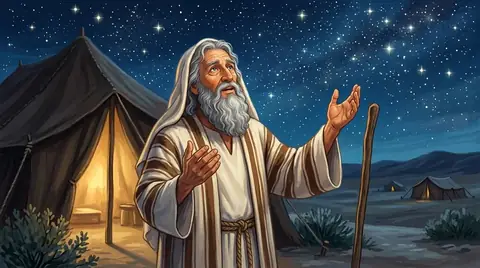 PersonAbrahamThe man God called out of Ur to a land he had never seen, promising him a people and a blessing for the whole world. He…
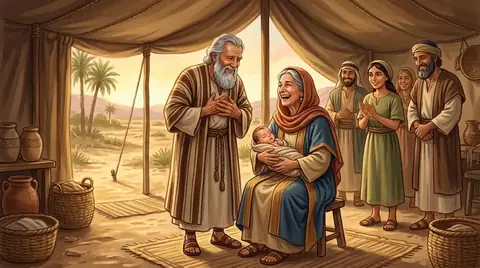 PersonSarahAbraham's wife and the mother of Isaac. She waited past ninety for the son God had promised, laughed when she heard it…
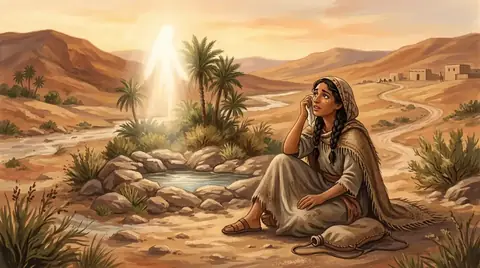 PersonIshmaelAbraham's first son, born to Hagar, Sarah's Egyptian maid. Sent away into the desert as a boy, he became a great archer…
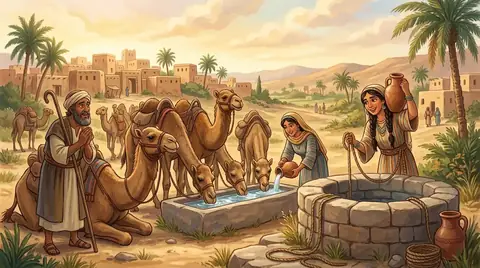 PersonRebekahIsaac's wife, found for him at a well far away in Abraham's homeland. She was told before her twins were born that the…
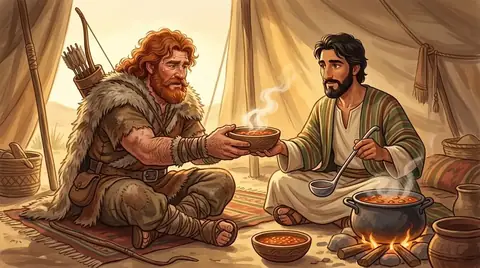 PersonEsauIsaac's elder twin, a hunter who traded away his birthright for a meal and lost his father's blessing to Jacob's trick.…
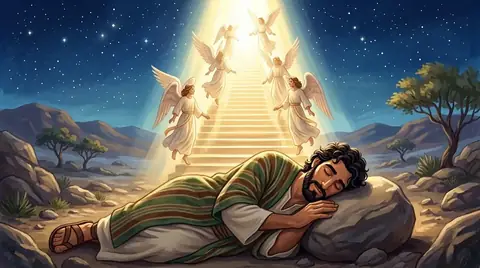 PersonJacobIsaac's younger twin son, who won his brother's birthright and blessing by cunning, was changed by God, and was renamed…
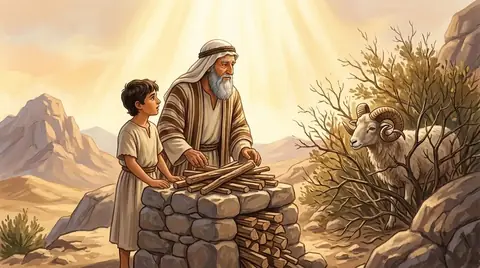 PlaceMount MoriahThe hill in Jerusalem where Solomon built the temple. It is the same land of Moriah where God told Abraham to offer…
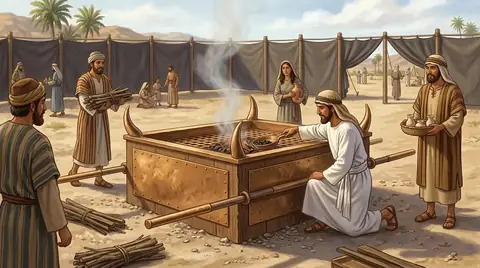 Thing · WorshipThe altarA raised structure of earth, stone or bronze on which sacrifices were offered to God. The big bronze altar stood in the…
Written for this app in its own words, from the Bible, with the facts checked against Bible dictionaries and encyclopedias: Easton's, Smith's, Fausset's, ISBE, Holman, the New Bible Dictionary, Vine's and the Thompson Chain topics. People and places: STEPBible.org (TIPNR), CC BY 4.0; where a place is today and its photo: OpenBible.info, CC BY 4.0.
