
Person
Abraham
AY-bra-hamOld Testament · about 2166–1991 BC · first called Abram
The man God called out of Ur to a land he had never seen, promising him a people and a blessing for the whole world. He believed God, and is called the father of all who have faith.
- Family
- Son of Terah. Husband of Sarah; father of Ishmael by Hagar, of Isaac by Sarah, and of six sons by Keturah. Uncle of Lot
- Known for
- Leaving Ur; the covenant; the birth of Isaac; offering Isaac on Mount Moriah
- Meaning
- Abram, exalted father; Abraham, father of a multitude
- Died
- Aged 175, buried beside Sarah in the cave of Machpelah at Hebron (Genesis 25:7–10)
His call
Abram grew up in Ur of the Chaldees, a rich city of idol-worshippers near the Persian Gulf (Joshua 24:2). God spoke to him there and he moved with his father Terah to Haran (Acts 7:2–4). After Terah died God called him again: leave your country and your family and go to a land I will show you, and I will make you a great nation and bless all the families of the earth through you (Genesis 12:1–3). Abram went, aged seventy-five, not knowing where he was going (Hebrews 11:8).
In the land
He lived in tents in Canaan, at Shechem, Bethel and Hebron, building altars wherever he stopped. He let his nephew Lot choose the best land (Genesis 13:8–11), rescued him from four invading kings, and was blessed by Melchizedek, the priest-king of Salem (Genesis 14). A famine drove him to Egypt, where he passed Sarah off as his sister out of fear, and he did the same later at Gerar (Genesis 12:10–20; Genesis 20). The father of faith was not always full of faith.
The covenant
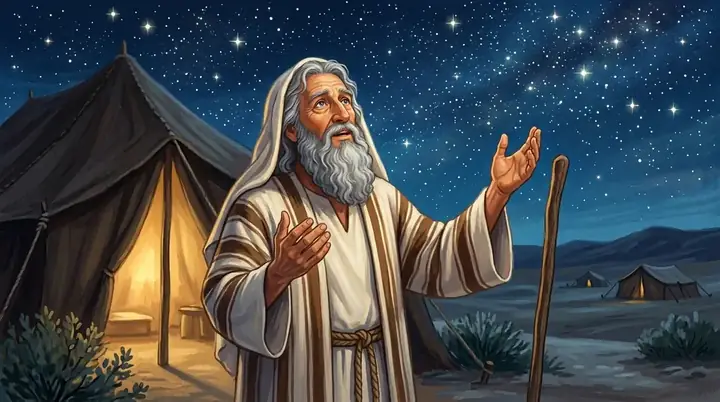
God told him to look at the stars and count them, for so many his children would be. Abram "believed in the LORD; and he counted it to him for righteousness" (Genesis 15:6). God made a solemn covenant with him, promising the land from Egypt to the Euphrates. Years passed with no child. Sarah gave him her maid Hagar, and Ishmael was born, but God said the promised son would be Sarah's. He changed Abram's name to Abraham, father of many, and gave circumcision as the sign of the covenant (Genesis 17). Three visitors came to his tent and said that in a year Sarah would have a son; she laughed, and Isaac was born when Abraham was a hundred (Genesis 18:1–15; Genesis 21:1–7).
The test
God told him to take Isaac to Mount Moriah and offer him as a burnt offering. Abraham obeyed, trusting that God could raise the dead if he had to (Hebrews 11:17–19). As the knife was raised the angel of the LORD stopped him, and a ram caught in a thicket died in Isaac's place (Genesis 22:1–14). God repeated his promise with an oath.
Points to Christ
Abraham's faith, not his works, made him right with God, and Paul says that everyone who trusts Christ is his true child, Jew or Gentile (Romans 4; Galatians 3:6–9). The blessing promised to all nations is Christ himself (Galatians 3:16). And on Mount Moriah a father spared his son because God provided a substitute; on a hill near the same place God did not spare his own Son (Romans 8:32). Jesus said, "Abraham rejoiced to see my day: and he saw it, and was glad" (John 8:56).
Key verses
- Genesis 12:1–3
Now the Lord had said unto Abram, Get thee out of thy country, and from thy kindred, and from thy father’s house, unto a land that I will shew thee: And I will make of thee a great nation, and I will bless thee, and make thy name great; and thou shalt be a blessing: And I will bless them that bless thee, and curse him that curseth thee: and in thee shall all families of the earth be blessed.
- Genesis 15:6
And he believed in the Lord; and he counted it to him for righteousness.
- Genesis 22:1–14
And it came to pass after these things, that God did tempt Abraham, and said unto him, Abraham: and he said, Behold, here I am. And he said, Take now thy son, thine only son Isaac, whom thou lovest, and get thee into the land of Moriah; and offer him there for a burnt offering upon one of the mountains which I will tell thee of. And Abraham rose up early in the morning, and saddled his ass, and took two of his young men with him, and Isaac his son, and clave the wood for the burnt offering, and rose up, and went unto the place of which God had told him. …
- Romans 4:3
For what saith the scripture? Abraham believed God, and it was counted unto him for righteousness.
- Hebrews 11:8–10
By faith Abraham, when he was called to go out into a place which he should after receive for an inheritance, obeyed; and he went out, not knowing whither he went. By faith he sojourned in the land of promise, as in a strange country, dwelling in tabernacles with Isaac and Jacob, the heirs with him of the same promise: For he looked for a city which hath foundations, whose builder and maker is God.
- John 8:56
Your father Abraham rejoiced to see my day: and he saw it, and was glad.
On the map
Family
- Parents
- Terah
- Brothers and sisters
- Nahor, Haran, Sarah
- Married to
- Sarah, Hagar, Keturah
- Children
- Ishmael, Isaac, Zimran, Jokshan, Medan, Midian, Ishbak, Shuah
Mentioned in 275 verses
- Genesis 164
- Exodus 9
- Leviticus 1
- Numbers 1
- Deuteronomy 7
- Joshua 2
- 1 Kings 1
- 2 Kings 1
- 1 Chronicles 6
- 2 Chronicles 2
- Nehemiah 1
- Psalms 4
- Isaiah 4
- Jeremiah 1
- Ezekiel 1
- Micah 1
- Matthew 6
- Mark 1
- Luke 14
- John 9
- Acts 7
- Romans 9
- 2 Corinthians 1
- Galatians 9
- Hebrews 10
- James 2
- 1 Peter 1
Read next
 PersonSarahAbraham's wife and the mother of Isaac. She waited past ninety for the son God had promised, laughed when she heard it…
 PersonIshmaelAbraham's first son, born to Hagar, Sarah's Egyptian maid. Sent away into the desert as a boy, he became a great archer…PersonHagarSarah's Egyptian servant, given to Abraham to bear a child, and the mother of Ishmael. Twice she was driven out into…
 PersonIsaacThe son God promised to Abraham and Sarah when they were far too old for children, offered on Mount Moriah and spared.…
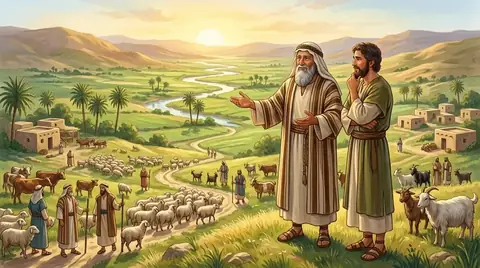 PersonLotAbraham's nephew, who chose the rich plain of Jordan and settled in Sodom. Angels dragged him out before the city…
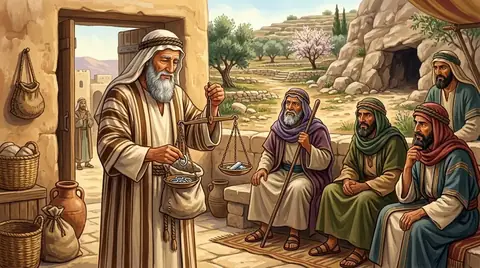 PlaceMachpelahThe cave near Hebron that Abraham bought as a grave for Sarah. Abraham, Isaac, Rebekah, Jacob and Leah were all buried…Place · CityHebronAn ancient city in the hills of Judah where Abraham lived and the patriarchs were buried in the cave of Machpelah.…
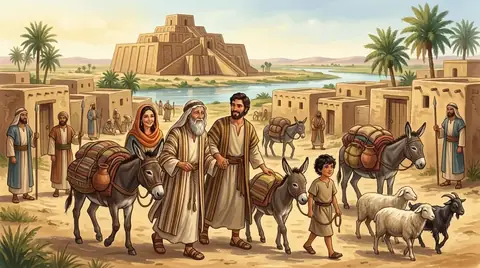 Place · CityUrThe great city in southern Mesopotamia where Abraham grew up. God called him out of Ur, away from its idols, to go to…
Written for this app in its own words, from the Bible, with the facts checked against Bible dictionaries and encyclopedias: Easton's, Smith's, Fausset's, ISBE, Holman, the New Bible Dictionary, Vine's and the Thompson Chain topics. People and places: STEPBible.org (TIPNR), CC BY 4.0; where a place is today and its photo: OpenBible.info, CC BY 4.0.
