
Custom · Covenant
Circumcision
The removal of a baby boy's foreskin on his eighth day, the mark God gave Abraham's family as the sign of his covenant. The apostles ruled that Gentile believers did not need it.
- Given to
- Abraham, aged 99 (Genesis 17:9–14, 24)
- When
- The eighth day after birth (Leviticus 12:3); the boy was named then (Luke 1:59; Luke 2:21)
- Meaning
- A sign and a seal (Romans 4:11); pointed to a changed heart (Deuteronomy 30:6)
- In the church
- Not required of Gentiles (Acts 15); baptism took its place as the sign of belonging
What it was
Circumcision cuts away the fold of skin at the tip of the male organ. Other ancient peoples practised it too, but God made it the badge of his own people. He commanded Abraham that every male in his household, born or bought, be circumcised, and that every boy after him be done on the eighth day of his life. A male who refused it had broken the covenant and was cut off from the people (Genesis 17:9–14). Abraham obeyed before the day was out, and thirteen-year-old Ishmael was circumcised with him (Genesis 17:23–27).
In the Old Testament
Isaac was circumcised on the eighth day (Genesis 21:4), and the Law fixed that day for every son (Leviticus 12:3). No uncircumcised man could eat the Passover (Exodus 12:48). When Moses neglected it for his own son, his life was in danger until Zipporah did it (Exodus 4:24–26). The rite lapsed during the forty years in the wilderness, and Joshua had the whole new generation circumcised at Gilgal before they could take Canaan (Joshua 5:2–9). From then on "the uncircumcised" was Israel's word for the Philistines and other outsiders (Judges 14:3; 1 Samuel 17:26).
In the New Testament
John the Baptist and Jesus were both circumcised and named on the eighth day (Luke 1:59; Luke 2:21). Once Gentiles began believing, some Jewish Christians insisted they must be circumcised to be saved. The apostles met in Jerusalem and ruled that they need not (Acts 15:1–29). Paul fought this battle all his life. He would not let Titus, a Greek, be circumcised, because the gospel was at stake (Galatians 2:3–5), yet he circumcised Timothy, whose mother was Jewish, so as not to hinder the work (Acts 16:3). To the Galatians he wrote that anyone relying on circumcision had fallen from grace: "in Jesus Christ neither circumcision availeth any thing, nor uncircumcision; but faith which worketh by love" (Galatians 5:2–6).
What it meant
From the start the sign pointed beyond itself. Moses told Israel to "circumcise the foreskin of your heart" (Deuteronomy 10:16) and promised that God himself would do it (Deuteronomy 30:6). Paul says Abraham received circumcision as a seal of a righteousness he already had by faith, before he was ever circumcised (Romans 4:9–11), and that the true Jew is one inwardly, with a circumcision of the heart by the Spirit (Romans 2:28–29). In Christ believers have a circumcision "made without hands", the old sinful self cut away, and have been buried and raised with him in baptism (Colossians 2:11–12).
Key verses
- Genesis 17:10–12
This is my covenant, which ye shall keep, between me and you and thy seed after thee; Every man child among you shall be circumcised. And ye shall circumcise the flesh of your foreskin; and it shall be a token of the covenant betwixt me and you. And he that is eight days old shall be circumcised among you, every man child in your generations, he that is born in the house, or bought with money of any stranger, which is not of thy seed.
- Leviticus 12:3
And in the eighth day the flesh of his foreskin shall be circumcised.
- Joshua 5:2–9
At that time the Lord said unto Joshua, Make thee sharp knives, and circumcise again the children of Israel the second time. And Joshua made him sharp knives, and circumcised the children of Israel at the hill of the foreskins. And this is the cause why Joshua did circumcise: All the people that came out of Egypt, that were males, even all the men of war, died in the wilderness by the way, after they came out of Egypt. …
- Acts 15:1–11
And certain men which came down from Judea taught the brethren, and said, Except ye be circumcised after the manner of Moses, ye cannot be saved. When therefore Paul and Barnabas had no small dissension and disputation with them, they determined that Paul and Barnabas, and certain other of them, should go up to Jerusalem unto the apostles and elders about this question. And being brought on their way by the church, they passed through Phenice and Samaria, declaring the conversion of the Gentiles: and they caused great joy unto all the brethren. …
- Romans 2:28–29
For he is not a Jew, which is one outwardly; neither is that circumcision, which is outward in the flesh: But he is a Jew, which is one inwardly; and circumcision is that of the heart, in the spirit, and not in the letter; whose praise is not of men, but of God.
- Galatians 5:6
For in Jesus Christ neither circumcision availeth any thing, nor uncircumcision; but faith which worketh by love.
Read next
 PersonAbrahamThe man God called out of Ur to a land he had never seen, promising him a people and a blessing for the whole world. He…Custom · TeachingBaptismWashing with water in the name of the Father, the Son and the Holy Spirit, the sign Jesus gave of entering his church.…
 PersonIshmaelAbraham's first son, born to Hagar, Sarah's Egyptian maid. Sent away into the desert as a boy, he became a great archer…
 PersonIsaacThe son God promised to Abraham and Sarah when they were far too old for children, offered on Mount Moriah and spared.…
 FeastPassoverThe yearly feast remembering the night God rescued Israel from Egypt, when death passed over every house marked with a…
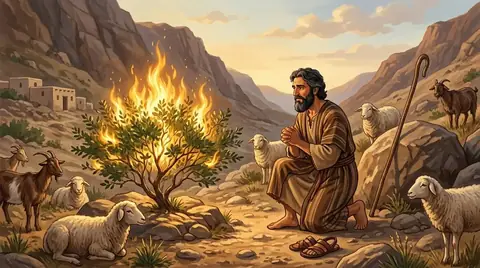 PersonMosesThe man God used to bring Israel out of Egypt, give them his Law at Sinai, and lead them for forty years in the…
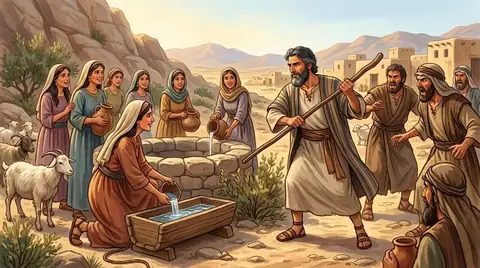 PersonZipporahThe wife of Moses, a daughter of Jethro the priest of Midian. She bore him two sons, Gershom and Eliezer, and once…
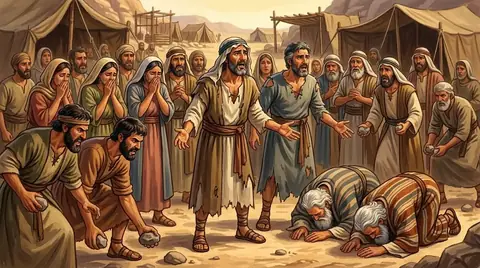 PersonJoshuaMoses' helper who took over from him and led Israel across the Jordan into the Promised Land. He fought the wars of…
Written for this app in its own words, from the Bible, with the facts checked against Bible dictionaries and encyclopedias: Easton's, Smith's, Fausset's, ISBE, Holman, the New Bible Dictionary, Vine's and the Thompson Chain topics.
