
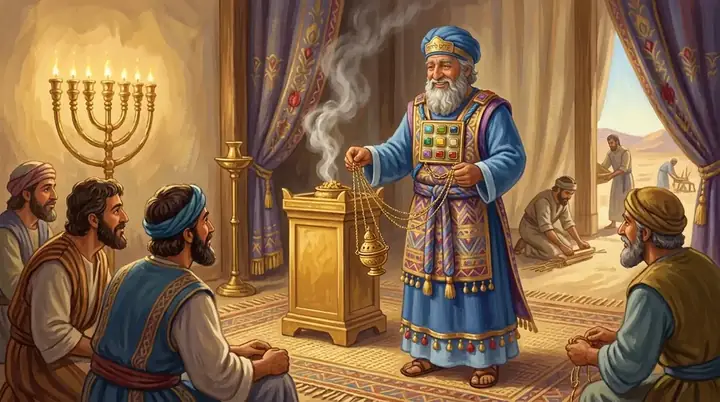
Book
Exodus (book)
Old Testament · Law, the second book of Moses · written by Moses, about 1445–1405 BC
The second book of the Bible. God frees Israel from slavery in Egypt through Moses, gives them his law at Mount Sinai, and comes to live among them in the tabernacle.
- Author
- Moses
- Written
- About 1445–1405 BC
- Chapters
- 40
- Key verse
- "When I see the blood, I will pass over you" (Exodus 12:13)
What it's about
Exodus means "going out". It opens with Jacob's family grown into a nation and crushed as slaves in Egypt. God hears their cry and calls Moses at the burning bush, telling him his name, "I AM THAT I AM" (Exodus 3:14). Through ten plagues God breaks Pharaoh's pride, and on the night of the Passover Israel walks free. The Red Sea opens before them and closes on the Egyptian army.
At Mount Sinai God makes a covenant with the people and gives the Ten Commandments (Exodus 20). The last chapters give the plans for the tabernacle, tell of the golden calf, and end with God's glory filling the finished tent (Exodus 40:34).
Its message
The LORD is a rescuing God who keeps his promises to Abraham. He saves his people first, then shows them how to live as his own "kingdom of priests, and an holy nation" (Exodus 19:6). And he wants to dwell with them: the whole book moves from slavery to God's presence in the camp.
Points to Christ
The Passover lamb, whose blood kept the firstborn safe, is a picture of Jesus: "Christ our passover is sacrificed for us" (1 Corinthians 5:7). The manna points to him as the bread from heaven (John 6:32–35), and the tabernacle to the Word who "dwelt among us" (John 1:14).
Key verses
- Exodus 3:14
And God said unto Moses, I AM THAT I AM: and he said, Thus shalt thou say unto the children of Israel, I AM hath sent me unto you.
- Exodus 12:13
And the blood shall be to you for a token upon the houses where ye are: and when I see the blood, I will pass over you, and the plague shall not be upon you to destroy you, when I smite the land of Egypt.
- Exodus 14:13–14
And Moses said unto the people, Fear ye not, stand still, and see the salvation of the Lord, which he will shew to you to day: for the Egyptians whom ye have seen to day, ye shall see them again no more for ever. The Lord shall fight for you, and ye shall hold your peace.
- Exodus 19:5–6
Now therefore, if ye will obey my voice indeed, and keep my covenant, then ye shall be a peculiar treasure unto me above all people: for all the earth is mine: And ye shall be unto me a kingdom of priests, and an holy nation. These are the words which thou shalt speak unto the children of Israel.
- Exodus 20:2–3
I am the Lord thy God, which have brought thee out of the land of Egypt, out of the house of bondage. Thou shalt have no other gods before me.
- Exodus 40:34
Then a cloud covered the tent of the congregation, and the glory of the Lord filled the tabernacle.
On the map
Read next
 PersonMosesThe man God used to bring Israel out of Egypt, give them his Law at Sinai, and lead them for forty years in the…
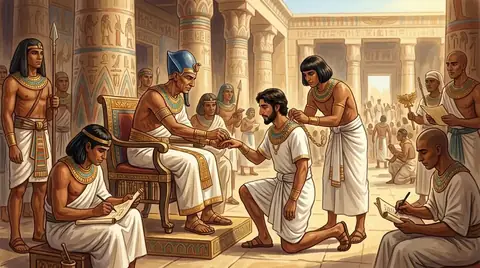 Place · NationEgyptThe great kingdom of the Nile, where Israel grew from a family into a nation and was then enslaved. The Exodus from…Event · SymbolBurning BushThe desert bush that burned without burning up, from which God spoke to Moses, told him his name and sent him to bring…
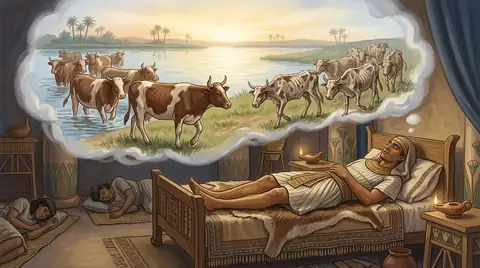 Title · RulerPharaohNot a personal name but the title borne by every king of Egypt, like "Caesar". The Bible names several, the best known…
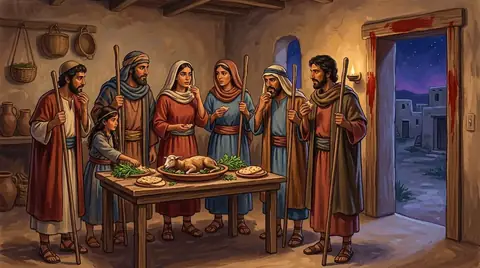 FeastPassoverThe yearly feast remembering the night God rescued Israel from Egypt, when death passed over every house marked with a…
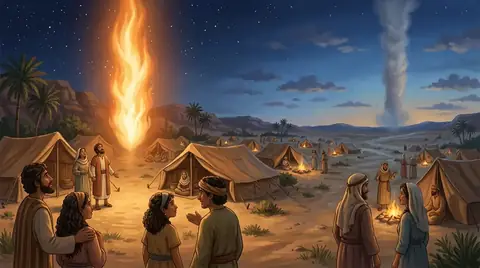 PlaceRed SeaThe sea God parted so Israel could escape from Egypt on dry ground, and then closed over Pharaoh's army. Its crossing…
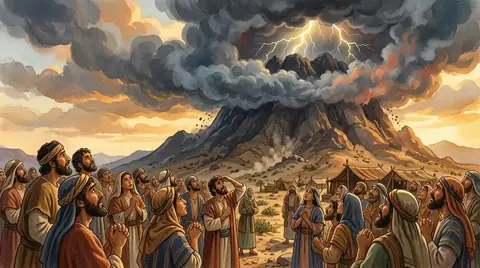 Place · MountainSinaiThe mountain where God came down in fire and smoke, spoke the Ten Commandments, and made his covenant with Israel. The…
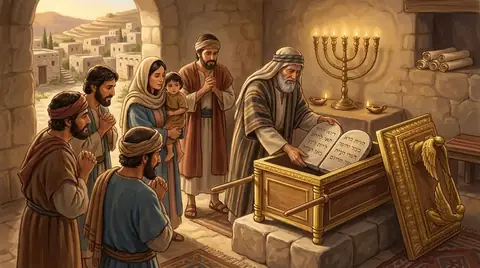 Teaching · LawDecalogueThe Ten Commandments, which God spoke from Mount Sinai and wrote with his own finger on two stone tablets. They sum up…
Written for this app in its own words, from the Bible, with the facts checked against Bible dictionaries and encyclopedias: Easton's, Smith's, Fausset's, ISBE, Holman, the New Bible Dictionary, Vine's and the Thompson Chain topics.
