
Event · Symbol
Burning Bush
Near Mount Horeb (Sinai), about 1446 BC
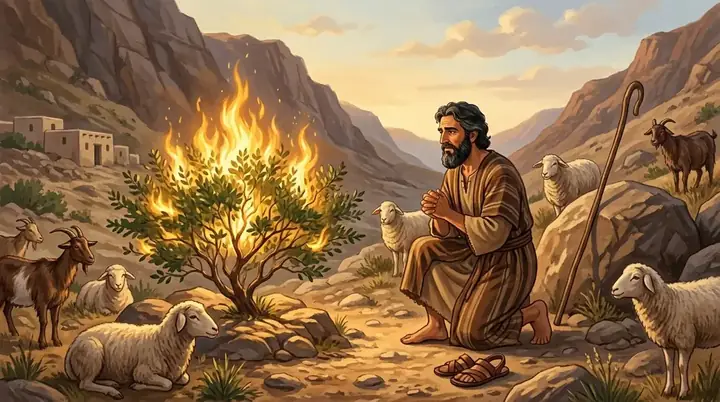
The desert bush that burned without burning up, from which God spoke to Moses, told him his name and sent him to bring Israel out of Egypt. Jesus pointed to it to prove the resurrection.
- Where
- Near Horeb, the mountain of God (Exodus 3:1)
- Told in
- Exodus 3:1–4:17; Acts 7:30–35
- Jesus on it
- Mark 12:26–27; Luke 20:37–38
- The bush
- A thorny desert shrub, perhaps an acacia; the kind isn't certain
What happened
Moses, now eighty and keeping his father-in-law's sheep, came to Horeb. "The angel of the LORD appeared unto him in a flame of fire out of the midst of a bush: and he looked, and, behold, the bush burned with fire, and the bush was not consumed." When he turned aside to look, God called him by name and said, "put off thy shoes from off thy feet, for the place whereon thou standest is holy ground" (Exodus 3:2–5).
There God said he had seen his people's misery in Egypt and was sending Moses to Pharaoh. When Moses asked his name, God answered, "I AM THAT I AM" (Exodus 3:7–14).
What it meant
Fire in the Bible often shows God's holy presence, as at Sinai later (Exodus 19:18). That the bush was not burned up has been seen as a picture of God's people, afflicted in Egypt but not destroyed, because the LORD himself dwelt among them. Moses, blessing Joseph, spoke of "the good will of him that dwelt in the bush" (Deuteronomy 33:16).
Jesus and the bush
When the Sadducees denied the resurrection, Jesus reminded them that "in the bush God spake unto him, saying, I am the God of Abraham, and the God of Isaac, and the God of Jacob", long after they had died. "He is not the God of the dead, but the God of the living" (Mark 12:26–27).
Key verses
- Exodus 3:2–5
And the angel of the Lord appeared unto him in a flame of fire out of the midst of a bush: and he looked, and, behold, the bush burned with fire, and the bush was not consumed. And Moses said, I will now turn aside, and see this great sight, why the bush is not burnt. And when the Lord saw that he turned aside to see, God called unto him out of the midst of the bush, and said, Moses, Moses. And he said, Here am I. …
- Exodus 3:14
And God said unto Moses, I AM THAT I AM: and he said, Thus shalt thou say unto the children of Israel, I AM hath sent me unto you.
- Deuteronomy 33:16
And for the precious things of the earth and fulness thereof, and for the good will of him that dwelt in the bush: let the blessing come upon the head of Joseph, and upon the top of the head of him that was separated from his brethren.
- Mark 12:26–27
And as touching the dead, that they rise: have ye not read in the book of Moses, how in the bush God spake unto him, saying, I am the God of Abraham, and the God of Isaac, and the God of Jacob? He is not the God of the dead, but the God of the living: ye therefore do greatly err.
- Acts 7:30
And when forty years were expired, there appeared to him in the wilderness of mount Sina an angel of the Lord in a flame of fire in a bush.
On the map
Read next
Written for this app in its own words, from the Bible, with the facts checked against Bible dictionaries and encyclopedias: Easton's, Smith's, Fausset's, ISBE, Holman, the New Bible Dictionary, Vine's and the Thompson Chain topics.
