
Nation
The Philistines
FIL-iss-teensIsrael's great enemy in the days of the judges and Saul
A warlike people from over the sea, settled in five cities on the coastal plain to the south-west of Israel. With iron weapons and a strong army they oppressed Israel for generations, until David broke their power.
- Where
- Philistia, the coastal plain: Gaza, Ashdod, Ashkelon, Gath and Ekron
- Came from
- Caphtor, probably Crete (Amos 9:7; Jeremiah 47:4)
- Gods
- Dagon, Ashtoreth, Baal-zebub
- Known for
- Fighting Samson, capturing the ark, Goliath, killing Saul
- Also called
- Cherethites (1 Samuel 30:14; Zephaniah 2:5)
Who they were
The Philistines were not natives of Canaan. They came over the sea from Caphtor, which is probably Crete, and settled along the coast to the south-west of Israel, where they are already found in the days of Abraham and Isaac at Gerar (Genesis 21:32; 26:1). Their main strength arrived about the time of the judges. They were ruled by the five "lords" of their five cities, worshipped Dagon, and were the only people in the region who could not be called Semitic; the Bible usually calls them "the uncircumcised". Above all they had iron. They kept the secret to themselves, so that in Saul's day Israel had to go down to the Philistines even to sharpen a ploughshare, and only Saul and Jonathan owned a sword (1 Samuel 13:19–22).
Israel's great enemy
For a century and more they were the terror of the hill country. Shamgar killed six hundred of them with an ox-goad (Judges 3:31). They oppressed Israel for forty years in the time of Samson, who fought them single-handed and died pulling down the temple of Dagon on their heads (Judges 13–16). They crushed Israel at Aphek, killed Eli's sons and captured the ark of the covenant, only to send it back when plagues broke out in every city that housed it (1 Samuel 4–6). Samuel won a great victory and set up the stone Ebenezer (1 Samuel 7). Saul fought them all his life; the boy David killed their champion Goliath in the valley of Elah (1 Samuel 17); and on Mount Gilboa they finally killed Saul and his sons and hung their bodies on the wall of Beth-shan (1 Samuel 31).
Broken by David
David had once hidden among them, serving Achish of Gath (1 Samuel 27). When he became king they came for him, and he beat them twice in the valley of Rephaim, then took Gath itself (2 Samuel 5:17–25; 1 Chronicles 18:1). After that they were never again a real threat, though they raided Judah under later kings (2 Chronicles 21:16; 28:18). Uzziah broke down their walls, and Hezekiah struck them as far as Gaza (2 Kings 18:8). The prophets foretold their end (Isaiah 14:29–31; Jeremiah 47; Amos 1:6–8; Zechariah 9:5–7), and after the exile they disappear from history, leaving only their name on the land: Palestine.
Key verses
- Judges 13:1
And the children of Israel did evil again in the sight of the Lord; and the Lord delivered them into the hand of the Philistines forty years.
- 1 Samuel 4:10–11
And the Philistines fought, and Israel was smitten, and they fled every man into his tent: and there was a very great slaughter; for there fell of Israel thirty thousand footmen. And the ark of God was taken; and the two sons of Eli, Hophni and Phinehas, were slain.
- 1 Samuel 13:19–20
Now there was no smith found throughout all the land of Israel: for the Philistines said, Lest the Hebrews make them swords or spears: But all the Israelites went down to the Philistines, to sharpen every man his share, and his coulter, and his axe, and his mattock.
- 1 Samuel 17:4
And there went out a champion out of the camp of the Philistines, named Goliath, of Gath, whose height was six cubits and a span.
- 2 Samuel 5:17–25
But when the Philistines heard that they had anointed David king over Israel, all the Philistines came up to seek David; and David heard of it, and went down to the hold. The Philistines also came and spread themselves in the valley of Rephaim. And David enquired of the Lord, saying, Shall I go up to the Philistines? wilt thou deliver them into mine hand? And the Lord said unto David, Go up: for I will doubtless deliver the Philistines into thine hand. …
- Amos 9:7
Are ye not as children of the Ethiopians unto me, O children of Israel? saith the Lord. Have not I brought up Israel out of the land of Egypt? and the Philistines from Caphtor, and the Syrians from Kir?
On the map
Read next
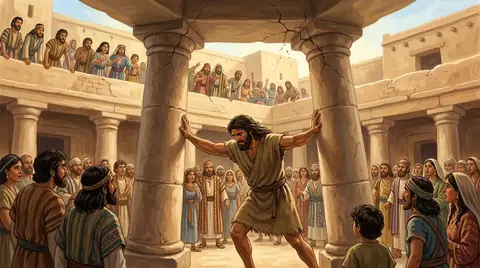 Place · RegionPhilistiaThe flat, fertile coastal plain south-west of Israel where the Philistines lived, with their five cities of Gaza…
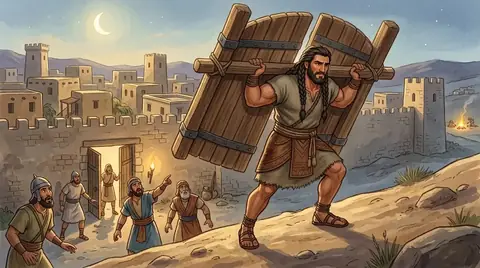 Place · CityGazaThe southernmost of the five Philistine cities, on the coast road to Egypt. Samson carried off its gates and later died…
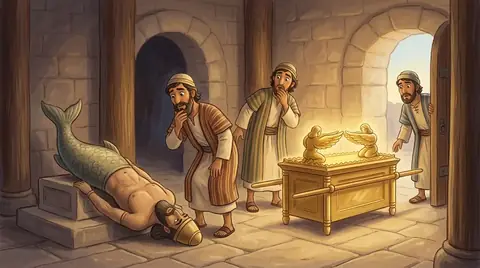 Place · CityAshdodOne of the five Philistine cities, on the coast road between Egypt and Israel. The captured ark was carried into its…
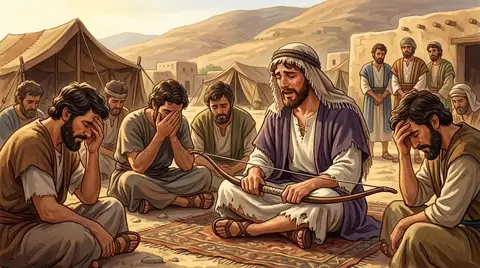 Place · CityAshkelonA Philistine port on the Mediterranean, one of the five chief cities. Samson killed thirty men there, David wished its…
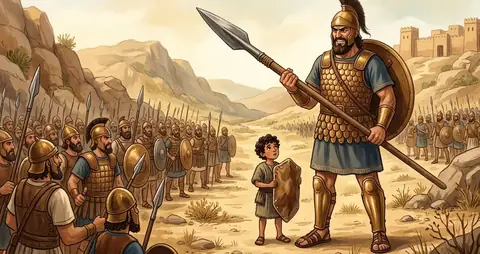 Place · CityGathA chief city of the Philistines on the border of Judah, home of Goliath and of the last of the giants. David twice took…
 Place · CityEkronOne of the five Philistine strongholds, the last stop of the captured ark before it was sent home, and the home of the…
 Place · IslandCaphtorThe land from which the Philistines came to the coast of Canaan, usually identified with the island of Crete. Amos…IdolDagonThe chief god of the Philistines, worshipped at Gaza and Ashdod. Samson pulled down his temple, and his statue fell…
Written for this app in its own words, from the Bible, with the facts checked against Bible dictionaries and encyclopedias: Easton's, Smith's, Fausset's, ISBE, Holman, the New Bible Dictionary, Vine's and the Thompson Chain topics.
