
Person
Sennacherib
sen-AK-er-ibOld Testament · king of Assyria 705–681 BC
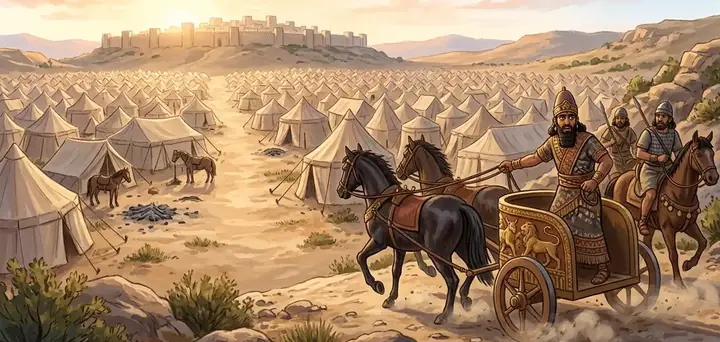
The king of Assyria who invaded Judah in Hezekiah's reign and threatened Jerusalem. God answered Hezekiah's prayer, struck down the Assyrian army in one night, and Sennacherib went home to be killed by his own sons.
- Ruled
- Assyria, from Nineveh
- Family
- Son of Sargon; father of Esarhaddon, Adrammelech and Sharezer
- Known for
- The siege of Jerusalem in 701 BC
- Died
- Murdered by two of his sons in the temple of Nisroch (2 Kings 19:37)
His invasion
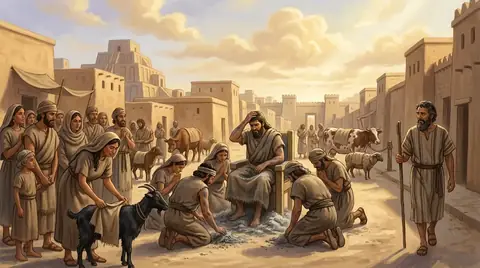
In the fourteenth year of Hezekiah, Sennacherib marched into Judah and captured its walled towns one after another (2 Kings 18:13). Hezekiah had stopped the springs outside Jerusalem and strengthened the walls (2 Chronicles 32:2–5). He tried to buy peace with 300 talents of silver and 30 of gold, stripping even the temple doors (2 Kings 18:14–16).
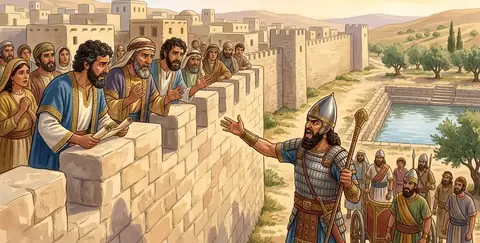
From the siege of Lachish, Sennacherib sent his officers, among them the Rabshakeh, to the walls of Jerusalem. In Hebrew, so that everyone could hear, the Rabshakeh mocked Hezekiah and the LORD: no god of any nation had saved its people from Assyria, so why should Judah's? (2 Kings 18:17–35).
God's answer
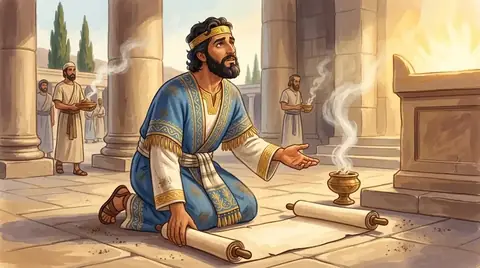
Hezekiah took Sennacherib's letter into the temple, "spread it before the LORD" and prayed (2 Kings 19:14–19). Through Isaiah, God replied that the Assyrian king would not enter the city or even shoot an arrow at it. In a single night the angel of the LORD struck down 185,000 men in the Assyrian camp. Sennacherib went back to Nineveh, and years later, while he worshipped his god, two of his sons killed him with the sword (2 Kings 19:32–37).
His own records
Sennacherib's own inscriptions boast of taking forty-six cities of Judah and of shutting Hezekiah up in Jerusalem. They tell of the tribute he received, but say nothing about taking Jerusalem. Great carved panels from his palace at Nineveh show the fall of Lachish.
What to learn
The proudest king on earth could not touch the city God had promised to defend. Hezekiah's way, laying the threat before the LORD, is still the right one.
Key verses
- 2 Kings 18:13
Now in the fourteenth year of king Hezekiah did Sennacherib king of Assyria come up against all the fenced cities of Judah, and took them.
- 2 Kings 19:14–15
And Hezekiah received the letter of the hand of the messengers, and read it: and Hezekiah went up into the house of the Lord, and spread it before the Lord. And Hezekiah prayed before the Lord, and said, O Lord God of Israel, which dwellest between the cherubims, thou art the God, even thou alone, of all the kingdoms of the earth; thou hast made heaven and earth.
- 2 Kings 19:35–37
And it came to pass that night, that the angel of the Lord went out, and smote in the camp of the Assyrians an hundred fourscore and five thousand: and when they arose early in the morning, behold, they were all dead corpses. So Sennacherib king of Assyria departed, and went and returned, and dwelt at Nineveh. And it came to pass, as he was worshipping in the house of Nisroch his god, that Adrammelech and Sharezer his sons smote him with the sword: and they escaped into the land of Armenia. And Esarhaddon his son reigned in his stead.
- 2 Chronicles 32:22
Thus the Lord saved Hezekiah and the inhabitants of Jerusalem from the hand of Sennacherib the king of Assyria, and from the hand of all other, and guided them on every side.
- Isaiah 37:21
Then Isaiah the son of Amoz sent unto Hezekiah, saying, Thus saith the Lord God of Israel, Whereas thou hast prayed to me against Sennacherib king of Assyria:
On the map
Family
- Children
- Adrammelech, Sharezer, Esarhaddon
Mentioned in 14 verses
- 2 Kings 4
- 2 Chronicles 5
- Isaiah 5
Read next
 Place · EmpireAssyriaThe land and empire on the upper Tigris whose capital was Nineveh. Assyria crushed the northern kingdom of Israel in…
 Place · CityNinevehThe last and greatest capital of Assyria, on the Tigris. Jonah preached there and the whole city repented; a century…Person · KingSargonA powerful king of Assyria, named once in the Bible, when his army commander captured the Philistine city of Ashdod. He…Person · King of AssyriaEsarhaddonThe son of Sennacherib who became king of Assyria after his brothers murdered their father. He also sent foreign…IdolNisrochThe Assyrian god in whose temple at Nineveh King Sennacherib was murdered by his own sons, soon after God had destroyed…Person · KingHezekiahOne of Judah's best kings. He cleansed the temple, smashed the idols, trusted God when Assyria besieged Jerusalem, and…
 Place · CityLachishA great walled city in the lowlands of Judah, taken by Joshua, made a fortress by Rehoboam, and besieged by…PersonRabshakehThe Assyrian king's spokesman who stood outside Jerusalem's wall and shouted at Hezekiah's people to give up and not to…
Written for this app in its own words, from the Bible, with the facts checked against Bible dictionaries and encyclopedias: Easton's, Smith's, Fausset's, ISBE, Holman, the New Bible Dictionary, Vine's and the Thompson Chain topics. Also: Sennacherib's own annals (the Taylor and Oriental Institute prisms); the Lachish reliefs. People and places: STEPBible.org (TIPNR), CC BY 4.0; where a place is today and its photo: OpenBible.info, CC BY 4.0.
