
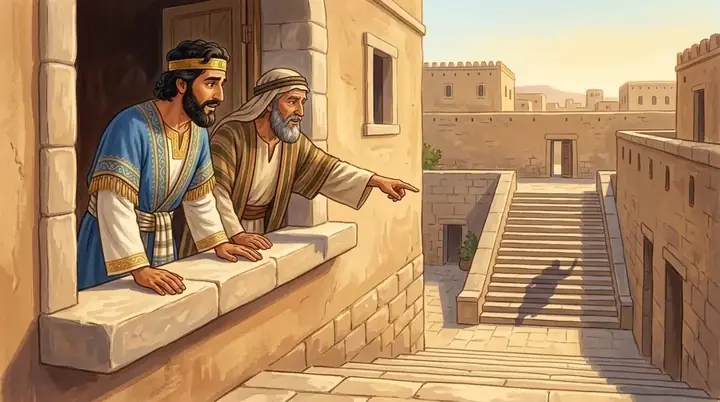
Person · Prophet
Isaiah
eye-ZAY-aOld Testament · prophesied about 740–680 BC · Hebrew for "the LORD saves" · also Esaias
The prophet of Jerusalem who served four kings, saw the LORD on his throne, and foretold the virgin's son, the suffering Servant and the new heavens and earth. The New Testament quotes him more than any other prophet.
- Family
- Son of Amoz; his wife was "the prophetess"; sons Shear-jashub and Maher-shalal-hash-baz (Isaiah 7:3; Isaiah 8:3)
- Served under
- Uzziah, Jotham, Ahaz and Hezekiah, kings of Judah (Isaiah 1:1)
- Known for
- His vision in the temple, Immanuel, the Servant songs, the defeat of Sennacherib
- Died
- Not recorded; tradition says he was sawn in two under Manasseh (compare Hebrews 11:37)
His life
Isaiah lived in Jerusalem and moved easily among kings, so he was probably of good family. His call came "in the year that king Uzziah died": he saw the LORD high and lifted up, the seraphim crying "Holy, holy, holy", felt himself undone as a man of unclean lips, was cleansed by a coal from the altar, and answered, "Here am I; send me" (Isaiah 6:1–8).
When Syria and Israel attacked Judah, he met the frightened King Ahaz at the aqueduct and told him to stand firm, giving him the sign of Immanuel (Isaiah 7:3–14). Ahaz chose to buy Assyrian help instead. For three years Isaiah walked barefoot and stripped like a captive, a sign that trusting Egypt would end in captivity (Isaiah 20:2–4).
His finest hour came under Hezekiah. When Sennacherib's Assyrian army surrounded Jerusalem and his officer mocked the LORD, Isaiah told the king not to fear, and that night the angel of the LORD struck the camp and the Assyrians went home (Isaiah 37:6–7; Isaiah 37:36–37). When Hezekiah lay dying, Isaiah brought him word of fifteen more years and the shadow on the stairway went backwards as a sign (Isaiah 38:1–8). But when the king showed all his treasures to envoys from Babylon, Isaiah foretold that Babylon would one day carry it all away (Isaiah 39). He also wrote the history of Uzziah and Hezekiah (2 Chronicles 26:22; 2 Chronicles 32:32).
His message
Isaiah's God is "the Holy One of Israel", and his first word is judgment on a people who honour God with their lips while oppressing the poor (Isaiah 1:11–17). Yet through the whole book runs a promise: a remnant will return, a shoot will grow from Jesse's stump, and the wolf will lie down with the lamb (Isaiah 11:1–9). The later chapters comfort the exiles yet to come, name Cyrus who would send them home (Isaiah 44:28), mock the idols, and sing of the Servant of the LORD who is wounded for our transgressions (Isaiah 53). The book ends with new heavens and a new earth (Isaiah 65:17).
Points to Christ
The Gospels open with Isaiah's "voice of him that crieth in the wilderness" (Isaiah 40:3; Matthew 3:3). Jesus read Isaiah 61 in the synagogue at Nazareth and said, "This day is this scripture fulfilled" (Luke 4:17–21). The virgin's son (Isaiah 7:14), the child called Mighty God (Isaiah 9:6), the light in Galilee (Isaiah 9:1–2), the healer who bore our sicknesses (Isaiah 53:4; Matthew 8:17), the lamb silent before its shearers which the Ethiopian was reading (Isaiah 53:7; Acts 8:32–35): the New Testament finds Jesus on nearly every page. John says plainly that Isaiah "saw his glory, and spake of him" (John 12:41).
Key verses
- Isaiah 6:1–8
In the year that king Uzziah died I saw also the Lord sitting upon a throne, high and lifted up, and his train filled the temple. Above it stood the seraphims: each one had six wings; with twain he covered his face, and with twain he covered his feet, and with twain he did fly. And one cried unto another, and said, Holy, holy, holy, is the Lord of hosts: the whole earth is full of his glory. …
- Isaiah 7:14
Therefore the Lord himself shall give you a sign; Behold, a virgin shall conceive, and bear a son, and shall call his name Immanuel.
- Isaiah 9:6
For unto us a child is born, unto us a son is given: and the government shall be upon his shoulder: and his name shall be called Wonderful, Counsellor, The mighty God, The everlasting Father, The Prince of Peace.
- Isaiah 53:4–6
Surely he hath borne our griefs, and carried our sorrows: yet we did esteem him stricken, smitten of God, and afflicted. But he was wounded for our transgressions, he was bruised for our iniquities: the chastisement of our peace was upon him; and with his stripes we are healed. All we like sheep have gone astray; we have turned every one to his own way; and the Lord hath laid on him the iniquity of us all.
- Isaiah 40:3
The voice of him that crieth in the wilderness, Prepare ye the way of the Lord, make straight in the desert a highway for our God.
- John 12:41
These things said Esaias, when he saw his glory, and spake of him.
On the map
Family
- Parents
- Amoz
- Children
- Shear-jashub, Maher-shalal-hash-baz
Mentioned in 54 verses
- 2 Kings 13
- 2 Chronicles 3
- Isaiah 16
- Matthew 6
- Mark 2
- Luke 2
- John 4
- Acts 3
- Romans 5
Read next
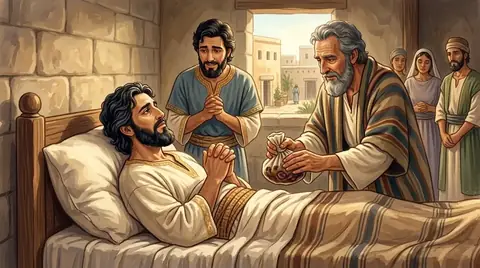 PersonAmozThe father of the prophet Isaiah. Isaiah is called "the son of Amoz" again and again, but nothing more is told of Amoz…PersonShear-jashubA boy whose father was Isaiah. His name, "a remnant shall return", was itself a message, and he went with his father to…PersonMaher-shalal-hash-bazThe son of the prophet Isaiah, whose long name means "hurry to the spoil, swift to the plunder". It was a sign that…
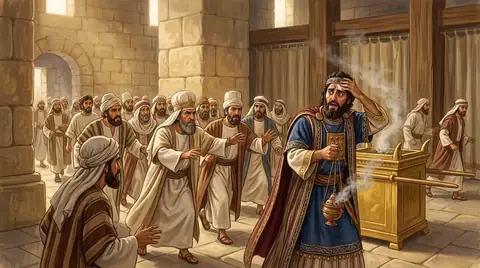 PersonUzziahKing of Judah for fifty-two years, a strong and godly ruler until pride led him into the temple to burn incense. God…
 Person · KingAhazA wicked king of Judah who sacrificed his own son, shut the temple, and paid Assyria for help instead of trusting God.…
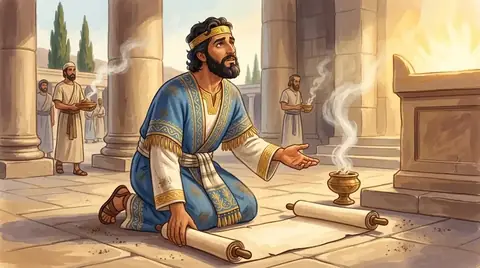 Person · KingHezekiahOne of Judah's best kings. He cleansed the temple, smashed the idols, trusted God when Assyria besieged Jerusalem, and…
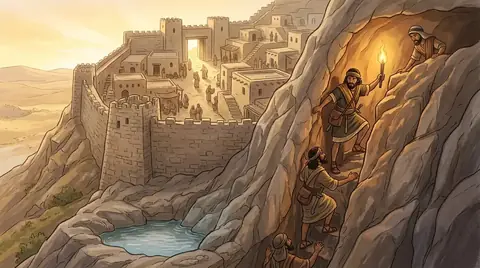 PlaceJerusalemThe city David made his capital and where Solomon built the temple. Jesus died and rose there and the church began…
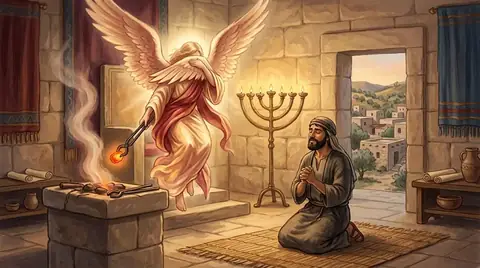 Heavenly beingsSeraphimHeavenly beings seen by Isaiah above God's throne, each with six wings, crying "Holy, holy, holy". One of them touched…
Written for this app in its own words, from the Bible, with the facts checked against Bible dictionaries and encyclopedias: Easton's, Smith's, Fausset's, ISBE, Holman, the New Bible Dictionary, Vine's and the Thompson Chain topics. People and places: STEPBible.org (TIPNR), CC BY 4.0; where a place is today and its photo: OpenBible.info, CC BY 4.0.
