
Teaching
The Promised Land
Promised to Abraham · given under Joshua · fulfilled in Christ
The land of Canaan, which God swore to give Abraham and his children for ever. He gave it to Israel under Joshua, kept every word of his promise, and through it pointed to a better country and a lasting rest for all his people.
- Promised
- To Abraham (Genesis 12:7), then Isaac and Jacob
- Given
- Under Joshua, about 1406 BC
- Borders
- "From the river of Egypt unto the great river, the river Euphrates" (Genesis 15:18)
- Called
- A land flowing with milk and honey (Exodus 3:8)
The promise
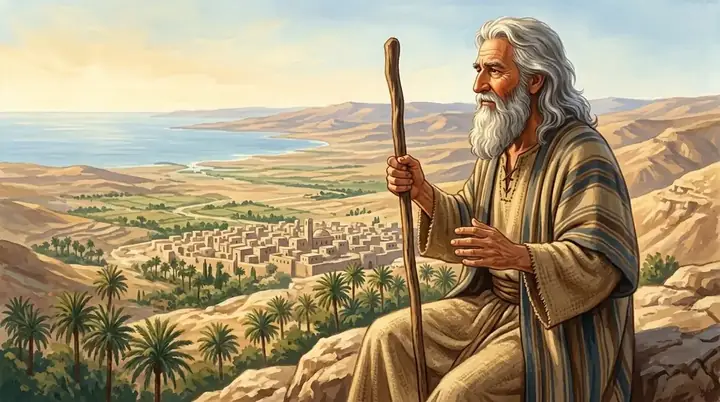
When God called Abraham out of Ur, he led him to Canaan and said, "Unto thy seed will I give this land" (Genesis 12:7). He made a covenant with him to seal it, naming its widest bounds from the river of Egypt to the Euphrates (Genesis 15:18), and promised it "for an everlasting possession" (Genesis 17:8). He said the same to Isaac and to Jacob (Genesis 26:3; Genesis 28:13). Yet the three of them lived there as strangers in tents, owning only the cave at Hebron where they were buried (Genesis 23).
Waiting and wandering
Jacob's family went down to Egypt, and God told Abraham they would be strangers in another land for four hundred years before he brought them back (Genesis 15:13–16). At the burning bush God told Moses he had come to bring them up "unto a good land and a large, unto a land flowing with milk and honey" (Exodus 3:8). But when the twelve spies came back with a huge cluster of grapes, ten of them said the people were too strong, and Israel refused to go in. That generation wandered forty years in the wilderness, and only Joshua and Caleb entered (Numbers 13–14). From the top of Nebo Moses saw the whole land before he died (Deuteronomy 34:1–4).
Given under Joshua
Joshua led the people across the Jordan, and Jericho fell (Joshua 3–6). The land was shared out by lot, tribe by tribe (Joshua 13–21). At the end the Bible says: "There failed not ought of any good thing which the LORD had spoken unto the house of Israel; all came to pass" (Joshua 21:45). Under David and Solomon Israel ruled out to the Euphrates, as far as God had said (1 Kings 4:21).
Lost and given back
The land was God's gift, held as long as his people kept his covenant (Deuteronomy 28:63–64). When they turned to idols, God sent them into exile, first Israel to Assyria and then Judah to Babylon. Even then he promised to bring them home, and after seventy years a remnant came back under Zerubbabel, Ezra and Nehemiah (Jeremiah 29:10; Ezra 1:1–3).
Points to Christ
The land points beyond itself. Hebrews says Abraham "sojourned in the land of promise, as in a strange country," looking for "a city which hath foundations, whose builder and maker is God" (Hebrews 11:9–10). The fathers wanted "a better country, that is, an heavenly" (Hebrews 11:16). Joshua gave Israel rest from their enemies, but "there remaineth therefore a rest to the people of God," which all who trust in Christ enter (Hebrews 4:8–9). Jesus promised that the meek shall inherit the earth (Matthew 5:5), and the Bible ends with a new heaven and a new earth where God lives with his people (Revelation 21:1–3).
Key verses
- Genesis 12:7
And the Lord appeared unto Abram, and said, Unto thy seed will I give this land: and there builded he an altar unto the Lord, who appeared unto him.
- Genesis 15:18
In the same day the Lord made a covenant with Abram, saying, Unto thy seed have I given this land, from the river of Egypt unto the great river, the river Euphrates:
- Exodus 3:8
And I am come down to deliver them out of the hand of the Egyptians, and to bring them up out of that land unto a good land and a large, unto a land flowing with milk and honey; unto the place of the Canaanites, and the Hittites, and the Amorites, and the Perizzites, and the Hivites, and the Jebusites.
- Joshua 21:45
There failed not ought of any good thing which the Lord had spoken unto the house of Israel; all came to pass.
- Hebrews 4:9
There remaineth therefore a rest to the people of God.
- Hebrews 11:16
But now they desire a better country, that is, an heavenly: wherefore God is not ashamed to be called their God: for he hath prepared for them a city.
On the map
Read next
 PersonAbrahamThe man God called out of Ur to a land he had never seen, promising him a people and a blessing for the whole world. He…
 PersonIsaacThe son God promised to Abraham and Sarah when they were far too old for children, offered on Mount Moriah and spared.…
 PersonJacobIsaac's younger twin son, who won his brother's birthright and blessing by cunning, was changed by God, and was renamed…
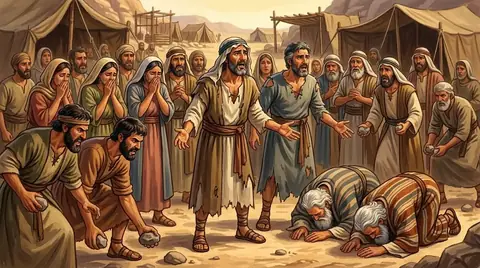 PersonJoshuaMoses' helper who took over from him and led Israel across the Jordan into the Promised Land. He fought the wars of…
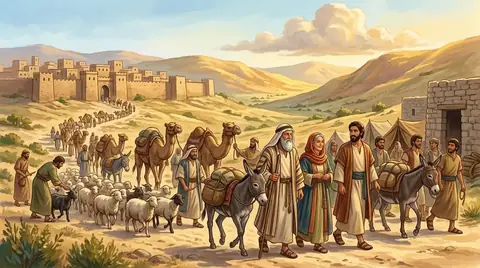 PlaceCanaanThe land between the Jordan and the Mediterranean that God promised to Abraham and gave to Israel under Joshua. It took…
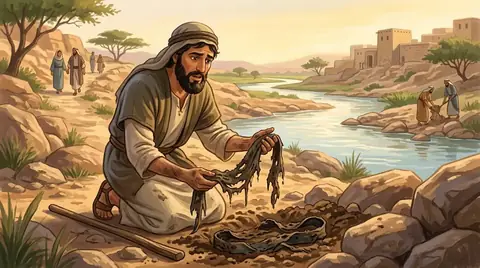 Place · RiverEuphratesThe greatest river of western Asia, one of the four rivers of Eden and the north-eastern limit of the land God promised…
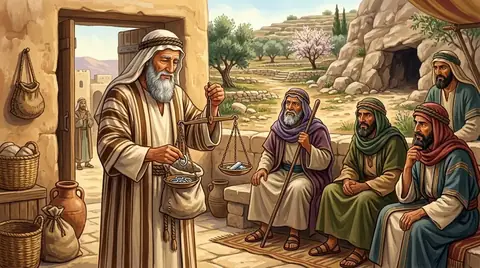 Place · CityHebronAn ancient city in the hills of Judah where Abraham lived and the patriarchs were buried in the cave of Machpelah.…
 PersonMosesThe man God used to bring Israel out of Egypt, give them his Law at Sinai, and lead them for forty years in the…
Written for this app in its own words, from the Bible, with the facts checked against Bible dictionaries and encyclopedias: Easton's, Smith's, Fausset's, ISBE, Holman, the New Bible Dictionary, Vine's and the Thompson Chain topics.
