
Measure · Weight
Pim
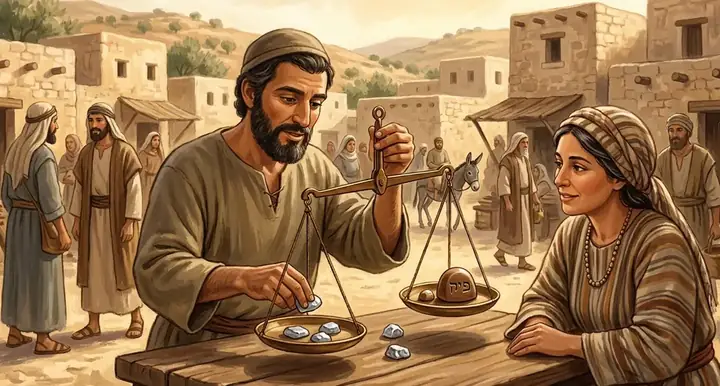
A small weight, about two-thirds of a shekel, named once in the Bible. Israelite farmers paid Philistine smiths a pim of silver for sharpening their tools, since they were not allowed smiths of their own.
- Weight
- About two-thirds of a shekel: roughly a quarter of an ounce (7.6 g)
- In the Bible
- 1 Samuel 13:21 only; the KJV, not knowing the word, has "a file"
- Found
- Stone weights marked "pim" have been dug up at several sites in Israel
In Saul's day the Philistines held Israel down by allowing no blacksmith in the land, so that the Hebrews could make no swords or spears. When a farmer's ploughshare, axe or ox-goad grew blunt, he had to go down to the Philistines to have it sharpened, and the charge was a pim for the heavier tools and a third of a shekel for the rest (1 Samuel 13:19–21).
The word puzzled translators for centuries, and the KJV guessed "a file". Then archaeologists dug up small stone weights with "pim" cut into them, weighing about two-thirds of a shekel. The verse is one of the Bible's little details confirmed by the spade. It also shows how helpless Israel was: when battle came, only Saul and Jonathan had a sword between them (1 Samuel 13:22).
Key verses
- 1 Samuel 13:19–22
Now there was no smith found throughout all the land of Israel: for the Philistines said, Lest the Hebrews make them swords or spears: But all the Israelites went down to the Philistines, to sharpen every man his share, and his coulter, and his axe, and his mattock. Yet they had a file for the mattocks, and for the coulters, and for the forks, and for the axes, and to sharpen the goads. …
Read next
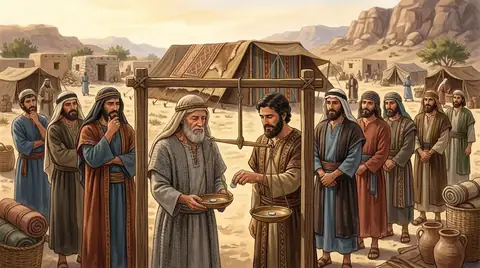 Measure · MoneyShekelThe basic weight of the Old Testament, about 11 grams (0.4 oz); then a lump of silver of that weight used as money long…
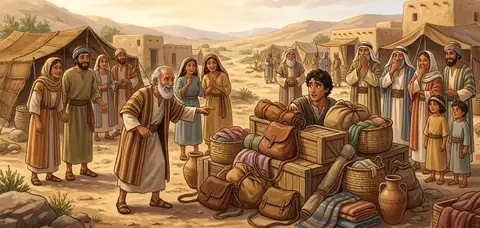 Person · KingSaulIsrael's first king, a tall Benjamite chosen when the people demanded a king like the nations. He began humbly and won…NationThe PhilistinesA warlike people from over the sea, settled in five cities on the coastal plain to the south-west of Israel. With iron…
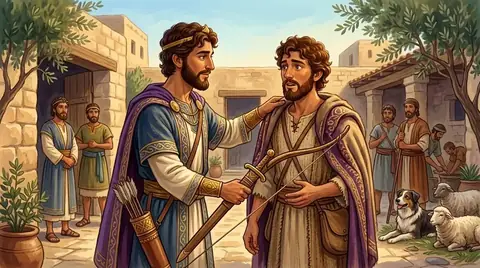 PersonJonathanSaul's eldest son and David's closest friend. A brave soldier who climbed a cliff to rout the Philistines, he gave up…
Written for this app in its own words, from the Bible, with the facts checked against Bible dictionaries and encyclopedias: Easton's, Smith's, Fausset's, ISBE, Holman, the New Bible Dictionary, Vine's and the Thompson Chain topics. Also: International Standard Bible Encyclopedia.
