
Symbol · Nature
Fire
God's presence, his purifying work and his judgment
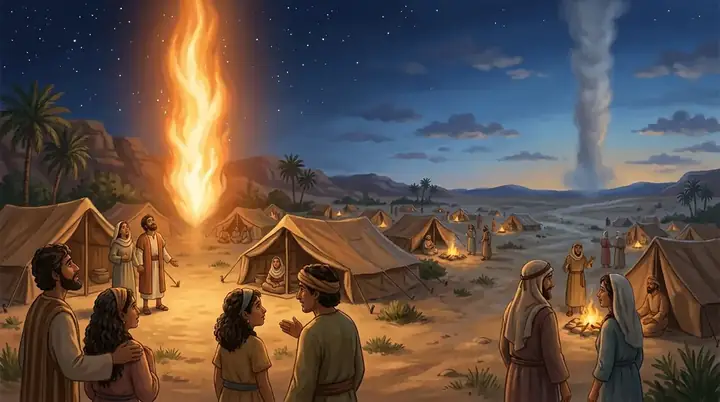
In the Bible fire marks God's presence, from the burning bush to the tongues of fire at Pentecost; it purifies like a refiner's furnace; and it is the picture of his judgment on sin. "Our God is a consuming fire."
- God's presence
- The burning bush (Exodus 3:2); the pillar of fire (Exodus 13:21); Mount Sinai (Exodus 19:18); Pentecost (Acts 2:3)
- Fire from heaven
- On Elijah's altar (1 Kings 18:38); at the dedication of the temple (2 Chronicles 7:1); on Sodom (Genesis 19:24)
- The altar fire
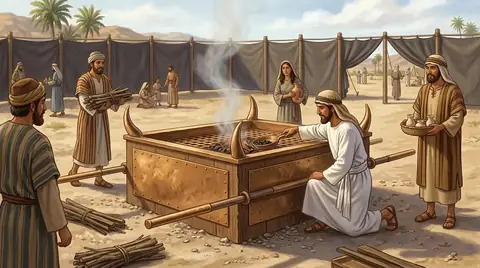
- Lit by God and never to go out (Leviticus 6:13; Leviticus 9:24)
- Judgment
- Matthew 25:41; Mark 9:43–48; Revelation 20:14–15
God's presence
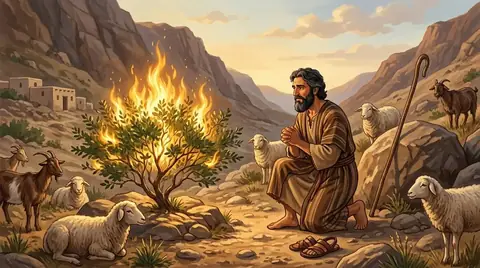
God spoke to Moses from a bush that burned and was not consumed (Exodus 3:2). He led Israel by night in a pillar of fire (Exodus 13:21), came down on Sinai in fire and smoke (Exodus 19:18), and lit the first fire on the altar himself; it was to be kept burning always (Leviticus 9:24; Leviticus 6:13). Fire fell on Elijah's drenched sacrifice on Carmel to prove who was God (1 Kings 18:38), and a chariot of fire carried him away (2 Kings 2:11). Ezekiel and Daniel saw God's throne in fire (Ezekiel 1:27; Daniel 7:9), and the risen Christ has eyes "as a flame of fire" (Revelation 1:14). When the Holy Spirit came at Pentecost he came as tongues of fire (Acts 2:3), as John the Baptist had promised: Jesus would baptize "with the Holy Ghost, and with fire" (Matthew 3:11).
Fire that purifies
A refiner heats silver until the dross floats off. God sits as a refiner of his people (Malachi 3:2–3); a burning coal cleansed Isaiah's lips (Isaiah 6:6–7); trials prove faith as fire proves gold (1 Peter 1:7); and every believer's work will be tested by fire on the last day (1 Corinthians 3:13–15). God's word is "like as a fire" (Jeremiah 23:29), and Jeremiah could not hold it in (Jeremiah 20:9).
Fire that judges
Fire from heaven destroyed Sodom (Genesis 19:24), Nadab and Abihu who offered "strange fire" (Leviticus 10:1–2), Korah's 250 men (Numbers 16:35), and the soldiers sent to seize Elijah (2 Kings 1:10). Cities taken in war were burned, as Jericho was (Joshua 6:24). Jesus spoke of "everlasting fire, prepared for the devil and his angels" (Matthew 25:41) and of hell "where their worm dieth not, and the fire is not quenched" (Mark 9:44), and Revelation ends with the lake of fire (Revelation 20:15). "Our God is a consuming fire" (Hebrews 12:29).
In daily life
Fire baked bread, cooked food and gave warmth on cold nights, as in the courtyard where Peter warmed himself (John 18:18). No fire was to be lit on the sabbath (Exodus 35:3). Samson tied torches to foxes' tails to burn the Philistines' grain (Judges 15:4–5), and Gideon's three hundred broke their jars to show their torches (Judges 7:20).
Key verses
- Exodus 3:2
And the angel of the Lord appeared unto him in a flame of fire out of the midst of a bush: and he looked, and, behold, the bush burned with fire, and the bush was not consumed.
- Leviticus 6:13
The fire shall ever be burning upon the altar; it shall never go out.
- 1 Kings 18:38
Then the fire of the Lord fell, and consumed the burnt sacrifice, and the wood, and the stones, and the dust, and licked up the water that was in the trench.
- Acts 2:3
And there appeared unto them cloven tongues like as of fire, and it sat upon each of them.
- Hebrews 12:29
For our God is a consuming fire.
- Malachi 3:2–3
But who may abide the day of his coming? and who shall stand when he appeareth? for he is like a refiner’s fire, and like fullers’ soap: And he shall sit as a refiner and purifier of silver: and he shall purify the sons of Levi, and purge them as gold and silver, that they may offer unto the Lord an offering in righteousness.
Read next
 Place · MountainSinaiThe mountain where God came down in fire and smoke, spoke the Ten Commandments, and made his covenant with Israel. The…
 PersonElijahThe fiery prophet who stood alone against King Ahab and the prophets of Baal, called down fire on Mount Carmel, and was…
 Thing · WorshipThe TempleGod's house in Jerusalem, where he was worshipped and the sacrifices offered. Solomon built it, Babylon burned it, the…
 PersonMosesThe man God used to bring Israel out of Egypt, give them his Law at Sinai, and lead them for forty years in the…
 Thing · WorshipThe altarA raised structure of earth, stone or bronze on which sacrifices were offered to God. The big bronze altar stood in the…PlaceCarmelMount Carmel is the wooded ridge by the sea where Elijah faced the prophets of Baal. Carmel was also a town in Judah's…
 PersonEzekielA priest and prophet taken to Babylon with the exiles from Judah. By the river Chebar he saw visions of God's glory and…
 Person · ProphetDanielA young noble of Judah carried off to Babylon, who served four kings with wisdom and never bent his faith. God gave him…
Written for this app in its own words, from the Bible, with the facts checked against Bible dictionaries and encyclopedias: Easton's, Smith's, Fausset's, ISBE, Holman, the New Bible Dictionary, Vine's and the Thompson Chain topics.
