
Person · Judge
Gideon
GID-ee-onOld Testament · the period of the judges, about 1170 BC · also called Jerubbaal · the name means "hewer" or "one who cuts down"
The farmer God called to free Israel from the Midianites. Timid and full of questions, he obeyed, and with three hundred men, trumpets and torches he routed an army too big to count.
- Family
- Son of Joash, of Abiezer in Manasseh; from Ophrah. Seventy sons, and Abimelech by a concubine of Shechem
- Known for
- The fleece; the three hundred; the altar of Baal cut down
- Also called
- Jerubbaal, "let Baal plead" (Judges 6:32)
- Where
- Judges 6–8; Hebrews 11:32
His call
For seven years the Midianites and Amalekites swept over Israel each harvest like locusts, stripping the land. Gideon was threshing wheat in a winepress, hidden from them, when the angel of the LORD sat down under the oak and said, "The LORD is with thee, thou mighty man of valour" (Judges 6:11–12). Gideon's reply was a string of doubts: if God is with us, why all this? and who am I, the least in the smallest family? God simply promised, "Surely I will be with thee". That night Gideon cut down his father's altar to Baal and the Asherah beside it and built an altar to the LORD; when the townsmen wanted him dead, his father answered that if Baal were a god he could plead for himself, and so Gideon got his nickname (Judges 6:25–32). Still unsure, he asked for a sign twice over: a fleece wet with dew on dry ground, then dry on wet ground, and God patiently gave both (Judges 6:36–40).
The battle
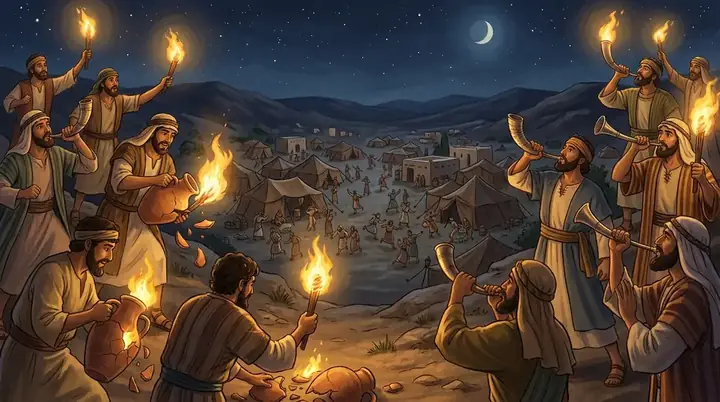
Thirty-two thousand men gathered to him, too many, God said, for Israel would boast. The fearful were sent home, and then all who knelt to drink at the spring of Harod, until three hundred were left (Judges 7:1–8). Creeping into the enemy camp by night, Gideon heard a soldier tell a dream of a barley loaf flattening a tent, and worshipped. He divided his men into three companies, each with a trumpet and a torch hidden in a clay jar. At the change of the watch they smashed the jars, blew the trumpets and shouted, "The sword of the LORD, and of Gideon", and the Midianites turned their swords on one another and fled (Judges 7:16–22). Gideon chased the kings Zebah and Zalmunna across the Jordan, "faint, yet pursuing", and killed them (Judges 8:4–21).
What went wrong
Israel asked Gideon to be their king. He refused, "the LORD shall rule over you", but then he asked for the gold earrings from the spoil and made an ephod which became an idol, "a snare unto Gideon, and to his house" (Judges 8:22–27). He died old, and the land had rest forty years; but his son Abimelech murdered his brothers, and Israel went back to Baal (Judges 8:28–35; Judges 9).
What to learn
God does not wait for brave people; he makes them. Gideon's fears and questions were met with patience, and his victory was designed so that no one could claim the credit but God. Hebrews lists him among the heroes of faith (Hebrews 11:32). His ephod is the warning: good men can make idols out of their own success.
Key verses
- Judges 6:12–16
And the angel of the Lord appeared unto him, and said unto him, The Lord is with thee, thou mighty man of valour. And Gideon said unto him, Oh my Lord, if the Lord be with us, why then is all this befallen us? and where be all his miracles which our fathers told us of, saying, Did not the Lord bring us up from Egypt? but now the Lord hath forsaken us, and delivered us into the hands of the Midianites. And the Lord looked upon him, and said, Go in this thy might, and thou shalt save Israel from the hand of the Midianites: have not I sent thee? …
- Judges 6:36–40
And Gideon said unto God, If thou wilt save Israel by mine hand, as thou hast said, Behold, I will put a fleece of wool in the floor; and if the dew be on the fleece only, and it be dry upon all the earth beside, then shall I know that thou wilt save Israel by mine hand, as thou hast said. And it was so: for he rose up early on the morrow, and thrust the fleece together, and wringed the dew out of the fleece, a bowl full of water. …
- Judges 7:2
And the Lord said unto Gideon, The people that are with thee are too many for me to give the Midianites into their hands, lest Israel vaunt themselves against me, saying, Mine own hand hath saved me.
- Judges 7:20
And the three companies blew the trumpets, and brake the pitchers, and held the lamps in their left hands, and the trumpets in their right hands to blow withal: and they cried, The sword of the Lord, and of Gideon.
- Judges 8:23
And Gideon said unto them, I will not rule over you, neither shall my son rule over you: the Lord shall rule over you.
- Hebrews 11:32
And what shall I more say? for the time would fail me to tell of Gedeon, and of Barak, and of Samson, and of Jephthae; of David also, and Samuel, and of the prophets:
Family
- Parents
- Joash
- Children
- Jether, Abimelech, Jotham
Mentioned in 50 verses
- Judges 47
- 1 Samuel 1
- 2 Samuel 1
- Hebrews 1
Read next
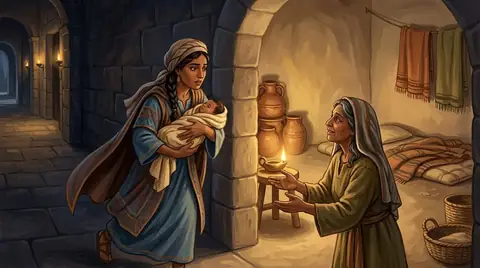 PersonJoashThe baby prince hidden in the temple for six years and crowned at seven. He repaired the temple while the priest…
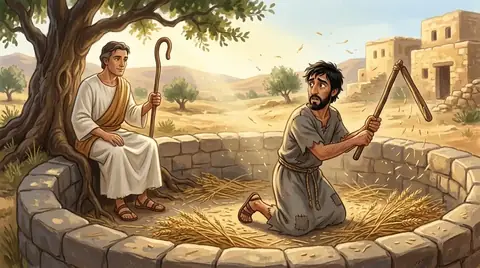 PersonAbiezerA great-grandson of Manasseh whose family, the Abiezrites, settled at Ophrah. Gideon came from this clan. Another…
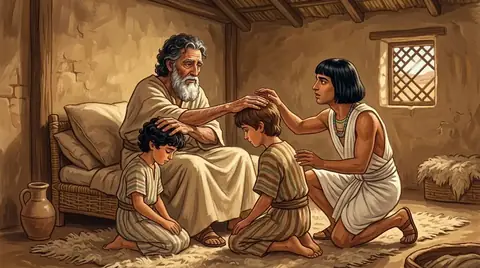 Person · TribeManassehJoseph's elder son, adopted by Jacob as a tribe of Israel, whose land straddled the Jordan. Also the longest-reigning…PlaceOphrahThe town in Manasseh where Gideon grew up, met the angel of the LORD and later set up his golden ephod. Another Ophrah…
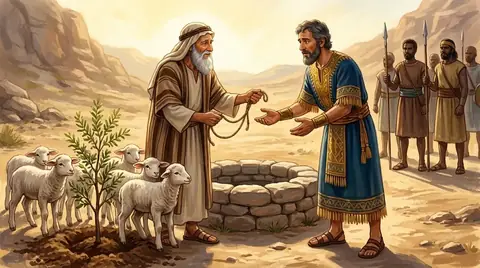 PersonAbimelechThe name of the kings of Gerar who dealt with Abraham and Isaac over their wives, and of Gideon's ruthless son who…
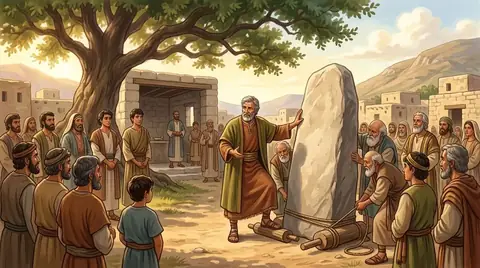 PlaceShechemAn ancient city in the heart of Canaan, between Mount Ebal and Mount Gerizim. Abraham built his first altar there…
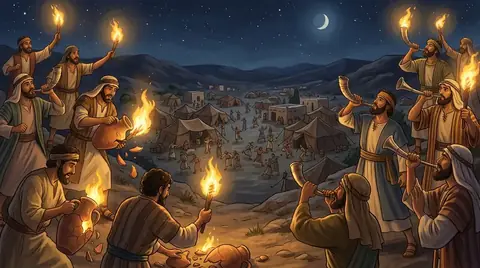 NationThe MidianitesNomads of the desert, traders and raiders, who came from Abraham. They sold Joseph into Egypt, sheltered Moses, lured…
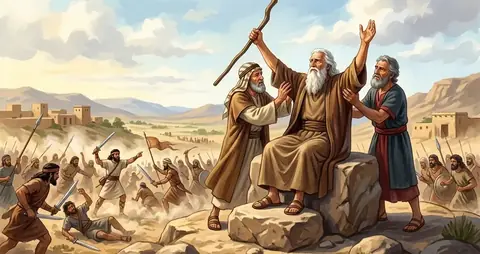 NationThe AmalekitesA desert tribe descended from Esau's grandson Amalek, and Israel's first enemy after the Exodus. They attacked the weak…
Written for this app in its own words, from the Bible, with the facts checked against Bible dictionaries and encyclopedias: Easton's, Smith's, Fausset's, ISBE, Holman, the New Bible Dictionary, Vine's and the Thompson Chain topics. People and places: STEPBible.org (TIPNR), CC BY 4.0; where a place is today and its photo: OpenBible.info, CC BY 4.0.
