
Person
Elijah
ee-LYE-jahOld Testament · prophet in Israel about 870–850 BC · called Elias in the KJV New Testament
The fiery prophet who stood alone against King Ahab and the prophets of Baal, called down fire on Mount Carmel, and was carried to heaven in a whirlwind without dying.
- From
- Tishbe in Gilead, east of the Jordan (1 Kings 17:1)
- Meaning
- My God is the LORD
- Known for
- The drought; fire on Mount Carmel; the still small voice; taken up in a whirlwind
- In the New Testament
- Appeared with Moses at the transfiguration; John the Baptist came "in the spirit and power of Elias" (Luke 1:17)
His life
Elijah appears without warning, a rough man in a hairy cloak and leather belt (2 Kings 1:8), telling King Ahab that there would be no rain until he said so (1 Kings 17:1). Ahab and Jezebel had made Baal worship the religion of Israel, and Baal was supposed to be the god of rain. God hid Elijah by the brook Cherith, where ravens brought him bread and meat, and then with a widow at Zarephath, whose flour and oil never ran out and whose dead son Elijah brought back to life (1 Kings 17).
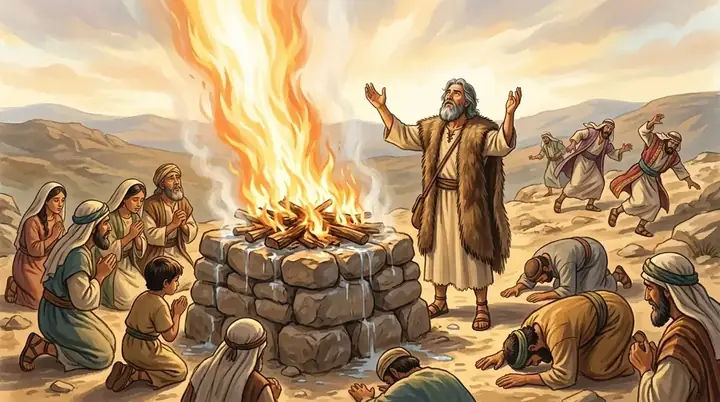
In the third year came the contest on Mount Carmel. Four hundred and fifty prophets of Baal cried to their god all day, and nothing happened. Elijah rebuilt the LORD's altar, soaked the sacrifice with water, and prayed; fire fell and burned up everything, and the people shouted, "The LORD, he is the God" (1 Kings 18:20–39). Then the rain came.
His weakness
Jezebel swore to kill him, and the man who had faced a nation ran for his life. Under a broom tree in the desert he asked to die. God fed him, sent him forty days to Horeb, and spoke to him there, not in the wind, earthquake or fire, but in "a still small voice", and gave him work to do: anoint Hazael, Jehu and Elisha (1 Kings 19). Later Elijah confronted Ahab over the murder of Naboth (1 Kings 21:17–24), and told King Ahaziah he would die for consulting Baal-zebub of Ekron (2 Kings 1).
Taken to heaven
Elijah's end was no end. As he and Elisha walked beyond the Jordan, a chariot and horses of fire parted them, and Elijah went up to heaven in a whirlwind. His cloak fell to Elisha (2 Kings 2:1–14).
In the New Testament
Malachi promised that Elijah would come again before the day of the LORD (Malachi 4:5), and Jesus said that promise was kept in John the Baptist (Matthew 11:14). Elijah himself stood with Moses on the mountain when Jesus was transfigured (Matthew 17:3). James holds him up as proof that the prayer of an ordinary man, "subject to like passions as we are", can shut and open heaven (James 5:17–18).
Others with this name
A Benjamite chief (1 Chronicles 8:27) and two men who had married foreign wives in Ezra's time (Ezra 10:21, 26) share the name.
Key verses
- 1 Kings 17:1
And Elijah the Tishbite, who was of the inhabitants of Gilead, said unto Ahab, As the Lord God of Israel liveth, before whom I stand, there shall not be dew nor rain these years, but according to my word.
- 1 Kings 18:36–39
And it came to pass at the time of the offering of the evening sacrifice, that Elijah the prophet came near, and said, Lord God of Abraham, Isaac, and of Israel, let it be known this day that thou art God in Israel, and that I am thy servant, and that I have done all these things at thy word. Hear me, O Lord, hear me, that this people may know that thou art the Lord God, and that thou hast turned their heart back again. Then the fire of the Lord fell, and consumed the burnt sacrifice, and the wood, and the stones, and the dust, and licked up the water that was in the trench. …
- 1 Kings 19:11–12
And he said, Go forth, and stand upon the mount before the Lord. And, behold, the Lord passed by, and a great and strong wind rent the mountains, and brake in pieces the rocks before the Lord; but the Lord was not in the wind: and after the wind an earthquake; but the Lord was not in the earthquake: And after the earthquake a fire; but the Lord was not in the fire: and after the fire a still small voice.
- 2 Kings 2:11
And it came to pass, as they still went on, and talked, that, behold, there appeared a chariot of fire, and horses of fire, and parted them both asunder; and Elijah went up by a whirlwind into heaven.
- Malachi 4:5
Behold, I will send you Elijah the prophet before the coming of the great and dreadful day of the Lord:
- James 5:17
Elias was a man subject to like passions as we are, and he prayed earnestly that it might not rain: and it rained not on the earth by the space of three years and six months.
On the map
Mentioned in 92 verses
- 1 Kings 38
- 2 Kings 22
- 2 Chronicles 1
- Malachi 1
- Matthew 9
- Mark 9
- Luke 8
- John 2
- Romans 1
- James 1
Read next
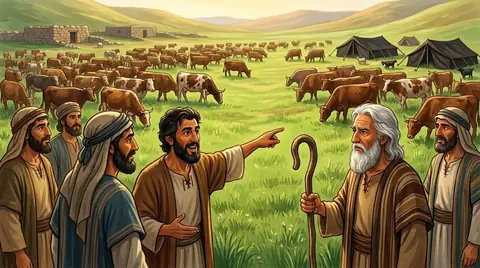 Place · RegionGileadThe wooded hill country east of the Jordan, famous for its flocks, its healing balm and its fighting men. Reuben, Gad…
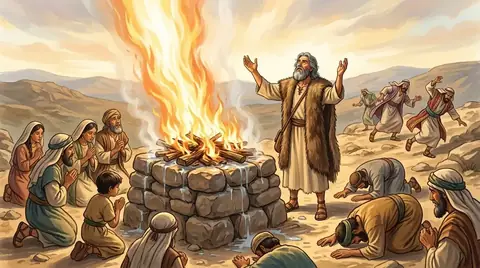 Place · MountainMount CarmelA wooded ridge running inland from the Mediterranean coast of northern Israel, famous as the place where Elijah called…
 PersonMosesThe man God used to bring Israel out of Egypt, give them his Law at Sinai, and lead them for forty years in the…
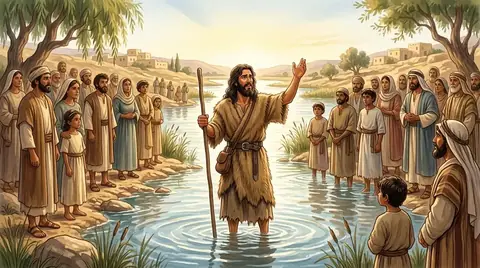 PersonJohn the BaptistThe prophet God sent to prepare the way for Jesus. He called Israel to repent, baptized in the Jordan, pointed to Jesus…
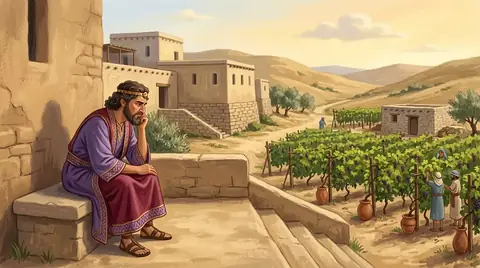 Person · KingAhabThe seventh king of the northern kingdom of Israel, who married Jezebel and led the nation into Baal worship. He…
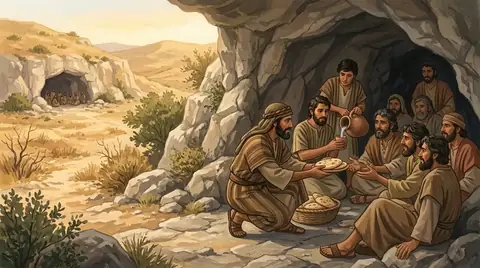 PersonJezebelAhab's foreign queen, who brought Baal worship to Israel, killed the LORD's prophets and had Naboth stoned for his…
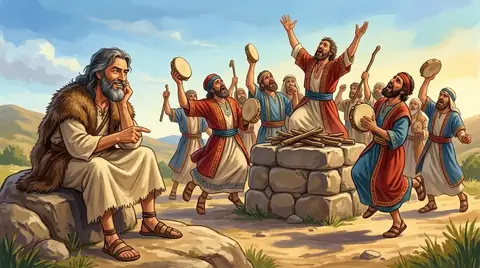 IdolBaalThe Canaanites' chief god, a storm god believed to send rain and harvests. Israel kept falling into his worship, until…
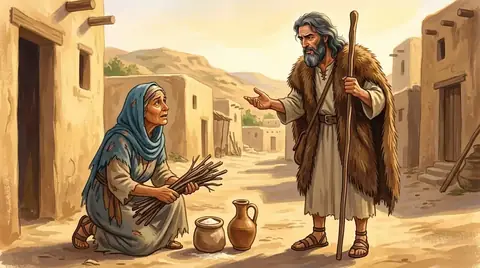 Place · TownZarephathA town on the Phoenician coast near Sidon. In a great famine God sent Elijah to a poor widow there; her flour and oil…
Written for this app in its own words, from the Bible, with the facts checked against Bible dictionaries and encyclopedias: Easton's, Smith's, Fausset's, ISBE, Holman, the New Bible Dictionary, Vine's and the Thompson Chain topics. People and places: STEPBible.org (TIPNR), CC BY 4.0; where a place is today and its photo: OpenBible.info, CC BY 4.0.
