
Thing · Worship
Anointing Oil
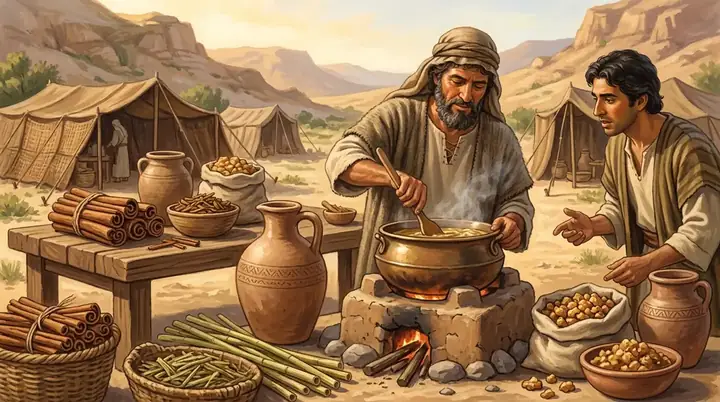
The holy oil God told Moses to blend from myrrh, cinnamon, calamus, cassia and olive oil. It was used only to anoint the tabernacle, its furniture and the priests, and no one was to copy it for common use.
- Made of
- Myrrh, sweet cinnamon, sweet calamus, cassia and a hin of olive oil (Exodus 30:23–24)
- Used on
- The tabernacle, ark, table, lampstand, altars, laver, and Aaron and his sons (Exodus 30:26–30)
- Compare
- Anointing, Oil, Ointment
What it was
God gave Moses the recipe himself: about 12 pounds (5.7 kg) of liquid myrrh, half as much sweet cinnamon and sweet calamus, as much cassia as myrrh, and a hin of olive oil, about a gallon (4 litres), blended by a perfumer's skill (Exodus 30:22–25).
How it was used
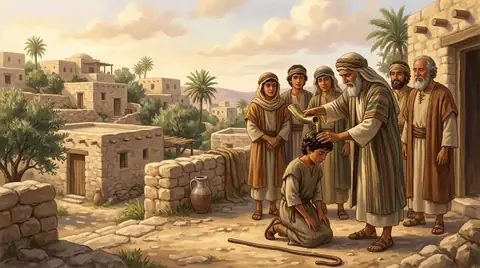
With it Moses anointed the tabernacle and everything in it, the ark, the table, the lampstand, both altars and the laver, so that they became most holy. Then he anointed Aaron and his sons as priests (Exodus 30:26–30; Leviticus 8:10–12). It was not to be poured on ordinary people or made for private use, on pain of being cut off from Israel (Exodus 30:31–33).
What it meant
The oil marked people and things as belonging wholly to God. Psalm 133 pictures it running down Aaron's beard to the collar of his robes, a picture of blessing and unity (Psalms 133:2). It looks ahead to the Holy Spirit, with whom Jesus, the Anointed One, was anointed (Acts 10:38).
Key verses
- Exodus 30:25
And thou shalt make it an oil of holy ointment, an ointment compound after the art of the apothecary: it shall be an holy anointing oil.
- Exodus 30:30–32
And thou shalt anoint Aaron and his sons, and consecrate them, that they may minister unto me in the priest’s office. And thou shalt speak unto the children of Israel, saying, This shall be an holy anointing oil unto me throughout your generations. Upon man’s flesh shall it not be poured, neither shall ye make any other like it, after the composition of it: it is holy, and it shall be holy unto you.
- Leviticus 8:12
And he poured of the anointing oil upon Aaron’s head, and anointed him, to sanctify him.
- Psalms 133:2
It is like the precious ointment upon the head, that ran down upon the beard, even Aaron’s beard: that went down to the skirts of his garments;
Read next
 Custom · WorshipAnointingPouring or rubbing oil on a person or thing to mark it as God's own. Priests, kings and prophets received it; "Messiah"…Thing · SymbolOilIn the Bible oil nearly always means olive oil, used for food, lamps, medicine, hospitality and for anointing kings and…
 ThingOintmentPerfumed oil, costly and sweet-smelling, used to anoint the body, to honour a guest and to prepare the dead. A special…
 PersonMosesThe man God used to bring Israel out of Egypt, give them his Law at Sinai, and lead them for forty years in the…
 Plant · SpiceMyrrhA bitter, sweet-smelling gum from a thorny desert tree, costly and prized as perfume, medicine and for burial. The wise…PlantCinnamonA sweet spice from the inner bark of a tree that grows far to the east, in Ceylon and India. It went into the holy…PlantCalamusA fragrant reed, probably a sweet-smelling grass from India or Arabia, whose dried stalk was ground into perfume. It…PlantCassiaA sweet spice from the bark of a tree like the cinnamon, probably brought from India. It went into the holy anointing…
Written for this app in its own words, from the Bible, with the facts checked against Bible dictionaries and encyclopedias: Easton's, Smith's, Fausset's, ISBE, Holman, the New Bible Dictionary, Vine's and the Thompson Chain topics.
