
Teaching
Allegory
AL-e-gor-eeA story in which each part stands for something else
A story or picture in which the people and things stand for something else. The word is used once in the Bible, of Hagar and Sarah in Galatians 4, but the Bible is full of such pictures.
- Where
- Galatians 4:24, of Sarah and Hagar
- Examples
- Jotham's trees (Judges 9), Nathan's lamb (2 Samuel 12), the vine out of Egypt (Psalms 80), old age (Ecclesiastes 12)
What it is
In an allegory the story is told for the sake of what lies behind it: each person, place or thing stands for another. It is a cousin of the parable; a parable usually makes one point, while an allegory carries its meaning in every part.
In the Bible
Jotham told the men of Shechem about trees that wanted a king; the olive, the fig and the vine refused, and only the useless bramble accepted (Judges 9:8–15). Everyone knew the bramble was Abimelech. Nathan told David of a rich man who stole a poor man's one little lamb, and David condemned himself before he saw that the rich man was him (2 Samuel 12:1–7). Psalm 80 pictures Israel as a vine God carried out of Egypt and planted, now broken down and burned. Ecclesiastes 12 paints old age as a house falling into ruin, its keepers trembling and its windows darkened.
The one place the word itself appears is Galatians 4:24. Paul says the two sons of Abraham, one born of the slave Hagar and one of the free woman Sarah, can be read as a picture of two covenants: law from Mount Sinai that bears children for slavery, and the promise that bears children for freedom. Christians, he says, are children of the promise, like Isaac.
What to learn
Paul draws his allegory from a real history, and he says so; the people were real and so was the meaning. The Bible's stories can carry deeper lessons without ceasing to be true.
Key verses
- Galatians 4:22–26
For it is written, that Abraham had two sons, the one by a bondmaid, the other by a freewoman. But he who was of the bondwoman was born after the flesh; but he of the freewoman was by promise. Which things are an allegory: for these are the two covenants; the one from the mount Sinai, which gendereth to bondage, which is Agar. …
- Judges 9:8–15
The trees went forth on a time to anoint a king over them; and they said unto the olive tree, Reign thou over us. But the olive tree said unto them, Should I leave my fatness, wherewith by me they honour God and man, and go to be promoted over the trees? And the trees said to the fig tree, Come thou, and reign over us. …
- 2 Samuel 12:1–7
And the Lord sent Nathan unto David. And he came unto him, and said unto him, There were two men in one city; the one rich, and the other poor. The rich man had exceeding many flocks and herds: But the poor man had nothing, save one little ewe lamb, which he had bought and nourished up: and it grew up together with him, and with his children; it did eat of his own meat, and drank of his own cup, and lay in his bosom, and was unto him as a daughter. …
- Psalms 80:8
Thou hast brought a vine out of Egypt: thou hast cast out the heathen, and planted it.
Read next
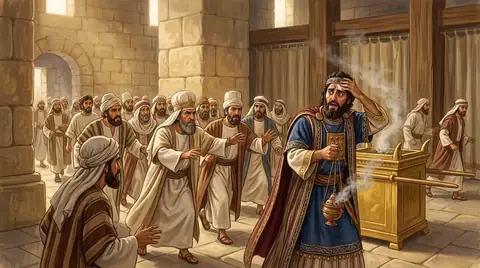 PersonJothamA good king of Judah who ruled for his leprous father Uzziah and then in his own right. He built the temple's upper…
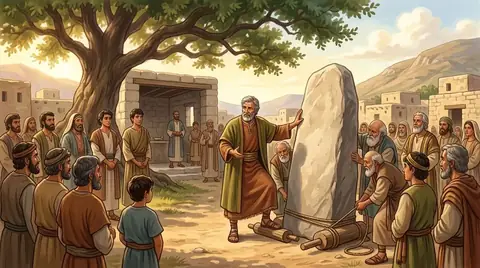 PlaceShechemAn ancient city in the heart of Canaan, between Mount Ebal and Mount Gerizim. Abraham built his first altar there…
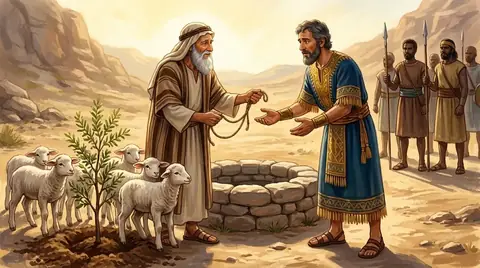 PersonAbimelechThe name of the kings of Gerar who dealt with Abraham and Isaac over their wives, and of Gideon's ruthless son who…
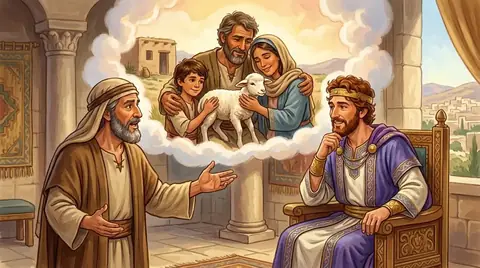 PersonNathanThe prophet who told David that his son, not he, would build the temple, who confronted him over Bathsheba with the…
 Person · KingDavidThe shepherd boy who killed Goliath and became Israel's greatest king, "a man after God's own heart". He wrote many…
 PersonAbrahamThe man God called out of Ur to a land he had never seen, promising him a people and a blessing for the whole world. He…
 PersonHagarSarah's Egyptian servant, given to Abraham to bear a child, and the mother of Ishmael. Twice she was driven out into…
Written for this app in its own words, from the Bible, with the facts checked against Bible dictionaries and encyclopedias: Easton's, Smith's, Fausset's, ISBE, Holman, the New Bible Dictionary, Vine's and the Thompson Chain topics.
