
Teaching
Parable
PARR-uh-bul
A short story or comparison from everyday life that carries a spiritual meaning. Jesus taught the crowds almost entirely in parables, about sowers, lost sheep, a prodigal son and a good Samaritan.
- Greek
- parabole, something placed beside; Hebrew mashal, a comparison or proverb
- Old Testament
- Nathan's lamb (2 Samuel 12), Jotham's trees (Judges 9), Isaiah's vineyard (Isaiah 5)
- Jesus' best known
- The sower, the good Samaritan, the prodigal son, the lost sheep, the talents
- Why
- "Because they seeing see not" (Matthew 13:13)
What it is
A parable sets one thing beside another so that the known explains the unknown. An everyday story becomes a window onto the things of God. Usually it is a tale, a farmer sowing, a woman sweeping, a king settling accounts, but the word also covers a proverb, a riddle or a prophet's picture (1 Samuel 10:12; Psalms 78:2; Numbers 23:7). A parable is not an allegory where every detail stands for something; it usually has one main point, and it asks the hearer to see himself in it.
In the Old Testament
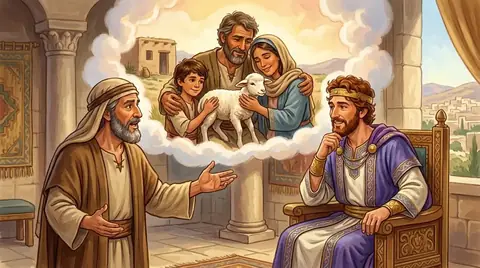
Jotham told the men of Shechem a fable of trees choosing a king to show what a worthless king they had chosen (Judges 9:7–15). Nathan told David of a rich man who took a poor man's one little ewe lamb, and when David exploded with anger said, "Thou art the man" (2 Samuel 12:1–7). A wise woman from Tekoa told David a story about her sons to make him recall Absalom (2 Samuel 14). Isaiah sang of a vineyard that gave wild grapes, and then named it: the house of Israel (Isaiah 5:1–7). Ezekiel used two eagles and a vine, and a boiling pot (Ezekiel 17; Ezekiel 24:3–5).
In Jesus
Jesus was the master of the parable. The first three Gospels record some forty of them, and Matthew says that at one time he spoke to the crowds in nothing else (Matthew 13:34). When the disciples asked why, he said the parables both reveal and hide: those who want to understand are given more, and those who have shut their eyes see only a story (Matthew 13:10–17). He explained them privately to his disciples (Mark 4:34). The kingdom of God is like seed in different soils, like a mustard seed, like treasure in a field; God is like a father running to meet his returning son; a neighbour is anyone in need, as the Samaritan showed (Luke 10:30–37; Luke 15). The Pharisees understood the parable of the wicked tenants well enough to want to arrest him (Matthew 21:45). John's Gospel has no story parables, but the good shepherd and the vine are pictures of the same kind (John 10; John 15).
For us
A parable is easy to remember and hard to escape. It slips past our defences, as Nathan's did, and then turns to face us. Jesus ended one with "Go, and do thou likewise", and that is how all of them are meant to end (Luke 10:37).
Key verses
- 2 Samuel 12:1–7
And the Lord sent Nathan unto David. And he came unto him, and said unto him, There were two men in one city; the one rich, and the other poor. The rich man had exceeding many flocks and herds: But the poor man had nothing, save one little ewe lamb, which he had bought and nourished up: and it grew up together with him, and with his children; it did eat of his own meat, and drank of his own cup, and lay in his bosom, and was unto him as a daughter. …
- Matthew 13:10–13
And the disciples came, and said unto him, Why speakest thou unto them in parables? He answered and said unto them, Because it is given unto you to know the mysteries of the kingdom of heaven, but to them it is not given. For whosoever hath, to him shall be given, and he shall have more abundance: but whosoever hath not, from him shall be taken away even that he hath. …
- Matthew 13:34
All these things spake Jesus unto the multitude in parables; and without a parable spake he not unto them:
- Mark 4:33–34
And with many such parables spake he the word unto them, as they were able to hear it. But without a parable spake he not unto them: and when they were alone, he expounded all things to his disciples.
- Luke 15:11–32
And he said, A certain man had two sons: And the younger of them said to his father, Father, give me the portion of goods that falleth to me. And he divided unto them his living. And not many days after the younger son gathered all together, and took his journey into a far country, and there wasted his substance with riotous living. …
Read next
 PersonNathanThe prophet who told David that his son, not he, would build the temple, who confronted him over Bathsheba with the…
 Person · KingDavidThe shepherd boy who killed Goliath and became Israel's greatest king, "a man after God's own heart". He wrote many…
 PersonAbsalomDavid's handsome third son, who murdered his brother Amnon, won the hearts of Israel and rose in rebellion against his…
 TeachingThe kingdom of GodGod's rule as King over his people and his world, the great theme of Jesus' preaching. It arrived with Jesus, grows now…
 Group · PeopleSamaritansThe mixed people of central Israel, descended from Israelites left behind by the Assyrians and settlers brought in from…
Written for this app in its own words, from the Bible, with the facts checked against Bible dictionaries and encyclopedias: Easton's, Smith's, Fausset's, ISBE, Holman, the New Bible Dictionary, Vine's and the Thompson Chain topics.
