
Thing
Yarn
"Linen yarn" in the King James Bible, 1 Kings 10:28
Spun thread, ready for weaving. The "linen yarn" that Solomon's traders brought from Egypt in the King James Bible is probably a mistranslation; the Hebrew word there likely means a drove of horses.
- Where
- 1 Kings 10:28; 2 Chronicles 1:16
In the King James Bible Solomon's horses come from Egypt "and linen yarn: the king's merchants received the linen yarn at a price" (1 Kings 10:28; 2 Chronicles 1:16). Egypt was famous for fine linen, so the translators' guess was a natural one. But the Hebrew word there, mikveh, means a gathering or a string of things, and most later translations take it as a drove: the royal merchants bought the horses from Egypt in droves, each drove at a set price. Solomon was trading in horses and chariots, which the Law had told Israel's kings not to multiply (Deuteronomy 17:16).
Spinning and weaving thread was women's everyday work in Israel all the same. The good wife "layeth her hands to the spindle" (Proverbs 31:19), and the women spun the blue, purple and scarlet thread and fine linen for the tabernacle (Exodus 35:25). See Spinning and Linen.
Key verses
- 1 Kings 10:28
And Solomon had horses brought out of Egypt, and linen yarn: the king’s merchants received the linen yarn at a price.
- Proverbs 31:19
She layeth her hands to the spindle, and her hands hold the distaff.
- Exodus 35:25
And all the women that were wise hearted did spin with their hands, and brought that which they had spun, both of blue, and of purple, and of scarlet, and of fine linen.
Read next
 Person · KingSolomonDavid's son and Israel's third king, who asked God for wisdom and received riches and fame as well. He built the temple…
 Thing · WorshipThe tabernacleThe holy tent Israel built in the wilderness, by God's own pattern, so that he could dwell in the middle of his people.…
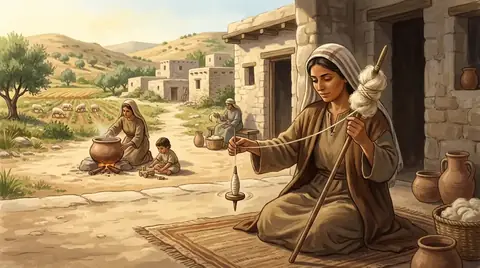 Thing · HomeDistaffThe stick that held the wool or flax while a woman spun it into thread by hand. The good wife of Proverbs 31 is…
 Thing · ClothLinenCloth woven from the fibres of the flax plant. The tabernacle's curtains and the priests' robes were linen; so were the…
Written for this app in its own words, from the Bible, with the facts checked against Bible dictionaries and encyclopedias: Easton's, Smith's, Fausset's, ISBE, Holman, the New Bible Dictionary, Vine's and the Thompson Chain topics.
