
Teaching
Version
A translation of the Bible into another language. Jews in exile needed their Scriptures put into Aramaic, the Greek Septuagint was made in Egypt, and the Bible has since been carried into thousands of tongues.
- Aramaic
- The Targums
- Greek
- The Septuagint, made at Alexandria
- English
- The King James Version, 1611
Why versions
God's word was written in Hebrew, with a little Aramaic, and the New Testament in Greek. But God means it to be understood by all. After the exile, when many Jews no longer knew Hebrew well, Ezra's helpers "read in the book in the law of God distinctly, and gave the sense" (Nehemiah 8:8). At Pentecost the gospel was heard in many languages at once (Acts 2:8–11).
The early versions
Paraphrases into Aramaic, called Targums, were spoken in the synagogues and later written down. For the many Jews living in Egypt the Old Testament was put into Greek at Alexandria, a work called the Septuagint or "the Seventy". It became the Bible of the early churches, and most Old Testament quotations in the New Testament follow it.
For us
English readers have had the King James Version since 1611, the text used in this app, and the work of translation goes on. The message is for "every nation, and kindred, and tongue, and people" (Revelation 14:6).
Key verses
- Nehemiah 8:8
So they read in the book in the law of God distinctly, and gave the sense, and caused them to understand the reading.
- Acts 2:8–11
And how hear we every man in our own tongue, wherein we were born? Parthians, and Medes, and Elamites, and the dwellers in Mesopotamia, and in Judea, and Cappadocia, in Pontus, and Asia, Phrygia, and Pamphylia, in Egypt, and in the parts of Libya about Cyrene, and strangers of Rome, Jews and proselytes, …
- Revelation 14:6
And I saw another angel fly in the midst of heaven, having the everlasting gospel to preach unto them that dwell on the earth, and to every nation, and kindred, and tongue, and people,
Read next
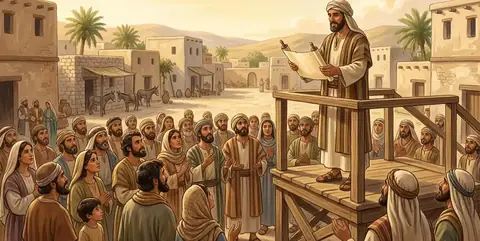 PersonEzraA priest and scribe who led a second group of exiles back from Babylon, taught the people God's law and read it to them…
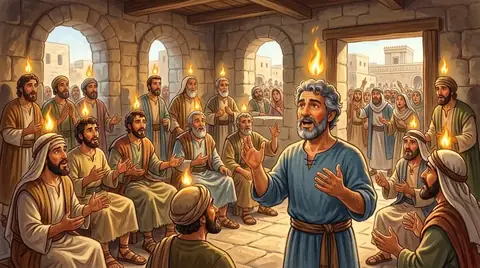 FeastPentecost (the Feast of Weeks)The harvest feast kept fifty days after Passover, when two loaves baked from the new wheat were offered to God. On the…BookSeptuagintThe Greek translation of the Old Testament, made at Alexandria in Egypt for Jews who spoke Greek. It became the Bible…
Written for this app in its own words, from the Bible, with the facts checked against Bible dictionaries and encyclopedias: Easton's, Smith's, Fausset's, ISBE, Holman, the New Bible Dictionary, Vine's and the Thompson Chain topics.
