
Thing · Home
Tent
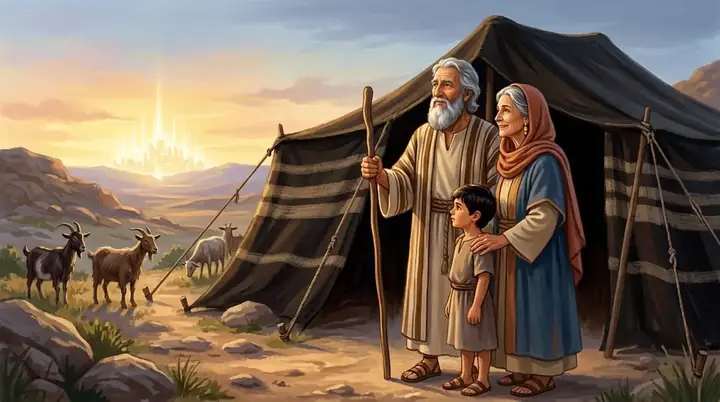
The home of the patriarchs, of Israel in the wilderness and of herdsmen ever since: a covering of woven goat hair on poles. The Bible also calls the tabernacle a tent, and our bodies.
- Made of
- Woven black goat hair over poles, pegged with cords (Song of Songs 1:5; Isaiah 54:2)
- Lived in by
- Abraham, Isaac and Jacob; all Israel for forty years; shepherds and desert peoples
- Also
- The tabernacle ("tent of meeting"); the body (2 Corinthians 5:1); Paul's trade (Acts 18:3)
What it was
A Bible tent was made of strips of cloth woven from black goat hair, sewn together and stretched over poles, held down by cords tied to pegs driven into the ground. It was dark inside and cool, and the hair swelled when wet so that it kept out rain. The first tent-dweller named is Jabal, "the father of such as dwell in tents, and of such as have cattle" (Genesis 4:20). A wealthy household had several: Sarah had her own tent, and so did Jacob's wives (Genesis 24:67; Genesis 31:33). Jael killed Sisera with a tent peg and a hammer, the tools of a woman who pitched the family tent (Judges 4:21).
Who lived in them
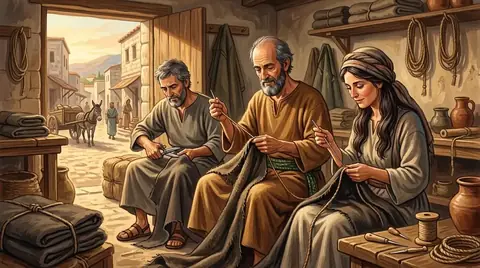
Abraham left the city of Ur and lived in tents all his life in the land God promised him, and so did Isaac and Jacob, "heirs with him of the same promise" (Hebrews 11:9). He pitched his tent near Bethel, then under the oaks at Mamre, where three visitors came to him in the heat of the day (Genesis 12:8; Genesis 18:1). For forty years every family of Israel lived in a tent, camped round God's tent in the middle (Numbers 2:2). Balaam looked down on the camp and could only bless it: "How goodly are thy tents, O Jacob" (Numbers 24:5). Even after Israel settled in houses, "To your tents, O Israel" was the cry for going home (1 Kings 12:16). Paul earned his living making tents, working with Aquila and Priscilla at Corinth (Acts 18:3).
God's tent
God himself chose to live in a tent among his people, the tabernacle, until Solomon built the temple (2 Samuel 7:6). John says that the Word became flesh and "dwelt among us", literally pitched his tent with us (John 1:14).
What it means
A tent is a home you can take down. So the Bible uses it for this life: Paul calls the body "our earthly house of this tabernacle", a tent that will be taken down and replaced by a building from God (2 Corinthians 5:1), and Peter speaks of the time when he must put off his tent (2 Peter 1:13–14). Isaiah tells Zion to enlarge her tent and lengthen her cords for the children who are coming (Isaiah 54:2). Those who live in tents are on their way somewhere, "looking for a city which hath foundations" (Hebrews 11:10).
Key verses
- Genesis 4:20
And Adah bare Jabal: he was the father of such as dwell in tents, and of such as have cattle.
- Numbers 24:5
How goodly are thy tents, O Jacob, and thy tabernacles, O Israel!
- Hebrews 11:9–10
By faith he sojourned in the land of promise, as in a strange country, dwelling in tabernacles with Isaac and Jacob, the heirs with him of the same promise: For he looked for a city which hath foundations, whose builder and maker is God.
- 2 Corinthians 5:1
For we know that if our earthly house of this tabernacle were dissolved, we have a building of God, an house not made with hands, eternal in the heavens.
- Isaiah 54:2
Enlarge the place of thy tent, and let them stretch forth the curtains of thine habitations: spare not, lengthen thy cords, and strengthen thy stakes;
Read next
 PersonAbrahamThe man God called out of Ur to a land he had never seen, promising him a people and a blessing for the whole world. He…
 PersonIsaacThe son God promised to Abraham and Sarah when they were far too old for children, offered on Mount Moriah and spared.…
 PersonJacobIsaac's younger twin son, who won his brother's birthright and blessing by cunning, was changed by God, and was renamed…
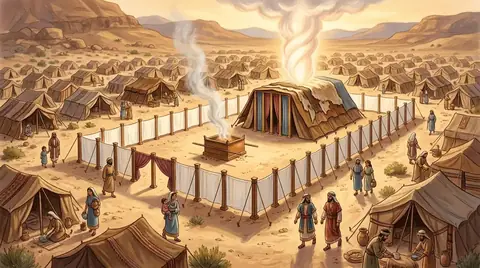 Thing · WorshipThe tabernacleThe holy tent Israel built in the wilderness, by God's own pattern, so that he could dwell in the middle of his people.…
 PersonSarahAbraham's wife and the mother of Isaac. She waited past ninety for the son God had promised, laughed when she heard it…
 PersonJaelThe wife of Heber the Kenite, who killed Sisera, the Canaanite general, with a tent peg while he slept in her tent…
 PersonPaulA Pharisee who hated the church until the risen Jesus met him on the road to Damascus. He became the apostle to the…
 PersonAquilaA Jewish tentmaker from Pontus who, with his wife Priscilla, worked beside Paul at Corinth, taught Apollos at Ephesus…
Written for this app in its own words, from the Bible, with the facts checked against Bible dictionaries and encyclopedias: Easton's, Smith's, Fausset's, ISBE, Holman, the New Bible Dictionary, Vine's and the Thompson Chain topics.
