
Place · Land
Plain
Old and New Testaments · the KJV uses "plain" for several Hebrew words
In the King James Version "plain" stands for several different Hebrew words: a meadow, a broad valley, the low ground of the Jordan, the high flat land east of the Jordan, the Arabah, the low hills of the Shephelah, and even, by mistake, an oak tree.
- Words
- Bikah (broad valley), kikkar (the Jordan circle), mishor (level tableland), arabah (the rift valley), shephelah (low hills), elon (oak)
What it was
Several quite different kinds of land are all called "plain" in the KJV. A bikah was a wide valley between mountains, like the plain in Shinar where the tower of Babel was built (Genesis 11:2) or the plain of Dura where Nebuchadnezzar set up his gold image (Daniel 3:1). The kikkar, "the circle", was the well-watered floor of the Jordan valley that Lot chose, where the cities of the plain stood (Genesis 13:10–12). The mishor was the smooth high tableland east of the Jordan, given to Reuben (Deuteronomy 3:10). The Arabah was the deep rift running south past the Jordan to the Dead Sea, "the sea of the plain", and on beyond it. The Shephelah was the low hill country between Judah's mountains and the Philistine coast (Jeremiah 17:26).
A word to watch
In some places the KJV's "plain" should be "oak" or "terebinth": Abraham camped by "the plain of Moreh" and "the plain of Mamre", that is, by great trees (Genesis 12:6; Genesis 13:18). And "the plain of the vineyards" is really a town name, Abel-keramim (Judges 11:33).
Key verses
- Genesis 13:10–12
And Lot lifted up his eyes, and beheld all the plain of Jordan, that it was well watered every where, before the Lord destroyed Sodom and Gomorrah, even as the garden of the Lord, like the land of Egypt, as thou comest unto Zoar. Then Lot chose him all the plain of Jordan; and Lot journeyed east: and they separated themselves the one from the other. Abram dwelled in the land of Canaan, and Lot dwelled in the cities of the plain, and pitched his tent toward Sodom.
- Genesis 12:6
And Abram passed through the land unto the place of Sichem, unto the plain of Moreh. And the Canaanite was then in the land.
- Deuteronomy 3:10
All the cities of the plain, and all Gilead, and all Bashan, unto Salchah and Edrei, cities of the kingdom of Og in Bashan.
- Jeremiah 17:26
And they shall come from the cities of Judah, and from the places about Jerusalem, and from the land of Benjamin, and from the plain, and from the mountains, and from the south, bringing burnt offerings, and sacrifices, and meat offerings, and incense, and bringing sacrifices of praise, unto the house of the Lord.
- Daniel 3:1
Nebuchadnezzar the king made an image of gold, whose height was threescore cubits, and the breadth thereof six cubits: he set it up in the plain of Dura, in the province of Babylon.
Read next
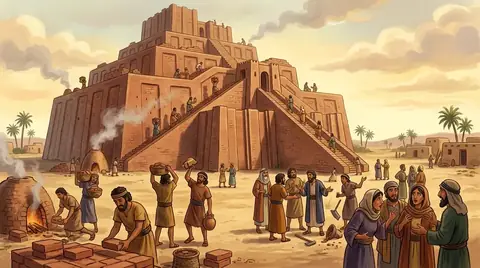 PlaceShinarThe Bible's old name for the broad plain of Babylonia between the Tigris and Euphrates. The Tower of Babel was built…Place · RiverJordanThe river of the Bible: Israel crossed it on dry ground into the promised land, Elijah and Elisha parted it, Naaman…
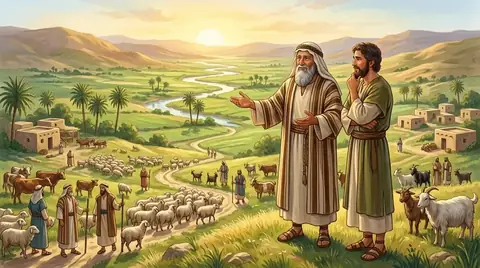 PersonLotAbraham's nephew, who chose the rich plain of Jordan and settled in Sodom. Angels dragged him out before the city…
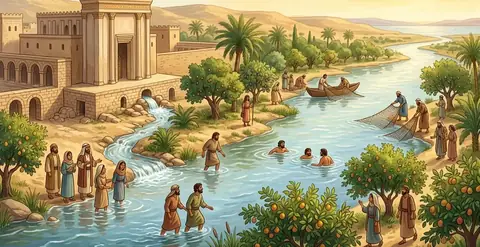 Place · RegionArabahThe long, deep valley running down the Jordan from the Sea of Galilee to the Dead Sea and on to the Red Sea. The King…
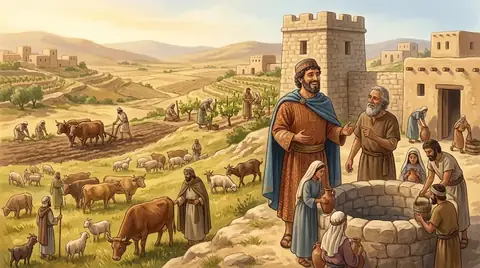 PlaceShephelahThe rolling foothills between the mountains of Judah and the Philistine coast: good farmland and a battleground.…
Written for this app in its own words, from the Bible, with the facts checked against Bible dictionaries and encyclopedias: Easton's, Smith's, Fausset's, ISBE, Holman, the New Bible Dictionary, Vine's and the Thompson Chain topics.
