
Animal
Camel
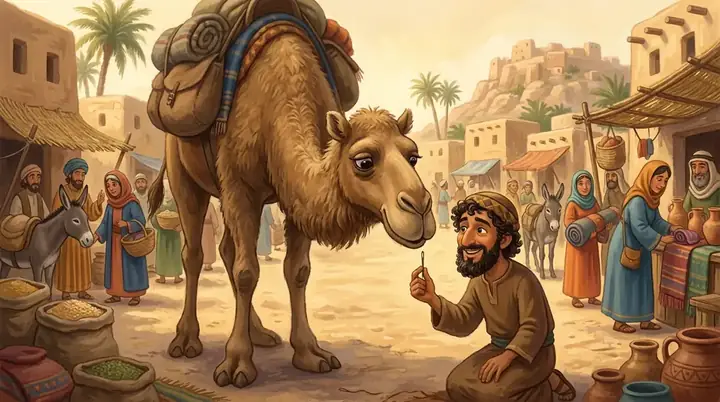
The great beast of the desert, able to walk for days on little water with a heavy load on its back. A herd of camels meant wealth, and Jesus made the camel the biggest animal in two of his sayings.
- Used for
- Riding, carrying goods, milk, hair for rough cloth
- Owned by
- Abraham, Jacob, Job (3,000), the Midianites
- Food
- Unclean for Israel (Leviticus 11:4)
What it was
The camel is built for the desert. It can walk for days on little water, carry a heavy load, and live on thorny plants that other animals refuse. In Bible times a man's camels were part of his riches. Abraham had camels, Jacob grew rich in them, and Job owned three thousand before his troubles began (Job 1:3). The Midianites who raided Israel came with camels too many to count (Judges 7:12).
How it was used
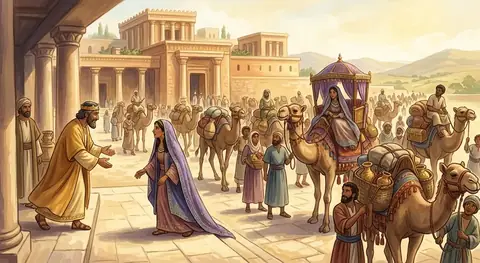
Camels carried people and goods across long distances. Abraham's servant took ten of them to find a wife for Isaac, and Rebekah rode one home (Genesis 24:10–64). The traders who bought Joseph were leading camels loaded with spices for Egypt (Genesis 37:25). The queen of Sheba came to Solomon with a camel train of gold and spices (1 Kings 10:2). Camel's milk was drunk, and the coarse hair was woven into cloth. John the Baptist wore a coat of camel's hair, the dress of a plain man of the wilderness (Matthew 3:4).
Israel was not allowed to eat camel meat, because the camel chews the cud but does not have a split hoof (Leviticus 11:4).
In Jesus' teaching
Jesus used the camel, the largest animal his hearers knew, to make a point. It is easier, he said, for a camel to pass through the eye of a needle than for a rich man to enter God's kingdom; with man it is impossible, but not with God (Matthew 19:24–26). And he said the Pharisees "strain at a gnat, and swallow a camel": careful over tiny rules, careless over justice and mercy (Matthew 23:24).
Key verses
- Genesis 24:10
And the servant took ten camels of the camels of his master, and departed; for all the goods of his master were in his hand: and he arose, and went to Mesopotamia, unto the city of Nahor.
- Job 1:3
His substance also was seven thousand sheep, and three thousand camels, and five hundred yoke of oxen, and five hundred she asses, and a very great household; so that this man was the greatest of all the men of the east.
- Matthew 3:4
And the same John had his raiment of camel’s hair, and a leathern girdle about his loins; and his meat was locusts and wild honey.
- Matthew 19:24
And again I say unto you, It is easier for a camel to go through the eye of a needle, than for a rich man to enter into the kingdom of God.
- Matthew 23:24
Ye blind guides, which strain at a gnat, and swallow a camel.
Read next
 PersonAbrahamThe man God called out of Ur to a land he had never seen, promising him a people and a blessing for the whole world. He…
 PersonJacobIsaac's younger twin son, who won his brother's birthright and blessing by cunning, was changed by God, and was renamed…
 PersonJobA rich and godly man who lost his children, his wealth and his health in a single stroke, and would not curse God. His…
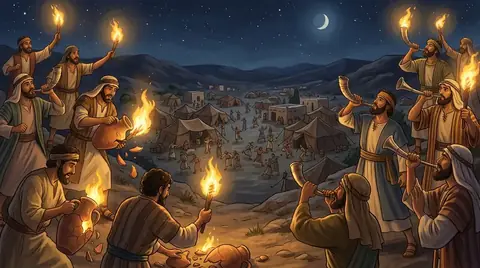 NationThe MidianitesNomads of the desert, traders and raiders, who came from Abraham. They sold Joseph into Egypt, sheltered Moses, lured…
 PersonIsaacThe son God promised to Abraham and Sarah when they were far too old for children, offered on Mount Moriah and spared.…
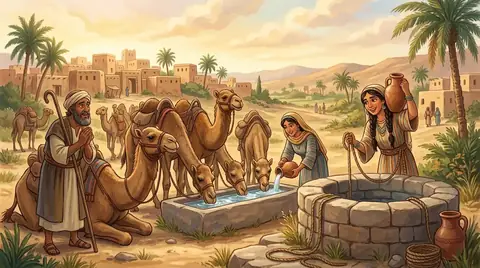 PersonRebekahIsaac's wife, found for him at a well far away in Abraham's homeland. She was told before her twins were born that the…
 PersonJosephJacob's favourite son, sold by his brothers into Egypt, where he rose from prison to rule the land and saved his family…
 PersonQueen of ShebaA queen from the land of Sheba, probably in south-west Arabia, who travelled to Jerusalem to test Solomon's famous…
Written for this app in its own words, from the Bible, with the facts checked against Bible dictionaries and encyclopedias: Easton's, Smith's, Fausset's, ISBE, Holman, the New Bible Dictionary, Vine's and the Thompson Chain topics.
