
Person
Job
JOBEThe land of Uz · probably in the days of the patriarchs
A rich and godly man who lost his children, his wealth and his health in a single stroke, and would not curse God. His book asks why the good suffer, and answers with God himself.
- Family
- Seven sons and three daughters, all killed; later seven more sons and three daughters, Jemima, Kezia and Keren-happuch (Job 42:13–14)
- Where
- The land of Uz, east of Israel, perhaps toward Edom or Arabia
- Known for
- Patience in suffering (James 5:11); "I know that my redeemer liveth"
- Died
- "Old and full of days", after 140 more years (Job 42:16–17)
His story
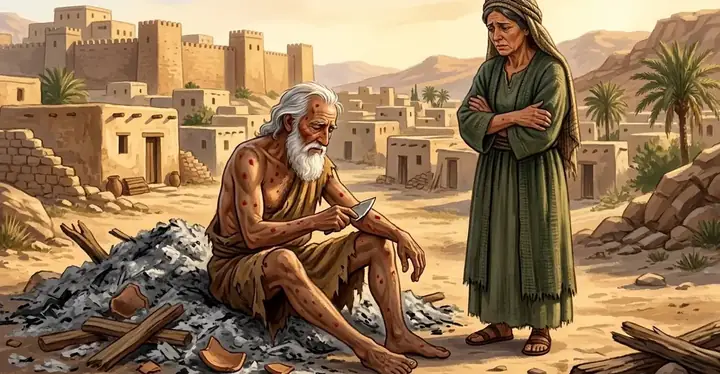
Job was "perfect and upright", the greatest man of the east, with thousands of sheep, camels, oxen and donkeys, and he rose early to offer sacrifices in case his children had sinned (Job 1:1–5). In heaven Satan sneered that Job served God only because God paid him. God allowed the test. In one day raiders took the herds, fire fell on the sheep, and a wind flattened the house where all ten children were feasting. Job tore his robe, fell down and worshipped: "the LORD gave, and the LORD hath taken away; blessed be the name of the LORD" (Job 1:21). Then boils covered him from head to foot. He sat in the ashes scraping himself with broken pottery, and his wife told him to curse God and die (Job 2:7–10).
The long argument
Three friends, Eliphaz, Bildad and Zophar, sat with him seven days in silence, which was the kindest thing they did. Then they argued, round after round, that God is just, so Job must have sinned. Job knew he had not. He cursed the day he was born, demanded a hearing with God, and in the depths cried, "I know that my redeemer liveth... yet in my flesh shall I see God" (Job 19:25–26). A younger man, Elihu, spoke of suffering as God's teaching. At last God answered out of a whirlwind, not with reasons but with questions: where was Job when the earth's foundations were laid? Could he feed the lions, or lead out the stars? (Job 38–41). Job put his hand on his mouth: "I abhor myself, and repent in dust and ashes" (Job 42:6).
The end
God rebuked the friends for not speaking rightly as Job had, and told them to ask Job to pray for them. Then he gave Job twice what he had before, and ten more children (Job 42:7–17). Job's story is set in the days of the patriarchs: no law or temple is mentioned, he sacrifices for his own family, and he lives long. Ezekiel names him with Noah and Daniel as a pattern of righteousness (Ezekiel 14:14), and James holds up his patience and the Lord's tender mercy at the end (James 5:11).
Points to Christ
Job longed for a "daysman", someone to stand between him and God and lay a hand on both (Job 9:33), and he trusted a Redeemer who lived. Christians find that mediator in Jesus, who suffered innocently and was raised, and through whom we come to God (1 Timothy 2:5).
Key verses
- Job 1:20–22
Then Job arose, and rent his mantle, and shaved his head, and fell down upon the ground, and worshipped, And said, Naked came I out of my mother’s womb, and naked shall I return thither: the Lord gave, and the Lord hath taken away; blessed be the name of the Lord. In all this Job sinned not, nor charged God foolishly.
- Job 2:9–10
Then said his wife unto him, Dost thou still retain thine integrity? curse God, and die. But he said unto her, Thou speakest as one of the foolish women speaketh. What? shall we receive good at the hand of God, and shall we not receive evil? In all this did not Job sin with his lips.
- Job 19:25–27
For I know that my redeemer liveth, and that he shall stand at the latter day upon the earth: And though after my skin worms destroy this body, yet in my flesh shall I see God: Whom I shall see for myself, and mine eyes shall behold, and not another; though my reins be consumed within me.
- Job 42:1–6
Then Job answered the Lord, and said, I know that thou canst do every thing, and that no thought can be withholden from thee. Who is he that hideth counsel without knowledge? therefore have I uttered that I understood not; things too wonderful for me, which I knew not. …
- James 5:11
Behold, we count them happy which endure. Ye have heard of the patience of Job, and have seen the end of the Lord; that the Lord is very pitiful, and of tender mercy.
Family
- Children
- Jemimah, Keziah, Keren-happuch
Mentioned in 53 verses
- Job 50
- Ezekiel 2
- James 1
Read next
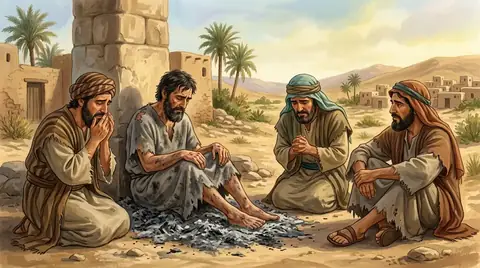 PersonEliphazThe oldest and most courteous of Job's three friends, who came from Teman to comfort him but insisted that his…PersonBildadOne of Job's three friends, called "the Shuhite." He came to comfort Job, but his speeches insisted that God was…PersonZopharThe third of Job's three friends who came to comfort him. He was the bluntest of them, telling Job he deserved even…PersonElihuThe young man who waited until Job and his three friends had run out of words, then spoke at length about God's…
 PersonNoahThe one righteous man of his age. God told him to build an ark, and through it saved him, his family and the animals…
 Person · ProphetDanielA young noble of Judah carried off to Babylon, who served four kings with wisdom and never bent his faith. God gave him…
 PersonJemimahThe eldest of the three daughters born to Job after God restored him. She and her sisters were the most beautiful women…
Written for this app in its own words, from the Bible, with the facts checked against Bible dictionaries and encyclopedias: Easton's, Smith's, Fausset's, ISBE, Holman, the New Bible Dictionary, Vine's and the Thompson Chain topics. People and places: STEPBible.org (TIPNR), CC BY 4.0; where a place is today and its photo: OpenBible.info, CC BY 4.0.
