
Custom · Daily life
Agriculture
Also: Seasons, Threshing
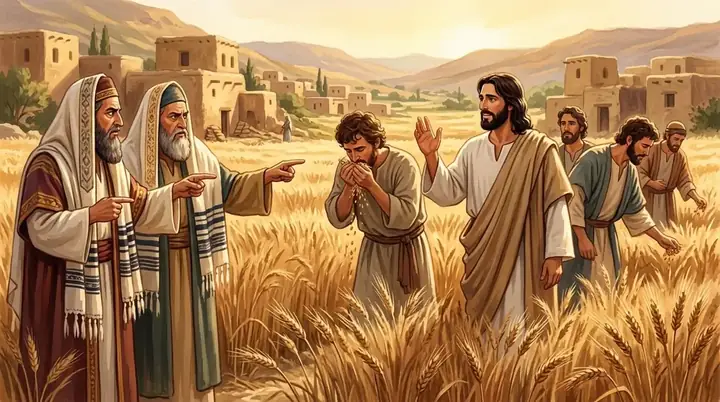
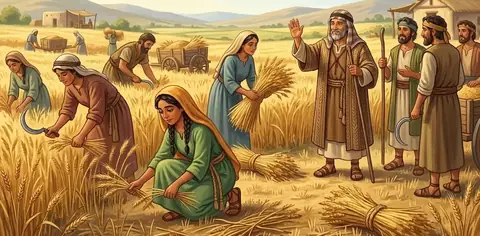
Farming was the main work of Israel: ploughing after the autumn rains, sowing grain, harvesting barley and wheat in spring, and gathering grapes, figs and olives in summer. Much of the Bible's teaching uses its pictures.
- Crops
- Wheat, barley, grapes, olives, figs, pomegranates, beans and lentils
- Seasons
- Early rain and ploughing in October; barley harvest at Passover; wheat harvest at Pentecost; grapes and olives in autumn
- Tools
- A light wooden plough, a goad, a sickle, a threshing sledge, a winnowing fork
The farmer's year
God put the first man in a garden to work it (Genesis 2:15), and most Israelites lived by the land. The year turned on the rains. The "former rain" in October softened the baked ground for ploughing and sowing wheat and barley; the "latter rain" in March and April filled the ears (Deuteronomy 11:14). Barley was cut at Passover, wheat seven weeks later at Pentecost, and in the dry heat of summer the grapes, figs and olives ripened for the feast of Tabernacles in the autumn (Exodus 23:16). No rain in its season meant famine, and the prophets say drought came when the people forgot the God who sent the rain (Jeremiah 5:24; Haggai 1:10–11).
Tools and methods
The plough was a light wooden frame with an iron tip, pulled by a pair of oxen and steered with one hand while the other held a goad, a long pointed stick (Judges 3:31; Luke 9:62). Seed was scattered by hand, which is why some fell on the path and among thorns (Matthew 13:3–8). Grain was cut with a sickle, bound in sheaves and carried to the threshing floor, a flat hilltop where oxen trod it or dragged a sledge over it to break the husks (Deuteronomy 25:4). Then it was thrown into the evening breeze with a fork: the grain fell, the chaff blew away (Psalms 1:4). Grapes were trodden in a rock-cut winepress, olives crushed for oil.
God's laws for the land
The law shaped farming. The corners of the field and the dropped ears were left for the poor and the stranger, which is how Ruth met Boaz (Leviticus 19:9–10; Ruth 2). Every seventh year the land rested (Leviticus 25:1–7). An ox treading grain was not to be muzzled, and an ox and a donkey were not yoked together (Deuteronomy 22:10; Deuteronomy 25:4). The firstfruits and a tithe of every crop went to God, a reminder that the land was his.
In Jesus' teaching
Jesus grew up among farmers and taught with their work: the sower, the wheat and the tares, the mustard seed, the vine and its branches, the harvest and the labourers (Matthew 13; John 15:1–5; Matthew 9:37–38). Paul adds the rule that "whatsoever a man soweth, that shall he also reap" (Galatians 6:7).
Key verses
- Genesis 2:15
And the Lord God took the man, and put him into the garden of Eden to dress it and to keep it.
- Deuteronomy 11:14
That I will give you the rain of your land in his due season, the first rain and the latter rain, that thou mayest gather in thy corn, and thy wine, and thine oil.
- Leviticus 19:9–10
And when ye reap the harvest of your land, thou shalt not wholly reap the corners of thy field, neither shalt thou gather the gleanings of thy harvest. And thou shalt not glean thy vineyard, neither shalt thou gather every grape of thy vineyard; thou shalt leave them for the poor and stranger: I am the Lord your God.
- Matthew 13:3–8
And he spake many things unto them in parables, saying, Behold, a sower went forth to sow; And when he sowed, some seeds fell by the way side, and the fowls came and devoured them up: Some fell upon stony places, where they had not much earth: and forthwith they sprung up, because they had no deepness of earth: …
- Galatians 6:7
Be not deceived; God is not mocked: for whatsoever a man soweth, that shall he also reap.
Read next
 FeastPassoverThe yearly feast remembering the night God rescued Israel from Egypt, when death passed over every house marked with a…
 FeastPentecost (the Feast of Weeks)The harvest feast kept fifty days after Passover, when two loaves baked from the new wheat were offered to God. On the…
 Thing · WorshipThe tabernacleThe holy tent Israel built in the wilderness, by God's own pattern, so that he could dwell in the middle of his people.…
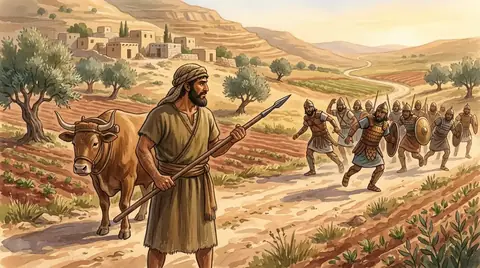 Thing · FarmingGoadA long pointed stick used to drive oxen at the plough. Shamgar killed six hundred Philistines with one, and the risen…
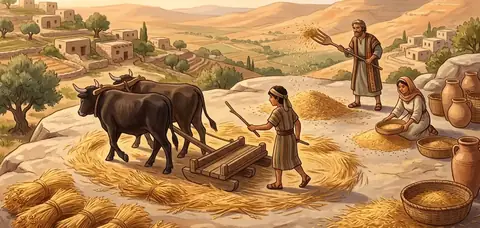 Custom · Daily lifeThe threshing floorA flat open space of beaten earth or rock, usually on a breezy hilltop, where cut grain was trodden out by oxen and…
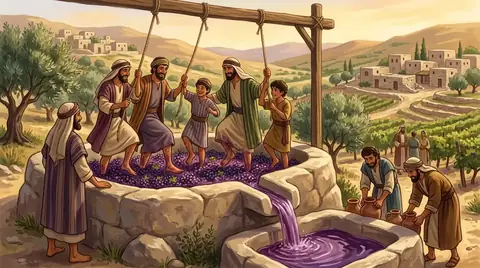 Custom · FarmingThe winepressA pit in the rock where the grape harvest was trodden by foot, the juice running into a lower basin. Gideon was…
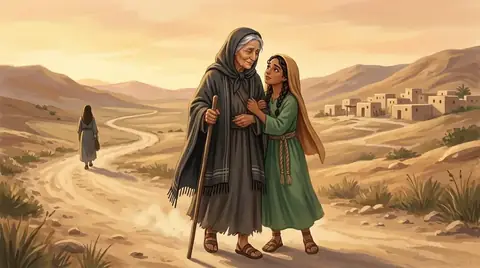 PersonRuthA young widow from Moab who left her own land to stay with her mother-in-law Naomi and trust Israel's God. She married…
 PersonBoazA wealthy farmer of Bethlehem who married Ruth, the Moabite widow, as her kinsman-redeemer. Their great-grandson was…
Written for this app in its own words, from the Bible, with the facts checked against Bible dictionaries and encyclopedias: Easton's, Smith's, Fausset's, ISBE, Holman, the New Bible Dictionary, Vine's and the Thompson Chain topics.
