
Custom · Daily life
The threshing floor
A flat open space of beaten earth or rock, usually on a breezy hilltop, where cut grain was trodden out by oxen and tossed into the wind. Ruth met Boaz on one, and the temple was built on another.
- Where
- Ruth 3:2–14; 2 Samuel 24:16–25; 2 Chronicles 3:1; Matthew 3:12
- How
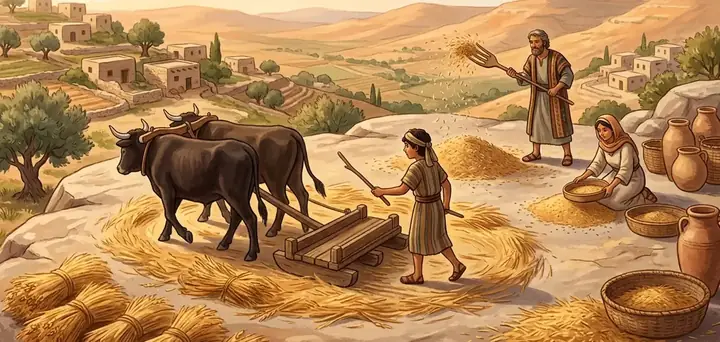
- Oxen trod the stalks or dragged a sledge over them; then the grain was winnowed with a fork in the evening wind
What it was
After the harvest the sheaves were carried to the threshing floor, a circle of hard, level ground outside the village, on high ground to catch the wind. The stalks were spread out and oxen were driven round and round over them, sometimes dragging a heavy wooden sledge with stones or iron set in its underside, until the grain was loosed from the straw (Deuteronomy 25:4; Isaiah 41:15). Then, in the breeze of the late afternoon, the farmer threw it all into the air with a fork or shovel. The chaff and straw blew away; the grain fell back at his feet (Psalms 1:4). Because the pile of grain lay out in the open, the owner slept beside it until it was stored.
In the Bible
Joseph and his brothers mourned Jacob at the threshing floor of Atad beyond the Jordan (Genesis 50:10). Gideon laid his fleece on one to ask for a sign (Judges 6:37). Ruth went down to the threshing floor by night, where Boaz lay guarding his barley, and asked him to take her as his wife as the family redeemer (Ruth 3:2–14). Uzzah died at the threshing floor of Nachon when he reached out to steady the ark (2 Samuel 6:6). When God stopped the plague on Jerusalem, the angel was standing at the threshing floor of Araunah the Jebusite; David bought it and built an altar, and there Solomon built the temple (2 Samuel 24:16–25; 2 Chronicles 3:1).
What it meant
The threshing floor was a picture of judgment, where what is worth keeping is parted from what is not. Micah sees the nations gathered "as the sheaves into the floor" (Micah 4:12). John the Baptist said that the one coming after him had his fan in his hand and would thoroughly purge his floor, gathering the wheat into the barn and burning the chaff (Matthew 3:12). It was also a place of plenty and of rejoicing (Hosea 9:1), and of the kindness shown there to a foreign widow.
Key verses
- Deuteronomy 25:4
Thou shalt not muzzle the ox when he treadeth out the corn.
- Ruth 3:2–7
And now is not Boaz of our kindred, with whose maidens thou wast? Behold, he winnoweth barley to night in the threshingfloor. Wash thyself therefore, and anoint thee, and put thy raiment upon thee, and get thee down to the floor: but make not thyself known unto the man, until he shall have done eating and drinking. And it shall be, when he lieth down, that thou shalt mark the place where he shall lie, and thou shalt go in, and uncover his feet, and lay thee down; and he will tell thee what thou shalt do. …
- 2 Samuel 24:18–25
And Gad came that day to David, and said unto him, Go up, rear an altar unto the Lord in the threshingfloor of Araunah the Jebusite. And David, according to the saying of Gad, went up as the Lord commanded. And Araunah looked, and saw the king and his servants coming on toward him: and Araunah went out, and bowed himself before the king on his face upon the ground. …
- Psalms 1:4
The ungodly are not so: but are like the chaff which the wind driveth away.
- Matthew 3:12
Whose fan is in his hand, and he will throughly purge his floor, and gather his wheat into the garner; but he will burn up the chaff with unquenchable fire.
Read next
 Person · JudgeGideonThe farmer God called to free Israel from the Midianites. Timid and full of questions, he obeyed, and with three…
 PersonRuthA young widow from Moab who left her own land to stay with her mother-in-law Naomi and trust Israel's God. She married…
 PersonBoazA wealthy farmer of Bethlehem who married Ruth, the Moabite widow, as her kinsman-redeemer. Their great-grandson was…
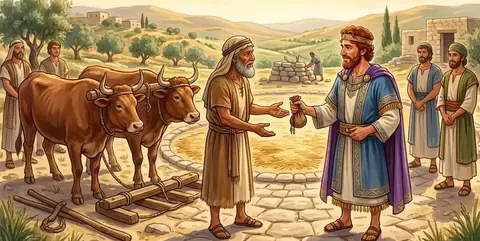 PersonOrnanThe Jebusite farmer whose threshing floor David bought to build an altar and stop the plague. The site became the place…
 Person · KingDavidThe shepherd boy who killed Goliath and became Israel's greatest king, "a man after God's own heart". He wrote many…
 Person · KingSolomonDavid's son and Israel's third king, who asked God for wisdom and received riches and fame as well. He built the temple…
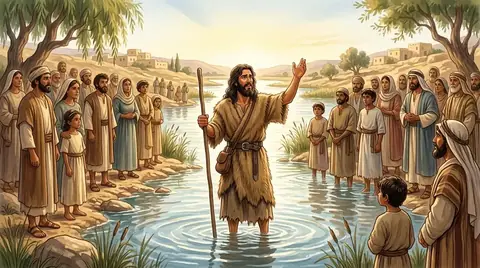 PersonJohn the BaptistThe prophet God sent to prepare the way for Jesus. He called Israel to repent, baptized in the Jordan, pointed to Jesus…
Written for this app in its own words, from the Bible, with the facts checked against Bible dictionaries and encyclopedias: Easton's, Smith's, Fausset's, ISBE, Holman, the New Bible Dictionary, Vine's and the Thompson Chain topics.
