
Custom
Tearing one's clothes
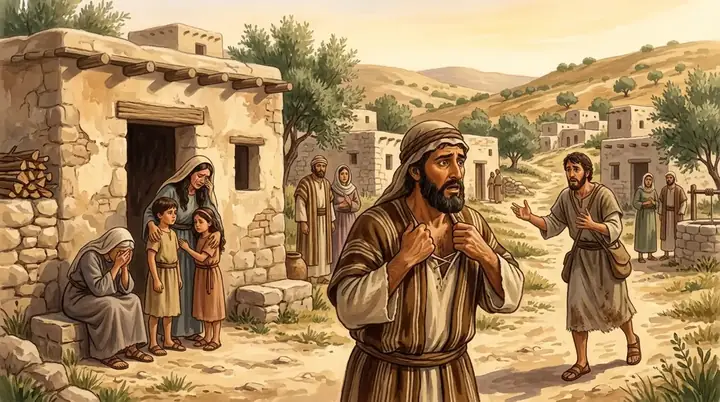
Ripping one's robe at the neck was the Bible's way of showing grief, horror or outrage, at a death, a disaster, or words against God. The high priest did it at Jesus' trial.
- Showed
- Grief, shock, shame, or horror at blasphemy
- Where
- Genesis 37:34; 2 Samuel 1:11; Job 1:20; Matthew 26:65
What it was
When bad news came, a man would take hold of his garment at the collar and rip it down a hand's breadth or more. It was done in the moment, with the hands, and the torn robe was often kept on afterwards as a sign of mourning, together with sackcloth and ashes on the head.
When it was done
Reuben tore his clothes when he found Joseph gone from the pit, and Jacob tore his when he was shown the bloodied coat (Genesis 37:29, 34). Joshua did it when Israel lost at Ai (Joshua 7:6), David on hearing of the death of Saul and Jonathan (2 Samuel 1:11), and Job when all his children died, before he fell down and worshipped (Job 1:20). King Josiah tore his robes when the lost book of the law was read to him and he saw how far the nation had gone from it (2 Kings 22:11). Ezra sat stunned with his coat and cloak torn when he learned that the returned exiles had married into the idolatrous peoples (Ezra 9:3). At Lystra, when the crowd tried to worship them as gods, Paul and Barnabas ran among them with their clothes torn, horrified (Acts 14:14).
The high priest was forbidden to tear his sacred robes (Leviticus 21:10). Yet Caiaphas tore his clothes when Jesus said he was the Son of God, crying "He hath spoken blasphemy" (Matthew 26:65). The gesture meant to show horror at an insult to God was aimed at God's own Son.
What it means
The outward tear could be done without any change inside. So God says through Joel, "rend your heart, and not your garments, and turn unto the LORD your God" (Joel 2:13). A broken heart is what he wants, not a broken coat.
Key verses
- Genesis 37:34
And Jacob rent his clothes, and put sackcloth upon his loins, and mourned for his son many days.
- Job 1:20
Then Job arose, and rent his mantle, and shaved his head, and fell down upon the ground, and worshipped,
- 2 Kings 22:11
And it came to pass, when the king had heard the words of the book of the law, that he rent his clothes.
- Joel 2:13
And rend your heart, and not your garments, and turn unto the Lord your God: for he is gracious and merciful, slow to anger, and of great kindness, and repenteth him of the evil.
- Matthew 26:65
Then the high priest rent his clothes, saying, He hath spoken blasphemy; what further need have we of witnesses? behold, now ye have heard his blasphemy.
Read next
 Person · TribeReubenJacob's firstborn, who lost the rights of the eldest by sleeping with his father's concubine. He tried to save Joseph…
 PersonJosephJacob's favourite son, sold by his brothers into Egypt, where he rose from prison to rule the land and saved his family…
 PersonJacobIsaac's younger twin son, who won his brother's birthright and blessing by cunning, was changed by God, and was renamed…
 PersonJoshuaMoses' helper who took over from him and led Israel across the Jordan into the Promised Land. He fought the wars of…
 Person · KingDavidThe shepherd boy who killed Goliath and became Israel's greatest king, "a man after God's own heart". He wrote many…
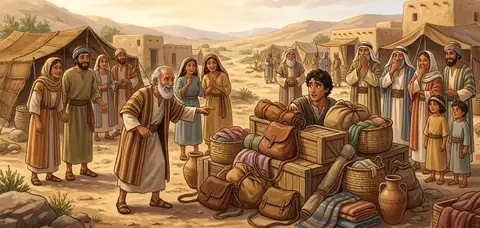 Person · KingSaulIsrael's first king, a tall Benjamite chosen when the people demanded a king like the nations. He began humbly and won…
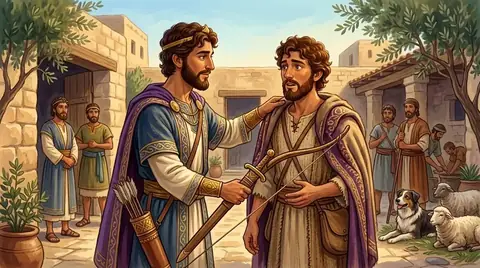 PersonJonathanSaul's eldest son and David's closest friend. A brave soldier who climbed a cliff to rout the Philistines, he gave up…
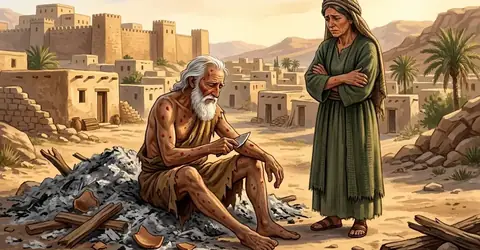 PersonJobA rich and godly man who lost his children, his wealth and his health in a single stroke, and would not curse God. His…
Written for this app in its own words, from the Bible, with the facts checked against Bible dictionaries and encyclopedias: Easton's, Smith's, Fausset's, ISBE, Holman, the New Bible Dictionary, Vine's and the Thompson Chain topics.
