
Plant · Perfume
Spikenard (nard)
SPIKE-nardHebrew nerd, Greek nardos · a scented oil from the Himalayas
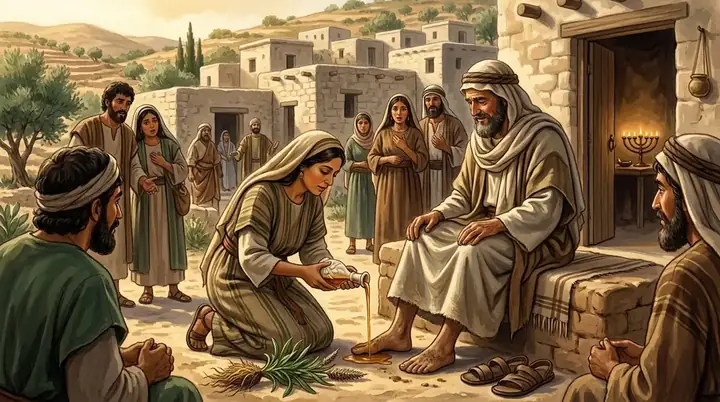
A sweet, very costly perfumed oil pressed from the root of a plant that grows high in the mountains of India. Mary of Bethany poured a jar of it, worth a year's wages, over Jesus.
- From
- The hairy root and lower stem of a small plant of the Himalayas
- Worth
- Mary's pound of it: three hundred pence, about a year's pay (John 12:5)
- Kept in
- Sealed flasks of alabaster
What it was
Spikenard, or nard, came from a plant that grows only on the high slopes of the Himalayas. Its root and the base of its stem are covered in hairs, like a spike, and from these a thick, fragrant oil was drawn. It travelled thousands of miles by caravan and ship before it reached Israel, which is why it cost so much, and it was sold in sealed alabaster flasks so that none of the scent escaped.
In the Song of Songs the bride's perfume fills the room while the king sits at his table (Song of Songs 1:12), and nard grows in the garden of spices with saffron, cinnamon, myrrh and aloes (Song of Songs 4:13–14).
Mary's gift
Six days before the last Passover, at a supper in Bethany, Mary took a pound of pure nard, broke the jar and poured it over Jesus' head and feet, wiping his feet with her hair, until "the house was filled with the odour of the ointment" (John 12:3; Mark 14:3). Judas complained that it could have been sold for three hundred pence and given to the poor: a working man's wages for a whole year. Jesus defended her. She had anointed his body for burial beforehand, and wherever the gospel was preached her gift would be told (Mark 14:6–9).
What it means
Mary gave the most valuable thing she owned, all at once, and counted it no waste. Love for Jesus does not calculate.
Key verses
- Song of Songs 1:12
While the king sitteth at his table, my spikenard sendeth forth the smell thereof.
- Mark 14:3–9
And being in Bethany in the house of Simon the leper, as he sat at meat, there came a woman having an alabaster box of ointment of spikenard very precious; and she brake the box, and poured it on his head. And there were some that had indignation within themselves, and said, Why was this waste of the ointment made? For it might have been sold for more than three hundred pence, and have been given to the poor. And they murmured against her. …
- John 12:3–5
Then took Mary a pound of ointment of spikenard, very costly, and anointed the feet of Jesus, and wiped his feet with her hair: and the house was filled with the odour of the ointment. Then saith one of his disciples, Judas Iscariot, Simon’s son, which should betray him, Why was not this ointment sold for three hundred pence, and given to the poor?
Read next
 MaterialAlabasterA soft, pale stone that could be carved into fine jars for costly perfume. A woman broke an alabaster jar of ointment…PlantCinnamonA sweet spice from the inner bark of a tree that grows far to the east, in Ceylon and India. It went into the holy…
 Plant · SpiceMyrrhA bitter, sweet-smelling gum from a thorny desert tree, costly and prized as perfume, medicine and for burial. The wise…
 FeastPassoverThe yearly feast remembering the night God rescued Israel from Egypt, when death passed over every house marked with a…
Written for this app in its own words, from the Bible, with the facts checked against Bible dictionaries and encyclopedias: Easton's, Smith's, Fausset's, ISBE, Holman, the New Bible Dictionary, Vine's and the Thompson Chain topics.
