
Material
Alabaster
AL-a-bas-terA soft white stone, carved into jars for perfume
A soft, pale stone that could be carved into fine jars for costly perfume. A woman broke an alabaster jar of ointment over Jesus at Bethany.
- Where
- A woman's gift to Jesus (Mark 14:3; Luke 7:37; Matthew 26:7)
- Made into
- Narrow-necked jars and flasks for ointment
What it was
Alabaster is a soft stone, usually creamy white and slightly see-through, that looks like marble but is easy to carve. Craftsmen in Egypt and elsewhere turned it into small jars with long narrow necks for storing perfume; the stone kept the scent cool and fresh. The jars took their name from the stone, and in time any perfume flask could be called an alabaster.
In the Gospels
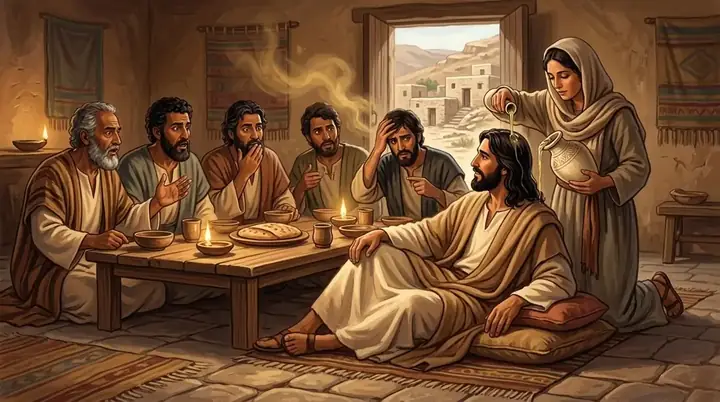
At a supper in Bethany, at the home of Simon the leper, a woman came in with an alabaster jar of pure spikenard, very costly. She broke off the neck of the jar and poured the whole of it over Jesus' head (Mark 14:3). Some of the guests grumbled that it was worth a year's wages and could have fed the poor. Jesus called it a good work done for his burial, and promised that wherever the gospel was preached her gift would be remembered. John tells us the woman was Mary of Bethany (John 12:3).
Earlier, in Galilee, a woman known in the town as a sinner had brought an alabaster box of ointment to another Simon's house, wet Jesus' feet with her tears, and anointed them (Luke 7:37–38). He told her that her sins were forgiven.
What it means
A sealed jar is worth nothing until it is broken. Both women gave the best they had, all at once, with no thought of cost.
Key verses
- Mark 14:3–9
And being in Bethany in the house of Simon the leper, as he sat at meat, there came a woman having an alabaster box of ointment of spikenard very precious; and she brake the box, and poured it on his head. And there were some that had indignation within themselves, and said, Why was this waste of the ointment made? For it might have been sold for more than three hundred pence, and have been given to the poor. And they murmured against her. …
- Luke 7:37–38
And, behold, a woman in the city, which was a sinner, when she knew that Jesus sat at meat in the Pharisee’s house, brought an alabaster box of ointment, And stood at his feet behind him weeping, and began to wash his feet with tears, and did wipe them with the hairs of her head, and kissed his feet, and anointed them with the ointment.
- John 12:3
Then took Mary a pound of ointment of spikenard, very costly, and anointed the feet of Jesus, and wiped his feet with her hair: and the house was filled with the odour of the ointment.
Read next
 Place · VillageBethanyThe village of Mary, Martha and Lazarus, two miles from Jerusalem over the Mount of Olives. Jesus raised Lazarus here…
 PersonSimonA very common name in New Testament times. Besides Simon Peter, the Bible names a second apostle, a brother of Jesus…
 Plant · PerfumeSpikenard (nard)A sweet, very costly perfumed oil pressed from the root of a plant that grows high in the mountains of India. Mary of…
 PersonMaryThe young woman of Nazareth chosen to be the mother of Jesus. She believed the angel's word, bore God's Son, and stood…
Written for this app in its own words, from the Bible, with the facts checked against Bible dictionaries and encyclopedias: Easton's, Smith's, Fausset's, ISBE, Holman, the New Bible Dictionary, Vine's and the Thompson Chain topics.
