
Custom · Worship
The scapegoat
Leviticus 16 · "the goat for Azazel" in other translations
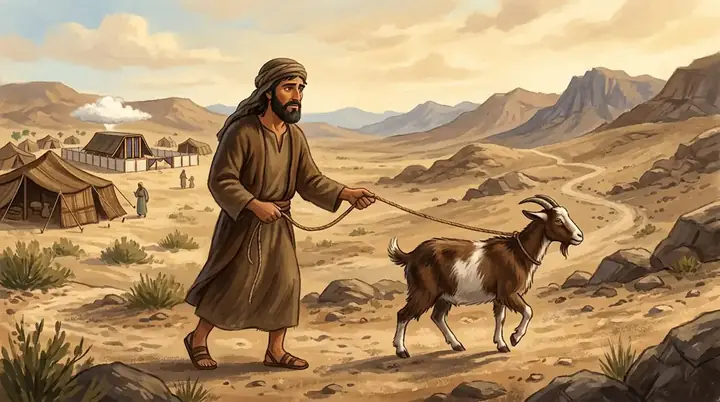
Once a year, at the Day of Atonement, the high priest confessed the nation's sins over a live goat and sent it off into the wilderness. It pictured sin carried far off, never to come back.
- When
- Once a year, on the Day of Atonement
- How chosen
- By lot between two goats; the other was sacrificed (Leviticus 16:8)
- Meaning
- Sins confessed, laid on another, and taken away for good
What happened
Each year on the Day of Atonement, the priests brought a pair of goats to the door of the tabernacle and cast lots over them. One was killed as a sin offering and its blood carried into the Most Holy Place. Then Aaron laid both hands on the head of the living goat and confessed over it "all the iniquities of the children of Israel", and a man led it away into the desert and let it go in a place where no one lived (Leviticus 16:20–22). The man who took it had to wash before he came back to camp (Leviticus 16:26). In later centuries, Jewish writers tell us, the goat was taken to a cliff some miles east of Jerusalem and pushed over, so that it could never wander home.
What it meant
The two goats together told one story. The first showed the price of sin: death, blood on the mercy seat. The second showed the result: sin lifted off the people, carried away out of sight, gone. The Psalms say the same without the goat: "as far as the east is from the west, so far hath he removed our transgressions from us" (Psalms 103:12).
The name is from Tyndale's English, "the goat that escapes". The Hebrew says the goat was "for Azazel", a word whose meaning isn't certain; it may mean "the goat sent away" or name the desolate place it went to.
Points to Christ
Isaiah said of the coming Servant, "the LORD hath laid on him the iniquity of us all" (Isaiah 53:6), the very picture of hands pressed on the goat's head. Jesus is both goats at once: he died as the sin offering, and he carried our sins away. Hebrews notes that the sin-offering bodies were burnt outside the camp, and that Jesus too "suffered without the gate" (Hebrews 13:11–12). Because of him, forgiven sin does not come back.
Key verses
- Leviticus 16:8–10
And Aaron shall cast lots upon the two goats; one lot for the Lord, and the other lot for the scapegoat. And Aaron shall bring the goat upon which the Lord’s lot fell, and offer him for a sin offering. But the goat, on which the lot fell to be the scapegoat, shall be presented alive before the Lord, to make an atonement with him, and to let him go for a scapegoat into the wilderness.
- Leviticus 16:20–22
And when he hath made an end of reconciling the holy place, and the tabernacle of the congregation, and the altar, he shall bring the live goat: And Aaron shall lay both his hands upon the head of the live goat, and confess over him all the iniquities of the children of Israel, and all their transgressions in all their sins, putting them upon the head of the goat, and shall send him away by the hand of a fit man into the wilderness: And the goat shall bear upon him all their iniquities unto a land not inhabited: and he shall let go the goat in the wilderness.
- Psalms 103:12
As far as the east is from the west, so far hath he removed our transgressions from us.
- Isaiah 53:6
All we like sheep have gone astray; we have turned every one to his own way; and the Lord hath laid on him the iniquity of us all.
Read next
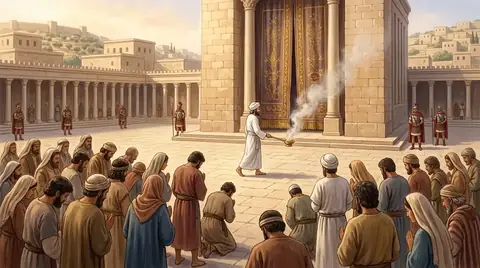 Feast · FastThe Day of AtonementThe one day in the year when the high priest went behind the veil with blood to atone for all Israel's sins, while a…
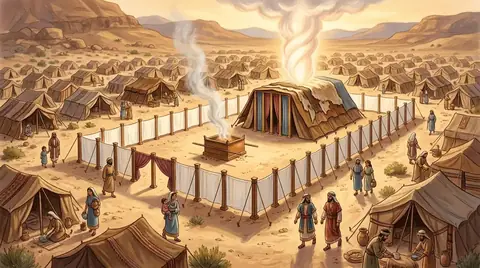 Thing · WorshipThe tabernacleThe holy tent Israel built in the wilderness, by God's own pattern, so that he could dwell in the middle of his people.…
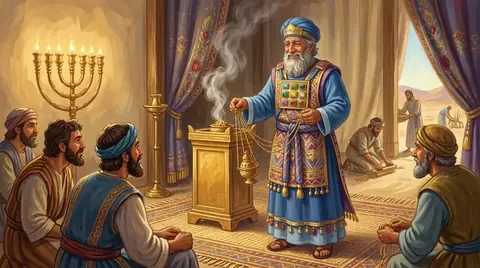 PersonAaronMoses' older brother and Israel's first high priest. He spoke for Moses before Pharaoh and served God at the tabernacle…
 Person · ProphetIsaiahThe prophet of Jerusalem who served four kings, saw the LORD on his throne, and foretold the virgin's son, the…
Written for this app in its own words, from the Bible, with the facts checked against Bible dictionaries and encyclopedias: Easton's, Smith's, Fausset's, ISBE, Holman, the New Bible Dictionary, Vine's and the Thompson Chain topics.
