
Custom · Money
Money
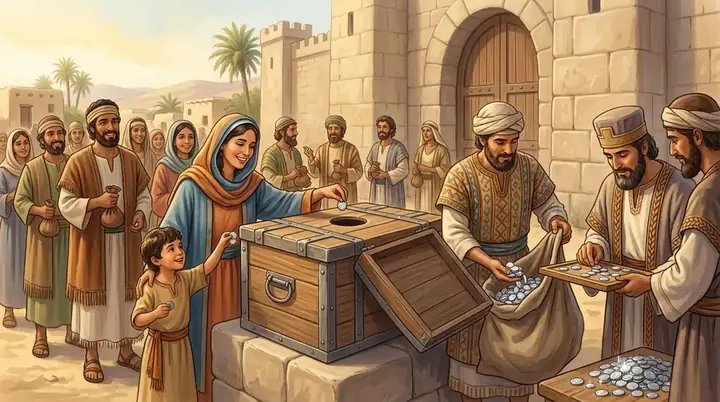
For most of Bible history money was silver weighed out by the shekel, not coins. Coins came in after the exile; in Jesus' day Roman, Greek and Jewish coins all passed from hand to hand.
- Old Testament
- Silver and gold by weight: gerah, shekel, mina, talent
- First coins
- Persian darics after the exile (Ezra 2:69; Nehemiah 7:70)
- New Testament
- Roman denarius (the "penny"), Greek drachma, the temple half-shekel, copper mites
Weighed, not counted
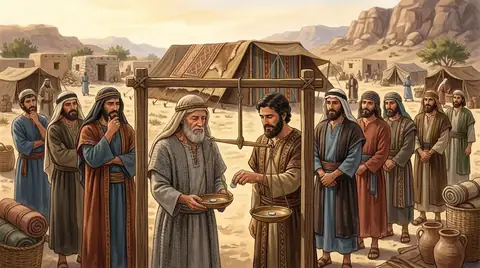
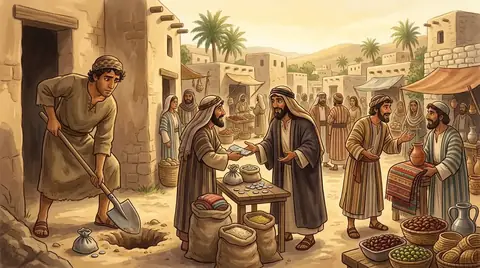
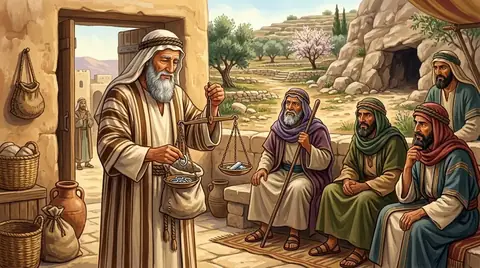
Abraham was rich in silver and gold (Genesis 13:2), but he had no coins. When he bought the cave of Machpelah he "weighed" out four hundred shekels of silver (Genesis 23:16). A shekel was a weight, about two-fifths of an ounce (11 g), and merchants carried scales and stone weights in a bag. Honest weights were a matter of law (Leviticus 19:36), and the prophets attacked traders who made the shekel heavy and the measure small (Amos 8:5). Joseph's brothers carried silver in their sacks; Jeremiah weighed out seventeen shekels for a field (Jeremiah 32:9–10).
Coins
Stamped coins first appear after the exile, when the Jews lived under Persia and used its gold daric (Ezra 8:27). Greek coins followed, and in the time of the Maccabees the Jews struck shekels of their own. In the Gospels the common coin is the Roman denarius, a day's wage, which the KJV calls a penny (Matthew 20:2). It bore Caesar's head, which is why Jesus asked for one when he was questioned about taxes (Matthew 22:19–21). Every Jewish man paid a half-shekel each year to the temple (Exodus 30:13; Matthew 17:24), and money changers turned foreign coins into it. The poor widow's two mites were the smallest coins of all (Mark 12:42).
What the Bible says about it
Money is useful and not evil in itself; it buys food, pays wages and builds the house of God (2 Kings 12:9–12). But the love of it "is the root of all evil" (1 Timothy 6:10). Judas sold his master for thirty pieces of silver (Matthew 26:15), and Simon the sorcerer tried to buy God's gift with it (Acts 8:20). Jesus said no one can serve both God and mammon (Matthew 6:24), and Isaiah invites all who are thirsty to come and buy "without money and without price" (Isaiah 55:1).
Key verses
- Genesis 23:16
And Abraham hearkened unto Ephron; and Abraham weighed to Ephron the silver, which he had named in the audience of the sons of Heth, four hundred shekels of silver, current money with the merchant.
- Amos 8:5
Saying, When will the new moon be gone, that we may sell corn? and the sabbath, that we may set forth wheat, making the ephah small, and the shekel great, and falsifying the balances by deceit?
- Matthew 22:19–21
Shew me the tribute money. And they brought unto him a penny. And he saith unto them, Whose is this image and superscription? They say unto him, Cesar’s. Then saith he unto them, Render therefore unto Cesar the things which are Cesar’s; and unto God the things that are God’s.
- Mark 12:42
And there came a certain poor widow, and she threw in two mites, which make a farthing.
- 1 Timothy 6:10
For the love of money is the root of all evil: which while some coveted after, they have erred from the faith, and pierced themselves through with many sorrows.
- Isaiah 55:1
Ho, every one that thirsteth, come ye to the waters, and he that hath no money; come ye, buy, and eat; yea, come, buy wine and milk without money and without price.
Read next
 Measure · MoneyShekelThe basic weight of the Old Testament, about 11 grams (0.4 oz); then a lump of silver of that weight used as money long…Measure · MoneyMina (pound)A weight equal to fifty shekels (sixty in Ezekiel), about a pound and a quarter (570 g). In Jesus' parable of the…
 Measure · WeightTalentThe heaviest weight in the Bible, about 75 pounds (34 kg), and so also the largest sum of money. A talent of silver was…Thing · MoneyMiteThe smallest copper coin in use in Jesus' day, the Greek lepton. A poor widow dropped two of them into the temple…
 PersonAbrahamThe man God called out of Ur to a land he had never seen, promising him a people and a blessing for the whole world. He…
 PlaceMachpelahThe cave near Hebron that Abraham bought as a grave for Sarah. Abraham, Isaac, Rebekah, Jacob and Leah were all buried…
 PersonJosephJacob's favourite son, sold by his brothers into Egypt, where he rose from prison to rule the land and saved his family…
 PersonJeremiahThe prophet who warned Judah for forty years that Babylon was coming, and wept as it came. He was beaten, put in the…
Written for this app in its own words, from the Bible, with the facts checked against Bible dictionaries and encyclopedias: Easton's, Smith's, Fausset's, ISBE, Holman, the New Bible Dictionary, Vine's and the Thompson Chain topics.
