
Word · Greek
Love: agapaō, love that gives itself
ag-ap-AH-ohGreek agapaō (verb), agapē (noun) · "charity" in the KJV of 1 Corinthians 13
The New Testament's chief word for love: a love that decides to seek another's good and pays whatever it costs, as God loved the world and gave his Son. Not a feeling first, but a choice.
- Greek
- Agapaō, to love; agapē, love
- Where
- John 3:16; John 21:15–16; Romans 5:8; 1 Corinthians 13; 1 John 4:8–10
What the word means
Greek had several words for love. Erōs, desire, is not in the New Testament at all. Phileō is warm liking, the love of friends (see Love: phileō, warm affection). Agapaō was a quieter word, and the Christians filled it with new meaning: the love that wills the good of another and acts on it, whether or not the other deserves it or returns it. Its clearest definition is a deed: "God so loved the world, that he gave" (John 3:16). "Herein is love, not that we loved God, but that he loved us, and sent his Son" (1 John 4:10).
Why it matters
Because it is a choice and not a mood, this love can be commanded. Jesus tells us to love our enemies (Matthew 5:44), which no one can do by liking them. Husbands are to love their wives as Christ loved the church and gave himself for it (Ephesians 5:25). It is the first fruit of the Spirit (Galatians 5:22), and Paul's hymn to it in 1 Corinthians 13, where the KJV says "charity", lists what it does and does not do.
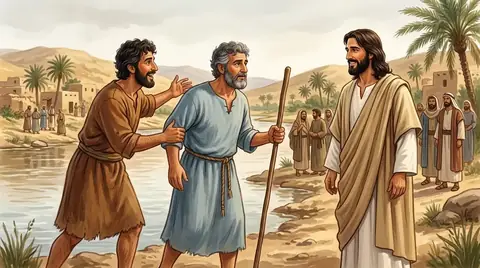
Peter by the lake
After the resurrection Jesus asked Peter, "Lovest thou me?", using agapaō; Peter answered with phileō, "I am fond of you", as if he dared not claim the greater word after denying him. Jesus asked again with agapaō, and Peter again answered with phileō. The third time Jesus came down to Peter's word, and Peter was grieved (John 21:15–17). Many readers see in the change Jesus meeting Peter where he was, and then sending him to feed his sheep.
Key verses
- John 3:16
For God so loved the world, that he gave his only begotten Son, that whosoever believeth in him should not perish, but have everlasting life.
- John 21:15–17
So when they had dined, Jesus saith to Simon Peter, Simon, son of Jonas, lovest thou me more than these? He saith unto him, Yea, Lord; thou knowest that I love thee. He saith unto him, Feed my lambs. He saith to him again the second time, Simon, son of Jonas, lovest thou me? He saith unto him, Yea, Lord; thou knowest that I love thee. He saith unto him, Feed my sheep. He saith unto him the third time, Simon, son of Jonas, lovest thou me? Peter was grieved because he said unto him the third time, Lovest thou me? And he said unto him, Lord, thou knowest all things; thou knowest that I love thee. Jesus saith unto him, Feed my sheep.
- 1 Corinthians 13:4–7
Charity suffereth long, and is kind; charity envieth not; charity vaunteth not itself, is not puffed up, Doth not behave itself unseemly, seeketh not her own, is not easily provoked, thinketh no evil; Rejoiceth not in iniquity, but rejoiceth in the truth; …
- 1 John 4:10
Herein is love, not that we loved God, but that he loved us, and sent his Son to be the propitiation for our sins.
Read next
Written for this app in its own words, from the Bible, with the facts checked against Bible dictionaries and encyclopedias: Easton's, Smith's, Fausset's, ISBE, Holman, the New Bible Dictionary, Vine's and the Thompson Chain topics.
