
Person
Haman
HAY-manOld Testament · in Persia, about 474 BC
The proud prime minister of King Ahasuerus of Persia, who plotted to kill every Jew in the empire because Mordecai would not bow to him. Esther exposed him, and he was hanged on his own gallows.
- Family
- Son of Hammedatha, an Agagite (of the royal line of Amalek). Wife Zeresh; ten sons
- Known for
- The plot to destroy the Jews; hanged on the gallows he built for Mordecai
- Remembered at
- The feast of Purim, named from the lot (pur) he cast (Esther 9:24–26)
His rise and his hate
King Ahasuerus promoted Haman above all his princes, and ordered everyone at the palace gate to bow to him. Mordecai the Jew would not. Haman was furious, and when he learned Mordecai's people, he decided to destroy not one man but every Jew in the empire. He cast lots to pick the day, told the king the Jews were a people who kept their own laws and were not worth keeping, and offered a huge sum of silver for the right to wipe them out. The king gave him his ring, and letters went out to every province to kill the Jews on the thirteenth of the month Adar (Esther 3).
His fall
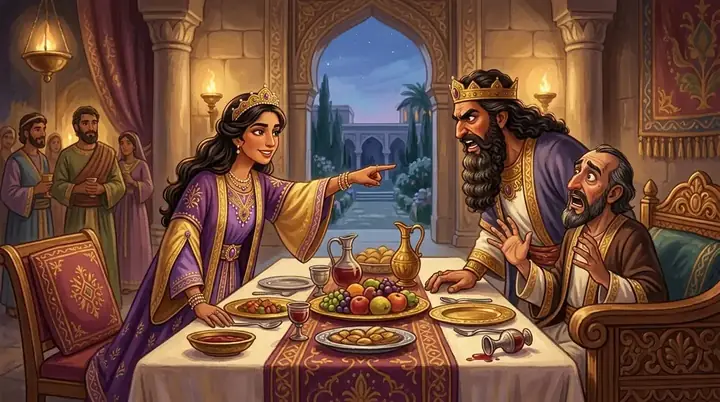
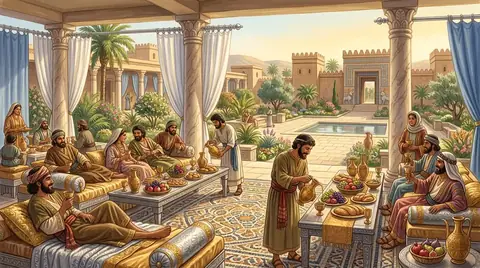
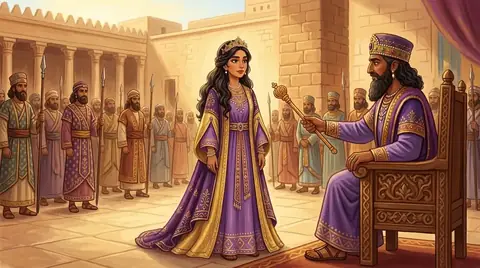
Esther invited the king and Haman to two banquets. Between them, Haman, boasting to his friends of his wealth and honour, built a gallows seventy-five feet (23 m) high to hang Mordecai on. But that night the king could not sleep, had the records read, and found that Mordecai had once saved his life. In the morning Haman came to ask for Mordecai's death and instead was ordered to lead him through the city in royal robes, crying, "Thus shall it be done to the man whom the king delighteth to honour" (Esther 6:11). At the second banquet Esther told the king that she and her people were to be killed, and named Haman as the enemy. The king had him hanged on his own gallows, gave his house to Esther and his position to Mordecai (Esther 7–8). His ten sons were killed on the day he had chosen for the Jews (Esther 9:10).
What to learn
Haman is the picture of pride that cannot bear one man's refusal, and of hatred that grows into a plan for murder. The Bible does not name God once in Esther, yet every turn of the story shows his hand. "Pride goeth before destruction", says the proverb (Proverbs 16:18); Haman dug a pit and fell into it.
Key verses
- Esther 3:5–6
And when Haman saw that Mordecai bowed not, nor did him reverence, then was Haman full of wrath. And he thought scorn to lay hands on Mordecai alone; for they had shewed him the people of Mordecai: wherefore Haman sought to destroy all the Jews that were throughout the whole kingdom of Ahasuerus, even the people of Mordecai.
- Esther 6:11
Then took Haman the apparel and the horse, and arrayed Mordecai, and brought him on horseback through the street of the city, and proclaimed before him, Thus shall it be done unto the man whom the king delighteth to honour.
- Esther 7:9–10
And Harbonah, one of the chamberlains, said before the king, Behold also, the gallows fifty cubits high, which Haman had made for Mordecai, who had spoken good for the king, standeth in the house of Haman. Then the king said, Hang him thereon. So they hanged Haman on the gallows that he had prepared for Mordecai. Then was the king’s wrath pacified.
- Proverbs 16:18
Pride goeth before destruction, and an haughty spirit before a fall.
Family
- Parents
- Hammedatha
- Married to
- Zeresh
- Children
- Parshandatha, Dalphon, Aspatha, Poratha, Adalia, Aridatha, Parmashta, Arisai, Aridai, Vaizatha
Mentioned in 45 verses
- Esther 45
Read next
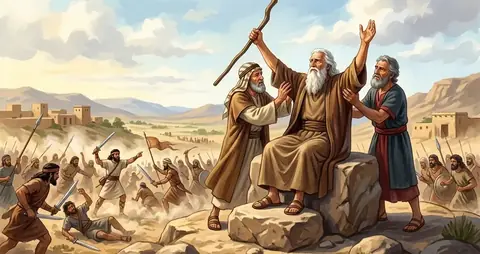 Person · NationAmalekThe grandson of Esau and the desert tribe descended from him, Israel's bitter enemy. The Amalekites attacked Israel on…
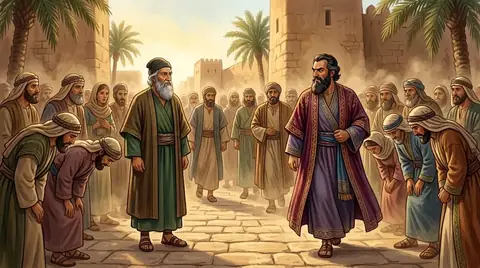 PersonMordecaiThe Jew who raised his cousin Esther, refused to bow to Haman, and with Esther saved the Jews of Persia from being…
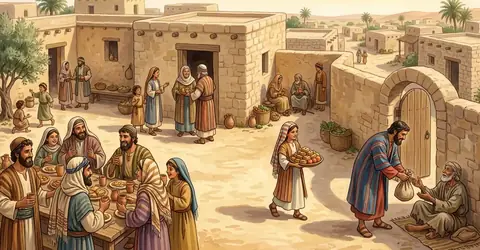 FeastPurimThe feast that remembers how the Jews of Persia escaped Haman's plot, the story the book of Esther tells. Named after…
 Person · KingAhasuerusThe king of Persia in the book of Esther, who put away Queen Vashti, made Esther his queen, and was tricked by Haman…
 PersonEstherA Jewish orphan who became queen of Persia and risked her life to stop Haman's plan to kill every Jew in the empire.…PersonHammedathaThe father of Haman, who schemed to wipe out the Jews in the book of Esther. He is called the Agagite, which links the…PersonZereshThe wife of Haman, the enemy of the Jews in the book of Esther. She urged him to build a gallows for Mordecai, and…PersonParshandathaThe first named of the ten sons of Haman, who were killed in Shushan on the day their father had chosen for the…
Written for this app in its own words, from the Bible, with the facts checked against Bible dictionaries and encyclopedias: Easton's, Smith's, Fausset's, ISBE, Holman, the New Bible Dictionary, Vine's and the Thompson Chain topics. People and places: STEPBible.org (TIPNR), CC BY 4.0; where a place is today and its photo: OpenBible.info, CC BY 4.0.
