
Measure · Weight
Gerah and bekah
GAY-ra, BEE-ka
The two small Hebrew weights of silver: the gerah (0.6 g, twenty to the shekel) and the bekah, a half-shekel of about 5.7 g, the sum each Israelite man paid when the tabernacle was built.
- Gerah
- A twentieth part of the shekel: a fiftieth of an ounce (0.6 g)
- Bekah
- A half-shekel: a fifth of an ounce (5.7 g)
- Where
- Exodus 30:13; Exodus 38:26; Leviticus 27:25; Numbers 3:47; Ezekiel 45:12
What they were
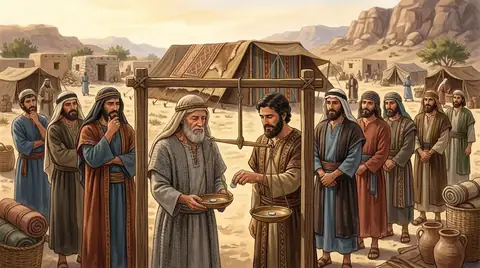
Silver was weighed, not counted, so the law fixed the standard: "the shekel is twenty gerahs" (Exodus 30:13). The gerah, named from a small seed used on the scales, was the smallest unit. The bekah, whose name means "a split", was a shekel cut in two. The first bekah in the Bible is the gold ring Abraham's servant gave Rebekah at the well (Genesis 24:22).
The half-shekel
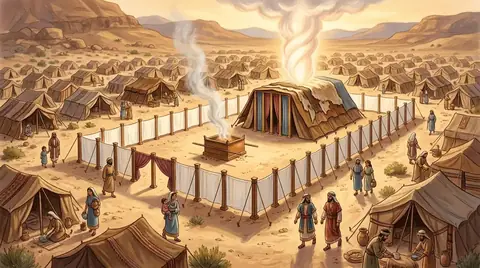
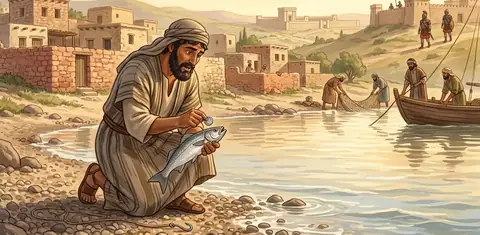
When Moses counted Israel, every man over twenty paid "half a shekel after the shekel of the sanctuary" as a ransom for his life, rich and poor alike (Exodus 30:11–16). From 603,550 men came about 100 talents of silver, enough to cast the hundred sockets that held up the tabernacle walls, so that the whole tent stood on the people's ransom money (Exodus 38:25–28). Later the half-shekel became a yearly temple tax (2 Chronicles 24:6–9; Nehemiah 10:32), and it was this that Peter paid with the coin from the fish's mouth (Matthew 17:24–27).
Key verses
- Exodus 30:13–15
This they shall give, every one that passeth among them that are numbered, half a shekel after the shekel of the sanctuary: (a shekel is twenty gerahs:) an half shekel shall be the offering of the Lord. Every one that passeth among them that are numbered, from twenty years old and above, shall give an offering unto the Lord. The rich shall not give more, and the poor shall not give less than half a shekel, when they give an offering unto the Lord, to make an atonement for your souls.
- Exodus 38:26
A bekah for every man, that is, half a shekel, after the shekel of the sanctuary, for every one that went to be numbered, from twenty years old and upward, for six hundred thousand and three thousand and five hundred and fifty men.
- Matthew 17:24–27
And when they were come to Capernaum, they that received tribute money came to Peter, and said, Doth not your master pay tribute? He saith, Yes. And when he was come into the house, Jesus prevented him, saying, What thinkest thou, Simon? of whom do the kings of the earth take custom or tribute? of their own children, or of strangers? Peter saith unto him, Of strangers. Jesus saith unto him, Then are the children free. …
Read next
 Measure · MoneyShekelThe basic weight of the Old Testament, about 11 grams (0.4 oz); then a lump of silver of that weight used as money long…
 ThingScalesIn the Bible, the scales of fish, which marked them as clean to eat; the scales of a weighing balance; and the "scales"…
 PersonRebekahIsaac's wife, found for him at a well far away in Abraham's homeland. She was told before her twins were born that the…
 PersonMosesThe man God used to bring Israel out of Egypt, give them his Law at Sinai, and lead them for forty years in the…TeachingRansomA price paid to set someone free. Jesus said he came to give his life "a ransom for many": his death is the price that…
 Thing · WorshipThe tabernacleThe holy tent Israel built in the wilderness, by God's own pattern, so that he could dwell in the middle of his people.…
 Custom · LawThe temple taxHalf a shekel a year from every Jewish man for the upkeep of God's house, first paid in the wilderness as a ransom for…
Written for this app in its own words, from the Bible, with the facts checked against Bible dictionaries and encyclopedias: Easton's, Smith's, Fausset's, ISBE, Holman, the New Bible Dictionary, Vine's and the Thompson Chain topics.
