
Custom · Law
The temple tax
Half a shekel a year from every Jewish man for the upkeep of God's house, first paid in the wilderness as a ransom for each life. Jesus settled it for Peter and himself with a coin taken from a fish's mouth.
- Amount
- Half a shekel, two drachmas in Jesus' day: about two days' wages
- Who paid
- Every man of twenty and over, rich and poor alike (Exodus 30:15)
- Where
- Exodus 30:11–16; 2 Chronicles 24:6–9; Nehemiah 10:32; Matthew 17:24–27
Where it began
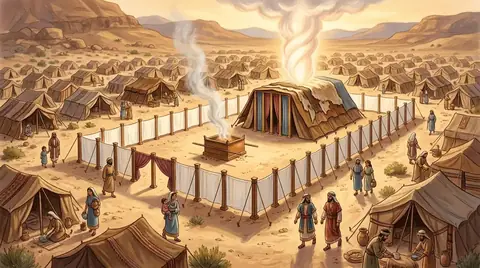
When Israel was counted in the wilderness, God told Moses that each man was to give half a shekel "a ransom for his soul", so that no plague would come on them for the counting (Exodus 30:11–16). The rich were not to give more nor the poor less: every life was worth the same before God. The silver, over 100 talents of it, went into the sockets of the tabernacle (Exodus 38:25–27). The house of God rested, quite literally, on the ransom paid for every one of his people.
In the temple
Later it became a yearly tax. King Joash revived "the collection that Moses laid upon Israel" to repair the temple, with a chest at the gate (2 Chronicles 24:6–9). After the exile, when the people were poor, Nehemiah had them pledge a third of a shekel a year for the services of God's house (Nehemiah 10:32). By Jesus' day it was back to half a shekel, two Greek drachmas, gathered every spring from Jews everywhere in the world and carried to Jerusalem in guarded convoys. Priests held themselves exempt.
Jesus pays it
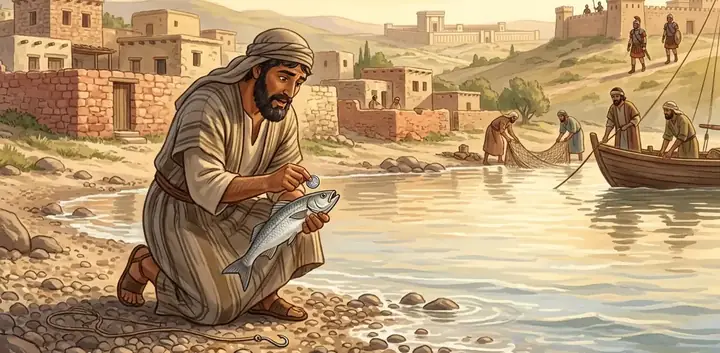
At Capernaum the collectors asked Peter whether his master paid the two-drachma tax. Peter said yes. Jesus, before Peter could speak, asked him whose children kings tax, their own or strangers'. Strangers', Peter said. "Then are the children free," said Jesus: the Son of God owed nothing to his Father's house. But so as not to offend, he sent Peter to the lake to catch a fish, and in its mouth was a stater, a coin worth four drachmas, exactly enough for the two of them (Matthew 17:24–27). He paid the ransom money for a life that needed no ransom, and paid Peter's with it.
Key verses
- Exodus 30:12–16
When thou takest the sum of the children of Israel after their number, then shall they give every man a ransom for his soul unto the Lord, when thou numberest them; that there be no plague among them, when thou numberest them. This they shall give, every one that passeth among them that are numbered, half a shekel after the shekel of the sanctuary: (a shekel is twenty gerahs:) an half shekel shall be the offering of the Lord. Every one that passeth among them that are numbered, from twenty years old and above, shall give an offering unto the Lord. …
- 2 Chronicles 24:6–9
And the king called for Jehoiada the chief, and said unto him, Why hast thou not required of the Levites to bring in out of Judah and out of Jerusalem the collection, according to the commandment of Moses the servant of the Lord, and of the congregation of Israel, for the tabernacle of witness? For the sons of Athaliah, that wicked woman, had broken up the house of God; and also all the dedicated things of the house of the Lord did they bestow upon Baalim. And at the king’s commandment they made a chest, and set it without at the gate of the house of the Lord. …
- Nehemiah 10:32
Also we made ordinances for us, to charge ourselves yearly with the third part of a shekel for the service of the house of our God;
- Matthew 17:24–27
And when they were come to Capernaum, they that received tribute money came to Peter, and said, Doth not your master pay tribute? He saith, Yes. And when he was come into the house, Jesus prevented him, saying, What thinkest thou, Simon? of whom do the kings of the earth take custom or tribute? of their own children, or of strangers? Peter saith unto him, Of strangers. Jesus saith unto him, Then are the children free. …
Read next
 PersonMosesThe man God used to bring Israel out of Egypt, give them his Law at Sinai, and lead them for forty years in the…
 Thing · WorshipThe tabernacleThe holy tent Israel built in the wilderness, by God's own pattern, so that he could dwell in the middle of his people.…
 PersonJoashThe baby prince hidden in the temple for six years and crowned at seven. He repaired the temple while the priest…
 PersonNehemiahThe king of Persia's cupbearer who got leave to go to Jerusalem and rebuilt its broken walls in fifty-two days, despite…
 PlaceCapernaumA fishing town on the north shore of the Sea of Galilee that Jesus made his home. He taught in its synagogue and did…
 PersonPeterA Galilean fisherman who became the leader of the twelve apostles. Bold and impulsive, he confessed Jesus as the…
Written for this app in its own words, from the Bible, with the facts checked against Bible dictionaries and encyclopedias: Easton's, Smith's, Fausset's, ISBE, Holman, the New Bible Dictionary, Vine's and the Thompson Chain topics.
