
Money
Farthing
The two smallest Roman coins
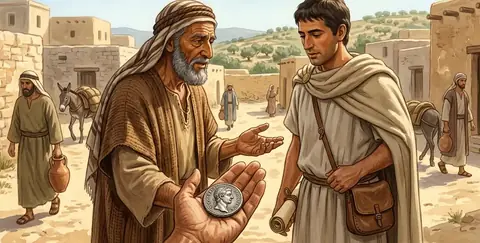
The English word for two small copper coins of Roman times: the assarion, the price of two sparrows, and the quadrans, worth two mites. Jesus used both to speak of small things that matter to God.
- Assarion
- A copper coin, a small fraction of a denarius, the day's wage (Matthew 10:29; Luke 12:6)
- Quadrans
- A quarter of an assarion, worth two mites (Matthew 5:26; Mark 12:42)
What it was
Two different Greek coins are both called a farthing in the King James Bible, after the smallest English coin of its day. The assarion was a copper coin worth about a sixteenth of a denarius, the wage for a day's work; two sparrows were sold for one, or five for two (Matthew 10:29; Luke 12:6). The quadrans was smaller still, a quarter of an assarion, and the least coin the Romans minted. The widow's two mites made one quadrans (Mark 12:42).
In Jesus' teaching
Jesus made these tiny coins carry big truths. Sparrows cost next to nothing, yet not one falls without the Father; so "ye are of more value than many sparrows" (Matthew 10:29–31). A man who will not settle with his accuser will stay in prison until he has paid "the uttermost farthing" (Matthew 5:26): God's justice counts every penny. And the widow's farthing, all she had, was worth more in Jesus' eyes than the rich men's large gifts (Mark 12:43–44).
Key verses
- Matthew 10:29
Are not two sparrows sold for a farthing? and one of them shall not fall on the ground without your Father.
- Matthew 5:26
Verily I say unto thee, Thou shalt by no means come out thence, till thou hast paid the uttermost farthing.
- Mark 12:42
And there came a certain poor widow, and she threw in two mites, which make a farthing.
- Luke 12:6
Are not five sparrows sold for two farthings, and not one of them is forgotten before God?
Read next
Written for this app in its own words, from the Bible, with the facts checked against Bible dictionaries and encyclopedias: Easton's, Smith's, Fausset's, ISBE, Holman, the New Bible Dictionary, Vine's and the Thompson Chain topics.
