
Custom · Rome
Crucifixion
The Roman way of executing slaves, rebels and the worst criminals: flogged, nailed or tied to a cross outside the city, and left there to die in full view. Jesus died this way, and Paul preached "Christ crucified".
- Used by
- Persians, Carthaginians and above all the Romans; never by the law of Moses, which punished by stoning, the sword or fire
- Jesus' crucifixion
- Matthew 27; Mark 15; Luke 23; John 19
- Its meaning
- Galatians 3:13; 1 Corinthians 1:23; Philippians 2:8
What it was
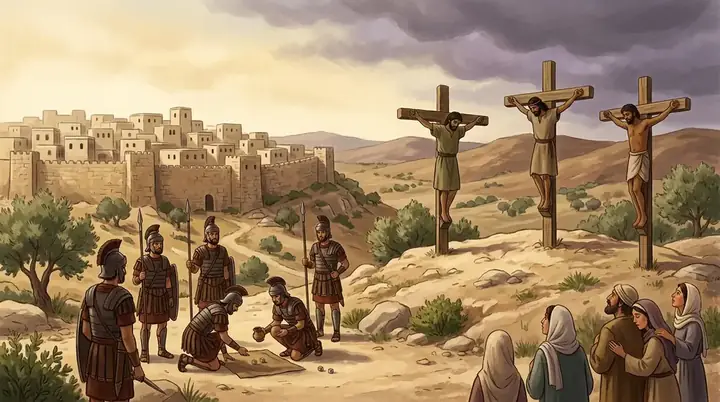
Crucifixion was meant to be as painful and as public as possible. The victim was first scourged with a whip of knotted leather, then made to carry the crossbeam through the streets to a place of execution outside the walls. There he was stripped, fixed to the beam by nails through the wrists or by ropes, and hoisted onto the upright post, where he hung for hours or days until exhaustion and suffocation killed him. A notice stated his crime. Roman citizens were almost never crucified; it was for slaves, bandits and rebels against Rome, and the Jews felt its horror doubly, since their law declared anyone hanged on a tree to be cursed by God (Deuteronomy 21:23). The soldiers could hasten death by breaking the legs, so that the victim could no longer push himself up to breathe (John 19:31–32).
The crucifixion of Jesus
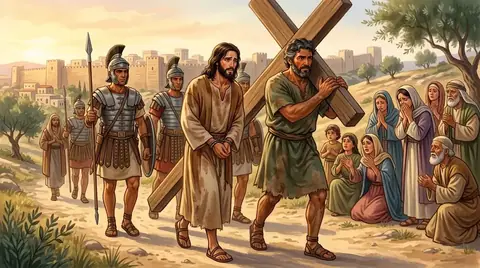
Every detail of the gospel accounts fits what we know of Roman practice. Pilate had Jesus scourged (John 19:1). He carried his cross until Simon of Cyrene was made to take it (Luke 23:26). At Golgotha he was offered wine mixed with myrrh to dull the pain and refused it (Mark 15:23). He was crucified between two robbers at the third hour, about nine in the morning (Mark 15:25–27); four soldiers divided his clothes and cast lots for his seamless coat (John 19:23–24). Darkness covered the land from noon until three, when he cried out and died (Mark 15:33–37). Because the Sabbath was near, the soldiers broke the legs of the two robbers, but Jesus was already dead, so they did not break his; instead one of them pierced his side with a spear, and blood and water came out (John 19:31–37). Not a bone of the Passover lamb was to be broken (Exodus 12:46).
Why he died this way
Jesus had said that he would be "lifted up" and that he would be killed by the Gentiles (John 12:32–33; Mark 10:33–34). Peter told the crowd at Pentecost that he was delivered up by God's set purpose and foreknowledge, and that they had crucified him by wicked hands (Acts 2:23). Paul saw the curse of Deuteronomy as the heart of it: Christ redeemed us from the curse of the law by becoming a curse for us (Galatians 3:13). He humbled himself to death, "even the death of the cross" (Philippians 2:8), and that shameful death became the message: "we preach Christ crucified" (1 Corinthians 1:23).
For us
Paul says the believer is crucified with Christ (Galatians 2:20) and has crucified the flesh with its passions (Galatians 5:24). The cross is where our sin was dealt with, and the shape of the life that follows.
Key verses
- Deuteronomy 21:23
His body shall not remain all night upon the tree, but thou shalt in any wise bury him that day; (for he that is hanged is accursed of God;) that thy land be not defiled, which the Lord thy God giveth thee for an inheritance.
- Mark 15:25
And it was the third hour, and they crucified him.
- John 19:18
Where they crucified him, and two other with him, on either side one, and Jesus in the midst.
- Acts 2:23
Him, being delivered by the determinate counsel and foreknowledge of God, ye have taken, and by wicked hands have crucified and slain:
- 1 Corinthians 1:23
But we preach Christ crucified, unto the Jews a stumblingblock, and unto the Greeks foolishness;
- Galatians 3:13
Christ hath redeemed us from the curse of the law, being made a curse for us: for it is written, Cursed is every one that hangeth on a tree:
Read next
 PersonMosesThe man God used to bring Israel out of Egypt, give them his Law at Sinai, and lead them for forty years in the…
 PersonPilateThe Roman governor of Judea who tried Jesus. He said three times that he found no fault in him, yet handed him over to…
 Custom · RomeCrossThe wooden post and crossbeam on which the Romans executed criminals, and on which Jesus died. In the New Testament…
 PersonSimonA very common name in New Testament times. Besides Simon Peter, the Bible names a second apostle, a brother of Jesus…PlaceGolgothaThe place just outside Jerusalem where Jesus was crucified. Its Aramaic name means "the place of a skull"; Calvary is…
 Thing · WarSpearA long shaft with a sharp point of bronze or iron, the main weapon of foot soldiers. Goliath's was huge; Saul threw his…
 PersonPeterA Galilean fisherman who became the leader of the twelve apostles. Bold and impulsive, he confessed Jesus as the…
 PersonPaulA Pharisee who hated the church until the risen Jesus met him on the road to Damascus. He became the apostle to the…
Written for this app in its own words, from the Bible, with the facts checked against Bible dictionaries and encyclopedias: Easton's, Smith's, Fausset's, ISBE, Holman, the New Bible Dictionary, Vine's and the Thompson Chain topics.
