
Place
Golgotha
GOL-go-tha"The place of a skull" · in Latin, Calvary · just outside Jerusalem's walls
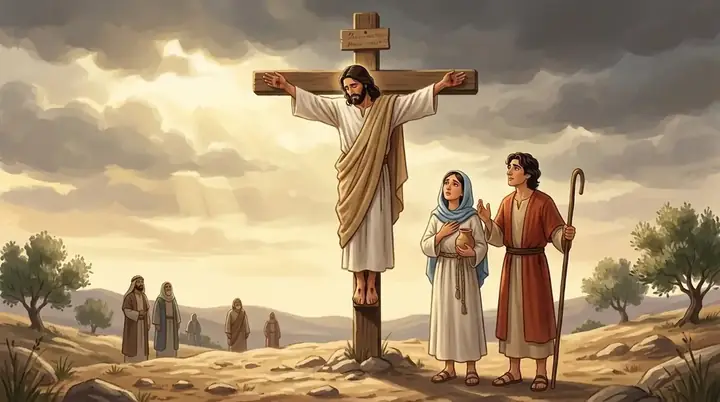
The place just outside Jerusalem where Jesus was crucified. Its Aramaic name means "the place of a skull"; Calvary is the Latin form of the same name.
- Meaning
- Skull, in Aramaic; Calvary in Latin (Luke 23:33)
- Where
- Outside the city gate, by a road, near a garden with a new tomb (John 19:17–20; John 19:41)
- Today
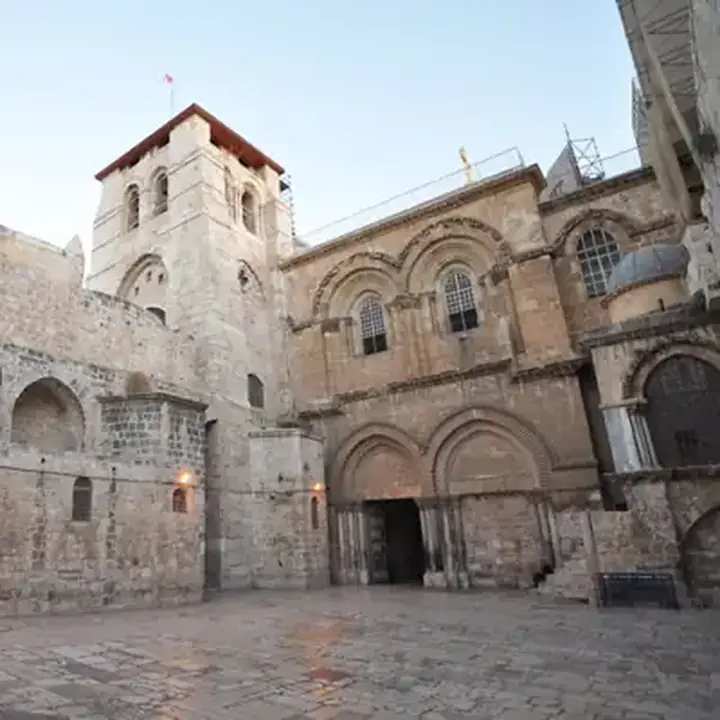
- Traditionally the Church of the Holy Sepulchre; some prefer the Garden Tomb hill
All four Gospels name the place where Jesus died. The soldiers led him out, Simon of Cyrene carrying the cross, to "a place called Golgotha, that is to say, a place of a skull" (John 19:17; Mark 15:22; Matthew 27:33). Why it had that name the Bible doesn't say: perhaps a bare, rounded hill, perhaps a place of execution. It was outside the walls yet close to the city, by a busy road, and nearby was a garden with the new tomb in which Jesus was buried (John 19:20; John 19:41–42).
The letter to the Hebrews sees meaning in this: as the bodies of the sin offerings were burned outside the camp, Jesus "suffered without the gate", so that he might make his people holy through his own blood (Hebrews 13:12). Since the fourth century Christians have honoured the site now inside the Church of the Holy Sepulchre.
Key verses
- Matthew 27:33
And when they were come unto a place called Golgotha, that is to say, a place of a skull,
- Mark 15:22
And they bring him unto the place Golgotha, which is, being interpreted, The place of a skull.
- Luke 23:33
And when they were come to the place, which is called Calvary, there they crucified him, and the malefactors, one on the right hand, and the other on the left.
- John 19:17
And he bearing his cross went forth into a place called the place of a skull, which is called in the Hebrew Golgotha:
- Hebrews 13:12
Wherefore Jesus also, that he might sanctify the people with his own blood, suffered without the gate.
On the map
Mentioned in 4 verses
- Matthew 1
- Mark 1
- Luke 1
- John 1
Written for this app in its own words, from the Bible, with the facts checked against Bible dictionaries and encyclopedias: Easton's, Smith's, Fausset's, ISBE, Holman, the New Bible Dictionary, Vine's and the Thompson Chain topics. People and places: STEPBible.org (TIPNR), CC BY 4.0; where a place is today and its photo: OpenBible.info, CC BY 4.0.
