
Saying · Custom
Wash the hands (innocence)
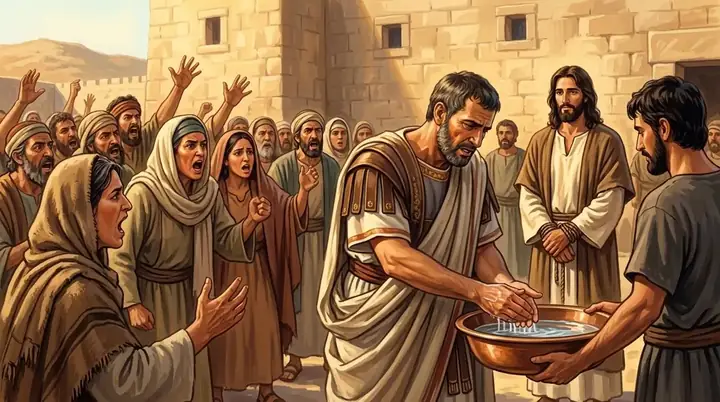
Washing the hands in public was a way of saying "I had no part in this". Pilate did it to disown the death of Jesus, though the sentence was his.
- Law
- Deuteronomy 21:6–7, for an unsolved murder
- Famous case
- Pilate (Matthew 27:24)
In the law
If a body was found in the open country and no one knew who had killed the man, the elders of the nearest town were to break a heifer's neck in a valley and wash their hands over it, declaring, "Our hands have not shed this blood, neither have our eyes seen it" (Deuteronomy 21:6–7). The washing was a sign: the town took no guilt for the blood. David uses the same picture of a clear conscience, "I will wash mine hands in innocency" (Psalms 26:6), and so does Asaph (Psalms 73:13).
Pilate
When the crowd in Jerusalem would not be moved, Pilate "took water, and washed his hands before the multitude, saying, I am innocent of the blood of this just person" (Matthew 27:24). The people answered that the blood could be on them and their children. But the water cleared nothing. Pilate had found Jesus guilty of no crime and still gave the order, and the cross was his doing as much as theirs. Clean hands are not made by a basin but by a right heart; only the blood of Jesus can do that (1 John 1:7). See also Washing.
Key verses
- Deuteronomy 21:6–7
And all the elders of that city, that are next unto the slain man, shall wash their hands over the heifer that is beheaded in the valley: And they shall answer and say, Our hands have not shed this blood, neither have our eyes seen it.
- Psalms 26:6
I will wash mine hands in innocency: so will I compass thine altar, O Lord:
- Matthew 27:24
When Pilate saw that he could prevail nothing, but that rather a tumult was made, he took water, and washed his hands before the multitude, saying, I am innocent of the blood of this just person: see ye to it.
Read next
 PersonPilateThe Roman governor of Judea who tried Jesus. He said three times that he found no fault in him, yet handed him over to…
 Custom · RomeCrossThe wooden post and crossbeam on which the Romans executed criminals, and on which Jesus died. In the New Testament…
 CustomWashingWashing in the Bible is both ordinary cleanliness and a religious act. The law required it for priests and for the…
Written for this app in its own words, from the Bible, with the facts checked against Bible dictionaries and encyclopedias: Easton's, Smith's, Fausset's, ISBE, Holman, the New Bible Dictionary, Vine's and the Thompson Chain topics.
