
Group · Trade
Smith
Old Testament · a worker in iron, bronze or gold
A craftsman who works metal at a forge. The Philistines once banned smiths in Israel so the Hebrews could not make weapons, and Babylon carried Judah's smiths into exile.
- First named
- Tubal-cain (Genesis 4:22)
- Known for
- Weapons, tools, and sometimes idols
- See also
- Iron, Bezalel
What it was
A smith heated metal in a charcoal fire, blowing up the coals with bellows, and hammered it into shape on an anvil. Genesis names Tubal-cain as the first to work in bronze and iron (Genesis 4:22). God filled Bezalel with skill to work gold, silver and bronze for the tabernacle (Exodus 31:2–5).
In Israel's history
In Saul's day the Philistines made sure "there was no smith found throughout all the land of Israel", so that the Hebrews could not make swords or spears. Farmers had to go down to the Philistines even to sharpen a ploughshare or an axe (1 Samuel 13:19–20). Centuries later, when Nebuchadnezzar took Jerusalem, he carried off "all the craftsmen and smiths", leaving no one to forge weapons (2 Kings 24:14).
What it meant
The prophets mocked the smith who sweats over the coals to make an idol, and then bows down to it (Isaiah 44:12–17). Yet God said, "I have created the smith that bloweth the coals" (Isaiah 54:16): every craftsman and every weapon is in his hand, and "no weapon that is formed against thee shall prosper" (Isaiah 54:17).
Key verses
- 1 Samuel 13:19–20
Now there was no smith found throughout all the land of Israel: for the Philistines said, Lest the Hebrews make them swords or spears: But all the Israelites went down to the Philistines, to sharpen every man his share, and his coulter, and his axe, and his mattock.
- 2 Kings 24:14
And he carried away all Jerusalem, and all the princes, and all the mighty men of valour, even ten thousand captives, and all the craftsmen and smiths: none remained, save the poorest sort of the people of the land.
- Isaiah 44:12
The smith with the tongs both worketh in the coals, and fashioneth it with hammers, and worketh it with the strength of his arms: yea, he is hungry, and his strength faileth: he drinketh no water, and is faint.
- Isaiah 54:16–17
Behold, I have created the smith that bloweth the coals in the fire, and that bringeth forth an instrument for his work; and I have created the waster to destroy. No weapon that is formed against thee shall prosper; and every tongue that shall rise against thee in judgment thou shalt condemn. This is the heritage of the servants of the Lord, and their righteousness is of me, saith the Lord.
Read next
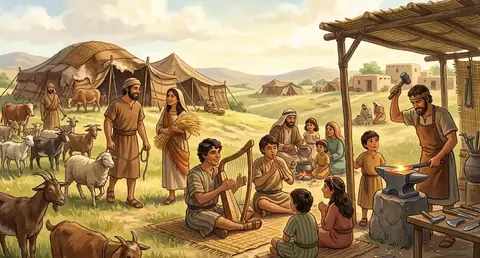 PersonTubal-cainA son of Lamech and Zillah, of the family of Cain, who worked bronze and iron. He is the first metalworker named in the…
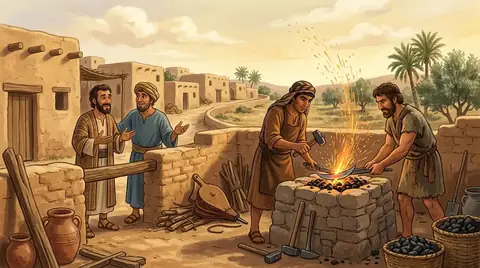 Thing · MetalIronThe hardest metal of Bible times, used for tools, weapons, chariots and chains. Israel lagged behind the Philistines in…
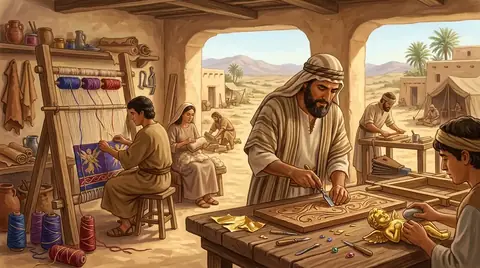 PersonBezalelThe craftsman from Judah whom God filled with his Spirit to make the tabernacle and everything in it, from the ark of…
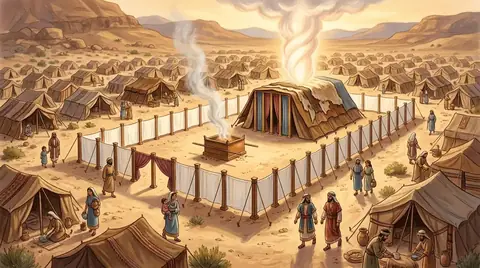 Thing · WorshipThe tabernacleThe holy tent Israel built in the wilderness, by God's own pattern, so that he could dwell in the middle of his people.…NationThe PhilistinesA warlike people from over the sea, settled in five cities on the coastal plain to the south-west of Israel. With iron…
 Person · KingNebuchadnezzarThe great king of Babylon who destroyed Jerusalem and its temple and carried Judah into exile. In Daniel he dreams of a…
Written for this app in its own words, from the Bible, with the facts checked against Bible dictionaries and encyclopedias: Easton's, Smith's, Fausset's, ISBE, Holman, the New Bible Dictionary, Vine's and the Thompson Chain topics.
