
Group · Jewish party
Sadducees
New Testament · the name probably comes from [Zadok], David's priest
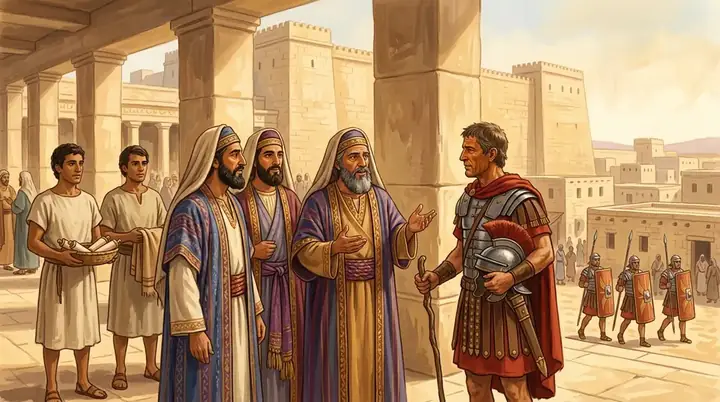
The wealthy priestly party that ran the temple in Jesus' day. They held only to the written Law, denied any resurrection or angels, and worked with Rome to keep their position.
- Who
- Rich priestly families and their allies; the high priests were mostly Sadducees
- Believed
- Only the books of Moses as final; no resurrection, angels or spirits
- Opposed
- John the Baptist, Jesus, and the apostles' preaching of the resurrection
- Rivals
- The Pharisees, who held the traditions and believed in the resurrection
Who they were
The Sadducees were the aristocrats of Jewish religion: a small circle of wealthy families, many of them priests, who controlled the temple and held a large share of the seats on the Sanhedrin. Their name is usually traced back to Zadok, the high priest under David and Solomon, whose line had served at the altar ever since. Because their power depended on the temple and on good relations with the Roman governor, they tended to be cautious, worldly and ready to cooperate with Rome.
What they believed
They accepted the written Law of Moses but rejected the mass of oral tradition that the Pharisees treasured. They did not believe in a resurrection, in a judgement after death, or in angels and spirits (Acts 23:8). This life, lived by the Law, was all there was. Jesus told them bluntly that they were wrong, "not knowing the scriptures, nor the power of God", and showed from the burning bush that God "is not the God of the dead, but of the living" (Matthew 22:23–33).
In the Gospels and Acts
They came to John the Baptist with the Pharisees and were called "a generation of vipers" (Matthew 3:7). They tested Jesus with a riddle about a woman married seven times (Mark 12:18–27). Jesus warned his disciples against their "leaven", their teaching (Matthew 16:6–12). The high priest's family who had Jesus arrested and condemned belonged to this party, and after Pentecost it was the Sadducees who were most angry at the apostles, because they "preached through Jesus the resurrection from the dead" (Acts 4:1–2; Acts 5:17). Paul, on trial before the council, split his judges by declaring himself a Pharisee on this very question (Acts 23:6–8). When the temple was destroyed in AD 70 the Sadducees lost everything their position rested on, and they disappear from history.
What to learn
A religion of this world only, without hope beyond death, ends in defending one's own position. Jesus' rising from the dead was the one thing they could not allow, and it is the one thing on which everything rests.
Key verses
- Matthew 3:7
But when he saw many of the Pharisees and Sadducees come to his baptism, he said unto them, O generation of vipers, who hath warned you to flee from the wrath to come?
- Matthew 22:23–33
The same day came to him the Sadducees, which say that there is no resurrection, and asked him, Saying, Master, Moses said, If a man die, having no children, his brother shall marry his wife, and raise up seed unto his brother. Now there were with us seven brethren: and the first, when he had married a wife, deceased, and, having no issue, left his wife unto his brother: …
- Acts 4:1–2
And as they spake unto the people, the priests, and the captain of the temple, and the Sadducees, came upon them, Being grieved that they taught the people, and preached through Jesus the resurrection from the dead.
- Acts 23:8
For the Sadducees say that there is no resurrection, neither angel, nor spirit: but the Pharisees confess both.
Read next
 PersonJohn the BaptistThe prophet God sent to prepare the way for Jesus. He called Israel to repent, baptized in the Jordan, pointed to Jesus…
 GroupPhariseesThe most exacting of the Jewish religious parties in Jesus' day, devoted to keeping the Law and the traditions added to…
 Thing · WorshipThe TempleGod's house in Jerusalem, where he was worshipped and the sacrifices offered. Solomon built it, Babylon burned it, the…
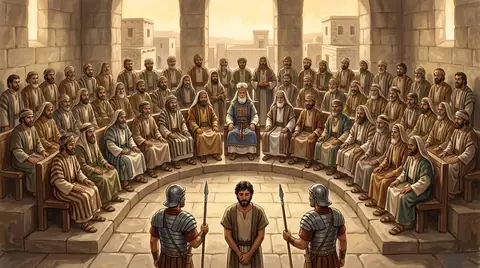 GroupThe council (Sanhedrin)The supreme Jewish court in Jerusalem, seventy-one chief priests, elders and scribes under the high priest. It…
 Person · KingDavidThe shepherd boy who killed Goliath and became Israel's greatest king, "a man after God's own heart". He wrote many…
 Person · KingSolomonDavid's son and Israel's third king, who asked God for wisdom and received riches and fame as well. He built the temple…
 PersonMosesThe man God used to bring Israel out of Egypt, give them his Law at Sinai, and lead them for forty years in the…
 PersonPaulA Pharisee who hated the church until the risen Jesus met him on the road to Damascus. He became the apostle to the…
Written for this app in its own words, from the Bible, with the facts checked against Bible dictionaries and encyclopedias: Easton's, Smith's, Fausset's, ISBE, Holman, the New Bible Dictionary, Vine's and the Thompson Chain topics.
