
Custom · Forbidden
Magic
Spells, charms, fortune-telling and calling up the dead, common among Israel's neighbours and strictly forbidden to God's people. The Bible treats it as rebellion against God, not a harmless trick.
- Forbidden in
- Leviticus 19:31; Deuteronomy 18:10–12; Galatians 5:20; Revelation 21:8
- Examples
- Egypt's magicians, the witch of Endor, Simon of Samaria, Elymas, the books burned at Ephesus
What it was
Every nation around Israel practised magic: reading omens in the stars or the liver of a sacrifice, casting spells, wearing charms, consulting household idols called teraphim, and asking the dead for guidance. In Egypt it was part of religion itself, and Pharaoh's magicians copied the first of Moses' signs before they had to confess, "This is the finger of God" (Exodus 7:11; Exodus 8:19). Balaam was a famous diviner hired to curse Israel (Numbers 22). The king of Babylon shook his arrows and looked at a liver to choose his road (Ezekiel 21:21).
What God said
The law was blunt. Israel was not to learn the practices of the nations: no one who used divination, told fortunes, cast spells, consulted mediums or asked the dead was to be found among them, "for all that do these things are an abomination unto the LORD" (Deuteronomy 18:9–12). Witchcraft was put on a level with rebellion (1 Samuel 15:23). King Saul cleared the mediums out of the land, then broke his own law by going at night to the witch of Endor, and was told his doom (1 Samuel 28). Magic kept creeping back under wicked kings like Manasseh (2 Kings 21:6), and the prophets mocked Babylon's sorcerers and star-gazers who could not save it (Isaiah 47:12–13).
In the New Testament
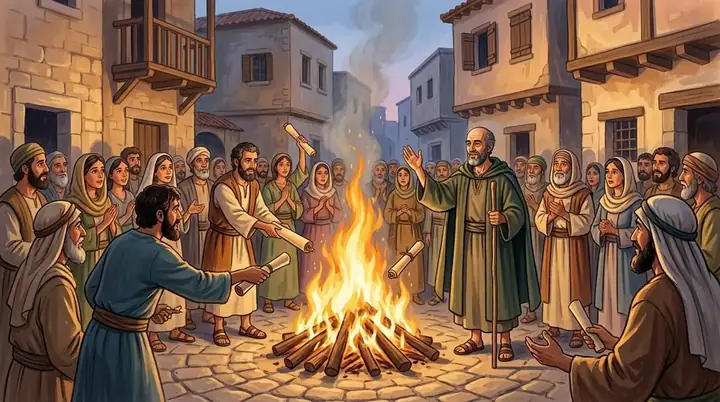
The wise men of Matthew 2 were star-watching scholars, not sorcerers. But Simon the sorcerer amazed Samaria with his magic until he saw the Spirit's real power and tried to buy it (Acts 8:9–24); the Jewish sorcerer Elymas opposed Paul in Cyprus and was struck blind (Acts 13:6–12); and at Ephesus, a city famous for charms, new believers burned their magic books, worth fifty thousand pieces of silver, in public (Acts 19:18–19). Paul lists witchcraft among the works of the flesh (Galatians 5:20), and Revelation puts sorcerers outside the holy city (Revelation 21:8). The reason is always the same: magic tries to bend hidden powers to our will, when we should trust God and ask him.
Key verses
- Exodus 8:19
Then the magicians said unto Pharaoh, This is the finger of God: and Pharaoh’s heart was hardened, and he hearkened not unto them; as the Lord had said.
- Deuteronomy 18:10–12
There shall not be found among you any one that maketh his son or his daughter to pass through the fire, or that useth divination, or an observer of times, or an enchanter, or a witch, Or a charmer, or a consulter with familiar spirits, or a wizard, or a necromancer. For all that do these things are an abomination unto the Lord: and because of these abominations the Lord thy God doth drive them out from before thee.
- 1 Samuel 15:23
For rebellion is as the sin of witchcraft, and stubbornness is as iniquity and idolatry. Because thou hast rejected the word of the Lord, he hath also rejected thee from being king.
- Acts 19:18–19
And many that believed came, and confessed, and shewed their deeds. Many of them also which used curious arts brought their books together, and burned them before all men: and they counted the price of them, and found it fifty thousand pieces of silver.
- Galatians 5:20
Idolatry, witchcraft, hatred, variance, emulations, wrath, strife, seditions, heresies,
Read next
 PersonMosesThe man God used to bring Israel out of Egypt, give them his Law at Sinai, and lead them for forty years in the…
 Person · ProphetBalaamA soothsayer hired by the king of Moab to curse Israel. God let him go but put only blessings in his mouth; his donkey…
 Person · KingSaulIsrael's first king, a tall Benjamite chosen when the people demanded a king like the nations. He began humbly and won…Place · TownEn-dorA town north of Mount Gilboa where King Saul, the night before his last battle, went in disguise to a woman who called…
 Person · TribeManassehJoseph's elder son, adopted by Jacob as a tribe of Israel, whose land straddled the Jordan. Also the longest-reigning…
 PersonSimonA very common name in New Testament times. Besides Simon Peter, the Bible names a second apostle, a brother of Jesus…PersonBar-jesusA Jewish sorcerer and false prophet on Cyprus who tried to turn the governor away from the faith. Paul declared that he…
Written for this app in its own words, from the Bible, with the facts checked against Bible dictionaries and encyclopedias: Easton's, Smith's, Fausset's, ISBE, Holman, the New Bible Dictionary, Vine's and the Thompson Chain topics.
