
Saying
His blood be on us
Matthew 27:25 · the crowd's words at Jesus' trial
A Hebrew way of saying "we take the guilt for his death". The crowd before Pilate accepted the blame for crucifying Jesus with the words "His blood be on us, and on our children".
- The idiom
- Someone's blood "on your head" means you answer for their death
- Where
- Leviticus 20:9; Joshua 2:19; 2 Samuel 1:16; Ezekiel 33:4–5; Matthew 27:25; Acts 18:6
The idiom
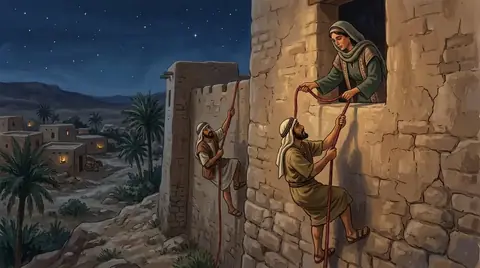
In the Old Testament, blood that has been shed cries out for justice, and it has to rest on somebody. "His blood shall be upon him" in the law means that a man who commits a crime deserving death has only himself to blame (Leviticus 20:9). The spies told Rahab that if anyone in her family went out into the street during the attack, "his blood shall be upon his head"; if they stayed inside and were harmed, the blood would be on the spies (Joshua 2:19). David said to the man who claimed to have killed Saul, "Thy blood be upon thy head" (2 Samuel 1:16). Ezekiel's watchman is clear of blame if he blows the trumpet and people ignore it; their blood is on themselves (Ezekiel 33:4–5).
At the cross
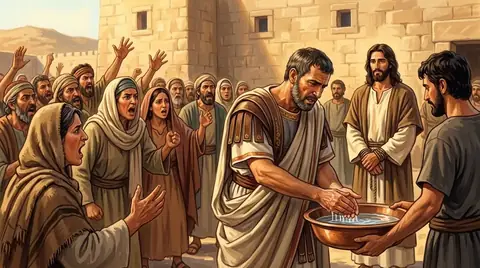
Pilate washed his hands in front of the crowd and said, "I am innocent of the blood of this just person". The people answered, "His blood be on us, and on our children" (Matthew 27:24–25). They were taking on themselves, and their children, the guilt of Jesus' death, and Peter later told Jerusalem that they had done just that (Acts 2:23; Acts 2:36). Yet the same blood they called down on their heads was the blood that could wash them clean, and three thousand of them were baptised that day (Acts 2:41). Paul, when the Jews of Corinth rejected his message, shook out his clothes and said, "Your blood be upon your own heads; I am clean" (Acts 18:6): he had warned them, and the responsibility was now theirs.
Key verses
- Matthew 27:24–25
When Pilate saw that he could prevail nothing, but that rather a tumult was made, he took water, and washed his hands before the multitude, saying, I am innocent of the blood of this just person: see ye to it. Then answered all the people, and said, His blood be on us, and on our children.
- Joshua 2:19
And it shall be, that whosoever shall go out of the doors of thy house into the street, his blood shall be upon his head, and we will be guiltless: and whosoever shall be with thee in the house, his blood shall be on our head, if any hand be upon him.
- Ezekiel 33:4–5
Then whosoever heareth the sound of the trumpet, and taketh not warning; if the sword come, and take him away, his blood shall be upon his own head. He heard the sound of the trumpet, and took not warning; his blood shall be upon him. But he that taketh warning shall deliver his soul.
- Acts 18:6
And when they opposed themselves, and blasphemed, he shook his raiment, and said unto them, Your blood be upon your own heads; I am clean: from henceforth I will go unto the Gentiles.
- Acts 2:36–38
Therefore let all the house of Israel know assuredly, that God hath made that same Jesus, whom ye have crucified, both Lord and Christ. Now when they heard this, they were pricked in their heart, and said unto Peter and to the rest of the apostles, Men and brethren, what shall we do? Then Peter said unto them, Repent, and be baptized every one of you in the name of Jesus Christ for the remission of sins, and ye shall receive the gift of the Holy Ghost.
Read next
 PersonRahabA woman of Jericho who hid Joshua's two spies because she believed in Israel's God. She and her family were spared when…
 PersonPilateThe Roman governor of Judea who tried Jesus. He said three times that he found no fault in him, yet handed him over to…
 PersonPeterA Galilean fisherman who became the leader of the twelve apostles. Bold and impulsive, he confessed Jesus as the…
 PersonPaulA Pharisee who hated the church until the risen Jesus met him on the road to Damascus. He became the apostle to the…
Written for this app in its own words, from the Bible, with the facts checked against Bible dictionaries and encyclopedias: Easton's, Smith's, Fausset's, ISBE, Holman, the New Bible Dictionary, Vine's and the Thompson Chain topics. Also: Bullinger, Figures of Speech.
