
Teaching
Hell, Sheol and Hades
Three Bible words behind the English word "hell"
The English word "hell" stands for three different words in the Bible: Sheol and Hades, the place of the dead, and Gehenna, the place of final punishment that Jesus warned about more than anyone.
- Sheol
- Hebrew: the place of the dead, "the grave" (Psalms 16:10)
- Hades
- Greek: the same place, where the rich man was in torment (Luke 16:23)
- Gehenna
- Greek, from the valley of Hinnom: the fire of final judgment (Mark 9:43)
- Lake of fire
- Revelation's name for the final hell (Revelation 20:14–15)
Three words, one English word
When the King James Version says "hell", it may be translating one of three words. Sheol in the Old Testament is where all the dead go, good and bad alike, out of sight beneath the earth; often it simply means the grave. Hades is the Greek word used for the same place in the New Testament. Gehenna is different. It comes from the valley of Hinnom outside Jerusalem, where in the days of the wicked kings children had been burned to Molech and which later became a place of fire and filth. Jesus used its name for the place where the lost are punished after the judgment.
What Jesus said
Nobody in the Bible spoke of hell as often, or as plainly, as Jesus. He said it was better to lose a hand or an eye than to be thrown whole into the unquenchable fire (Mark 9:43–48). He told people not to fear those who can only kill the body, but to fear God, who can destroy both body and soul in hell (Matthew 10:28). In his story of the rich man and Lazarus, the rich man died and found himself in Hades, in torment and unable to cross to where Lazarus was comforted (Luke 16:19–31). The warnings came from the one who loved sinners most and died to save them.
The last judgment
Revelation says that at the end death and Hades give up their dead, everyone is judged, and then death and Hades themselves are thrown into the lake of fire with the devil, the beast and all whose names are not in the book of life (Revelation 20:10–15). Hell was prepared for the devil and his angels (Matthew 25:41); people go there only by refusing the mercy offered them.
For us
The good news is the other side of the same truth. Christ died and rose, and now holds "the keys of hell and of death" (Revelation 1:18). Whoever trusts in him "shall not perish, but have everlasting life" (John 3:16).
Key verses
- Luke 16:19–31
There was a certain rich man, which was clothed in purple and fine linen, and fared sumptuously every day: And there was a certain beggar named Lazarus, which was laid at his gate, full of sores, And desiring to be fed with the crumbs which fell from the rich man’s table: moreover the dogs came and licked his sores. …
- Matthew 10:28
And fear not them which kill the body, but are not able to kill the soul: but rather fear him which is able to destroy both soul and body in hell.
- Mark 9:43–48
And if thy hand offend thee, cut it off: it is better for thee to enter into life maimed, than having two hands to go into hell, into the fire that never shall be quenched: Where their worm dieth not, and the fire is not quenched. And if thy foot offend thee, cut it off: it is better for thee to enter halt into life, than having two feet to be cast into hell, into the fire that never shall be quenched: …
- Revelation 20:10–15
And the devil that deceived them was cast into the lake of fire and brimstone, where the beast and the false prophet are, and shall be tormented day and night for ever and ever. And I saw a great white throne, and him that sat on it, from whose face the earth and the heaven fled away; and there was found no place for them. And I saw the dead, small and great, stand before God; and the books were opened: and another book was opened, which is the book of life: and the dead were judged out of those things which were written in the books, according to their works. …
- Revelation 1:18
I am he that liveth, and was dead; and, behold, I am alive for evermore, Amen; and have the keys of hell and of death.
Read next
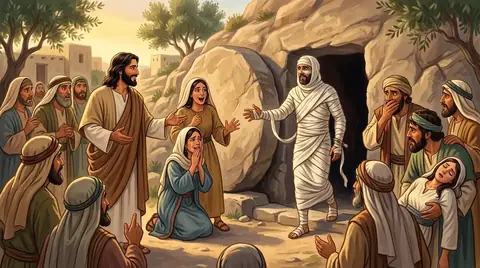 PersonLazarusThe brother of Mary and Martha whom Jesus called out of the tomb after four days. A poor beggar of the same name…
Written for this app in its own words, from the Bible, with the facts checked against Bible dictionaries and encyclopedias: Easton's, Smith's, Fausset's, ISBE, Holman, the New Bible Dictionary, Vine's and the Thompson Chain topics. Also: Westminster Confession 32-33.
