
Custom · Law
Debtor
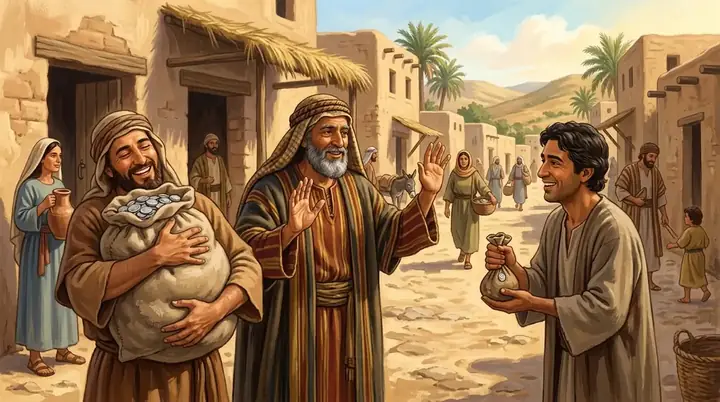
Someone who owes money. In Bible times a debtor could lose his cloak, his land, his children or his freedom. The law set limits to protect him, and Jesus used debtors in his stories of forgiveness.
- Law
- Only the pledge the debtor could spare (Deuteronomy 24:10–13); a bondservant freed in the seventh year (Exodus 21:2); land returned at the jubilee (Leviticus 25:28)
- Surety
- A man who stood surety was liable like the debtor (Proverbs 11:15; Proverbs 17:18)
- In Jesus' stories
- The unforgiving servant (Matthew 18:23–35); the two debtors (Luke 7:41–43); the unjust steward (Luke 16:1–8)
In the law
A lender could ask for a pledge, but he could not walk into the debtor's house to pick it; he waited outside for what the man chose to give (Deuteronomy 24:10–11). A poor man's cloak had to be back by nightfall, for it was his blanket (Exodus 22:26–27), and the millstones he ground his bread with could not be taken at all (Deuteronomy 24:6). If a debtor sold himself, he served six years and went free with gifts in the seventh (Deuteronomy 15:12–14), and land sold for debt came back to the family in the jubilee (Leviticus 25:25–28). None of this was always kept: Amos saw the poor sold for a pair of shoes (Amos 2:6).
In the New Testament
Under Roman law a debtor could be jailed until he paid, as in Jesus' warning about settling with your accuser on the way to court (Matthew 5:25–26). Jesus turned debt into a picture of sin. The servant forgiven a vast sum who then seized a fellow servant by the throat for a trifle was handed to the tormentors (Matthew 18:23–35). Of two debtors forgiven, Jesus asked Simon which would love the lender more, and the answer explained the woman weeping at his feet (Luke 7:41–43). Paul called himself a debtor to Greeks and barbarians: he owed them the gospel (Romans 1:14). See also Debt.
Key verses
- Exodus 22:26–27
If thou at all take thy neighbour’s raiment to pledge, thou shalt deliver it unto him by that the sun goeth down: For that is his covering only, it is his raiment for his skin: wherein shall he sleep? and it shall come to pass, when he crieth unto me, that I will hear; for I am gracious.
- Deuteronomy 24:10–13
When thou dost lend thy brother any thing, thou shalt not go into his house to fetch his pledge. Thou shalt stand abroad, and the man to whom thou dost lend shall bring out the pledge abroad unto thee. And if the man be poor, thou shalt not sleep with his pledge: …
- Matthew 18:23–35
Therefore is the kingdom of heaven likened unto a certain king, which would take account of his servants. And when he had begun to reckon, one was brought unto him, which owed him ten thousand talents. But forasmuch as he had not to pay, his lord commanded him to be sold, and his wife, and children, and all that he had, and payment to be made. …
- Luke 7:41–43
There was a certain creditor which had two debtors: the one owed five hundred pence, and the other fifty. And when they had nothing to pay, he frankly forgave them both. Tell me therefore, which of them will love him most? Simon answered and said, I suppose that he, to whom he forgave most. And he said unto him, Thou hast rightly judged.
- Romans 1:14
I am debtor both to the Greeks, and to the Barbarians; both to the wise, and to the unwise.
Read next
 Feast · LawThe JubileeEvery fiftieth year in Israel, announced by a trumpet blast on the Day of Atonement. Sold land went back to its first…
 PersonAmosA shepherd and fig-grower from Tekoa in Judah whom God sent to warn the rich northern kingdom of Israel. He called for…
 Teaching · LawDebtOwing money or anything else. God's law told Israel to lend freely to the poor, not to charge them interest, and to…
Written for this app in its own words, from the Bible, with the facts checked against Bible dictionaries and encyclopedias: Easton's, Smith's, Fausset's, ISBE, Holman, the New Bible Dictionary, Vine's and the Thompson Chain topics.
