
Custom · Worship
The burnt offering
Hebrew olah, "that which goes up"
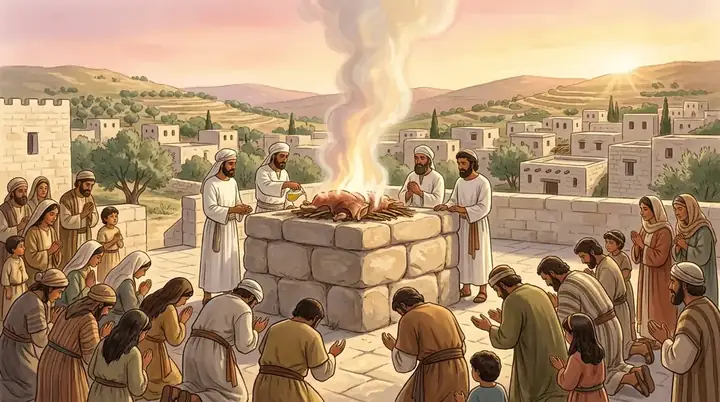
A sacrifice burned whole on the altar, with nothing held back: a picture of giving oneself completely to God. A lamb was offered for Israel every morning and every evening.
- Animals
- A bull, ram, male goat, or for the poor a dove or pigeon (Leviticus 1)
- Daily
- One lamb at morning and one at evening, with flour, oil and wine (Exodus 29:38–42)
- Earliest
- Offered by Noah (Genesis 8:20) and Abraham (Genesis 22:13)
What it was
Other sacrifices were shared: part burned, part eaten by priests or worshippers. The burnt offering went up to God entire. The worshipper brought an animal without blemish, laid a hand on its head to make it stand for himself, and killed it; the priests sprinkled the blood on the altar, cut up the animal, washed the inner parts and burned it all, "a sweet savour unto the LORD" (Leviticus 1:3–9). The poor could bring a dove (Leviticus 1:14). It made atonement for the offerer (Leviticus 1:4), and it said: all of me is yours.
When it was offered
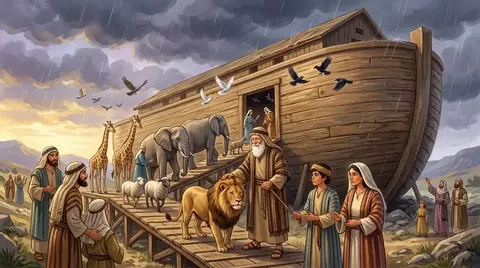
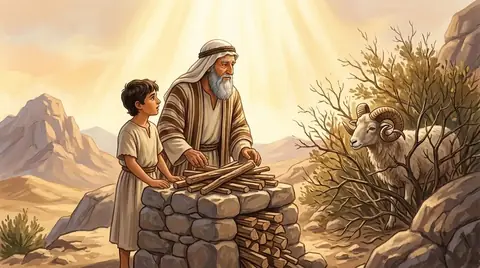
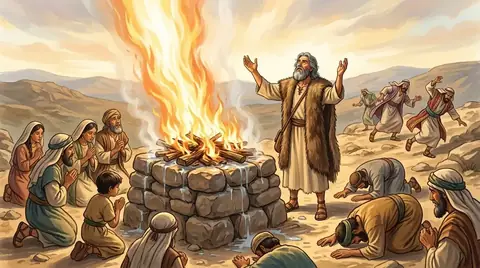
It is the oldest sacrifice in the Bible. Noah offered burnt offerings when he left the ark, and Abraham was told to offer Isaac as one, until God provided a ram (Genesis 8:20; Genesis 22:2–13). Under the law a lamb was burned every morning and every evening, with a Sabbath double portion, and extra offerings at the new moons and feasts (Numbers 28–29). The fire on the altar was never to go out (Leviticus 6:13). Great occasions brought great numbers: Solomon offered thousands when the temple was dedicated (1 Kings 8:64), and Elijah's burnt offering on Mount Carmel was consumed by fire from heaven (1 Kings 18:38).
What it meant
God made clear that the animal was not the point. "To obey is better than sacrifice" (1 Samuel 15:22), and David knew God took no pleasure in burnt offerings from an unbroken heart (Psalms 51:16–17). Hebrews says Christ came because burnt offerings for sin could never please God in themselves, and offered his body once for all (Hebrews 10:6–10). Christians answer by presenting their own bodies "a living sacrifice" (Romans 12:1): the burnt offering's whole-heartedness, lived out.
Key verses
- Leviticus 1:3–9
If his offering be a burnt sacrifice of the herd, let him offer a male without blemish: he shall offer it of his own voluntary will at the door of the tabernacle of the congregation before the Lord. And he shall put his hand upon the head of the burnt offering; and it shall be accepted for him to make atonement for him. And he shall kill the bullock before the Lord: and the priests, Aaron’s sons, shall bring the blood, and sprinkle the blood round about upon the altar that is by the door of the tabernacle of the congregation. …
- Exodus 29:38–42
Now this is that which thou shalt offer upon the altar; two lambs of the first year day by day continually. The one lamb thou shalt offer in the morning; and the other lamb thou shalt offer at even: And with the one lamb a tenth deal of flour mingled with the fourth part of an hin of beaten oil; and the fourth part of an hin of wine for a drink offering. …
- Genesis 22:13
And Abraham lifted up his eyes, and looked, and behold behind him a ram caught in a thicket by his horns: and Abraham went and took the ram, and offered him up for a burnt offering in the stead of his son.
- 1 Samuel 15:22
And Samuel said, Hath the Lord as great delight in burnt offerings and sacrifices, as in obeying the voice of the Lord? Behold, to obey is better than sacrifice, and to hearken than the fat of rams.
- Romans 12:1
I beseech you therefore, brethren, by the mercies of God, that ye present your bodies a living sacrifice, holy, acceptable unto God, which is your reasonable service.
Read next
 PersonNoahThe one righteous man of his age. God told him to build an ark, and through it saved him, his family and the animals…
 PersonAbrahamThe man God called out of Ur to a land he had never seen, promising him a people and a blessing for the whole world. He…
 PersonIsaacThe son God promised to Abraham and Sarah when they were far too old for children, offered on Mount Moriah and spared.…
 PersonElijahThe fiery prophet who stood alone against King Ahab and the prophets of Baal, called down fire on Mount Carmel, and was…Place · MountainMount CarmelA wooded ridge running inland from the Mediterranean coast of northern Israel, famous as the place where Elijah called…
Written for this app in its own words, from the Bible, with the facts checked against Bible dictionaries and encyclopedias: Easton's, Smith's, Fausset's, ISBE, Holman, the New Bible Dictionary, Vine's and the Thompson Chain topics.
