
Teaching
Atonement
also called expiation; literally "at-one-ment"
How a sinner is made right with God: sin is covered by a sacrifice offered in the sinner's place. In the Old Testament this was done by animals; Jesus did it once for all by his death.
- Hebrew
- kaphar, "to cover"
- In the law
- By the blood of sacrifices, above all on the Day of Atonement (Leviticus 16)
- In Christ
- "the propitiation for our sins" (1 John 2:2), made once and never repeated (Hebrews 9:26)
The problem
Sin separates people from God. He is holy and cannot simply ignore wrong, yet he loves the people who do it. Atonement is God's way of dealing with the sin so that the sinner and he can be "at one" again. The English word was made up to say exactly that.
In the Old Testament
God told Israel that "it is the blood that maketh an atonement for the soul" (Leviticus 17:11). A person who sinned brought an animal, laid a hand on its head and killed it; the priest put its blood on the altar, and the sin was forgiven (Leviticus 4:27–31). The life of the animal stood in for the life of the sinner.
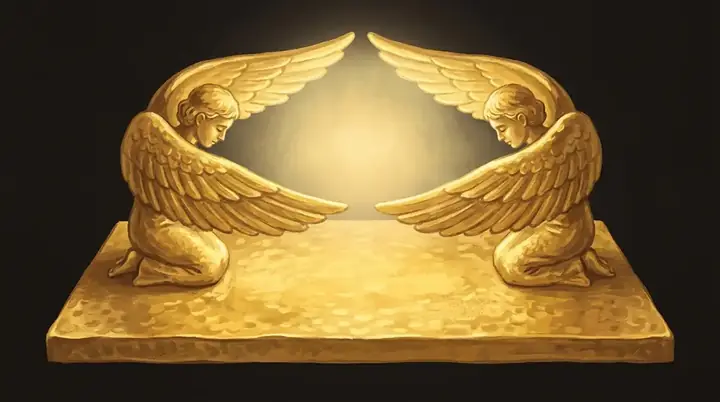
Once a year came the Day of Atonement. The high priest went behind the veil with blood for the whole nation and sprinkled it on the mercy seat, the lid of the ark of the covenant. Then he confessed Israel's sins over a second goat, the scapegoat, which was led away into the desert, carrying them out of sight (Leviticus 16). Everyone could see that sin had been both paid for and taken away.
In Jesus
Those sacrifices had to be offered every day and every year, which showed they could not really take sin away (Hebrews 10:1–4). They were pictures. Jesus is the reality: the Lamb of God who takes away the sin of the world (John 1:29). On the cross he bore our sins in his own body (1 Peter 2:24), the just for the unjust (1 Peter 3:18). He is our "propitiation", the sacrifice that turns God's anger away (Romans 3:25). It was done once, and it never needs doing again (Hebrews 9:26–28).
The atonement did not make God love us; it is because he already loved us that he sent his Son to be the sacrifice (1 John 4:10).
For us
Paul says we have "received the atonement" (Romans 5:11): it is a gift to be taken, not a debt to be paid. Whoever trusts in Christ's death is at peace with God (Romans 5:1).
Key verses
- Leviticus 17:11
For the life of the flesh is in the blood: and I have given it to you upon the altar to make an atonement for your souls: for it is the blood that maketh an atonement for the soul.
- Leviticus 16:30
For on that day shall the priest make an atonement for you, to cleanse you, that ye may be clean from all your sins before the Lord.
- Romans 3:25
Whom God hath set forth to be a propitiation through faith in his blood, to declare his righteousness for the remission of sins that are past, through the forbearance of God;
- Romans 5:11
And not only so, but we also joy in God through our Lord Jesus Christ, by whom we have now received the atonement.
- Hebrews 9:26
For then must he often have suffered since the foundation of the world: but now once in the end of the world hath he appeared to put away sin by the sacrifice of himself.
- 1 John 2:2
And he is the propitiation for our sins: and not for ours only, but also for the sins of the whole world.
Read next
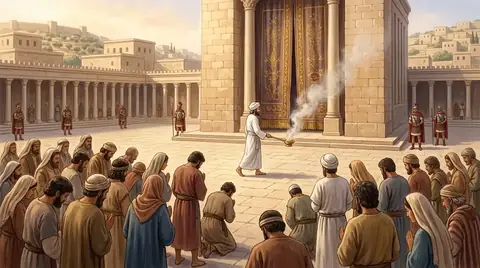 Feast · FastThe Day of AtonementThe one day in the year when the high priest went behind the veil with blood to atone for all Israel's sins, while a…
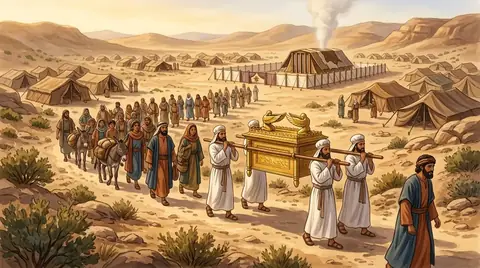 Thing · WorshipThe ark of the covenantThe gold-covered chest that held the Ten Commandments and stood in the Most Holy Place. God promised to meet with…
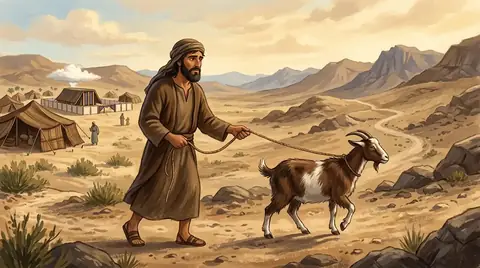 Custom · WorshipThe scapegoatOnce a year, at the Day of Atonement, the high priest confessed the nation's sins over a live goat and sent it off into…
Written for this app in its own words, from the Bible, with the facts checked against Bible dictionaries and encyclopedias: Easton's, Smith's, Fausset's, ISBE, Holman, the New Bible Dictionary, Vine's and the Thompson Chain topics.
