
Thing · Worship
The turban and the gold plate
The high priest's headdress and its crown of gold, "HOLINESS TO THE LORD"
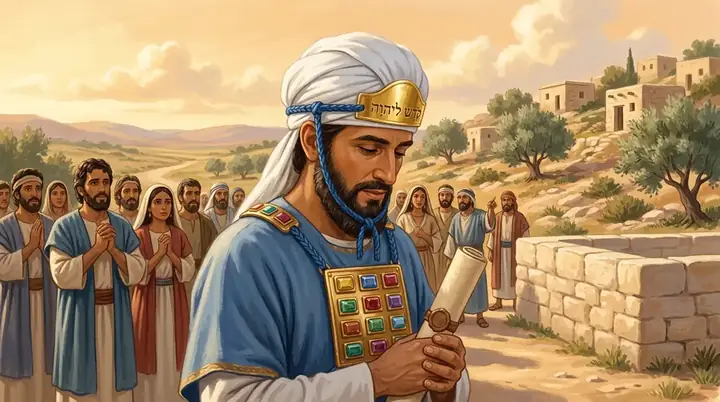
The high priest's headdress of fine linen (the KJV's "mitre"), with a plate of pure gold on its front engraved "HOLINESS TO THE LORD". It showed that he, and the people's gifts, were set apart for God.
- Hebrew
- mitsnepheth, the turban; tsits, the plate, also called "the holy crown"
- Where
- Exodus 28:36–39; Exodus 29:6; Exodus 39:30–31; Leviticus 8:9; Zechariah 3:5
- Worn by
- The high priest only; other priests wore plain linen caps (Exodus 28:40)
What it was
The last of the high priest's garments to be described is his headdress: a turban of fine linen wound round the head (Exodus 28:39). On its front, held by a cord of blue, was a plate of pure gold engraved like a seal with the words "HOLINESS TO THE LORD" (Exodus 28:36–37). Moses called it "the holy crown" (Exodus 29:6; Leviticus 8:9). The other priests had simpler caps; the crown belonged to Aaron alone.
What it meant
God explained the plate himself. It was to be always on Aaron's forehead so that he might "bear the iniquity of the holy things": even Israel's gifts and sacrifices were brought by sinful hands, and only through a priest marked as holy could they be accepted (Exodus 28:38). Everyone who looked at the high priest saw the word written over his face: whatever else he was, he belonged to God. On the Day of Atonement he set the gold aside and wore only a plain linen turban when he went into the Most Holy Place (Leviticus 16:4).
Long after, the prophet Zechariah saw the high priest Joshua standing before the angel of the LORD in filthy clothes while Satan accused him. God ordered the dirty clothes taken away and "a fair mitre" set on his head: his sin was taken away and he was fit to serve (Zechariah 3:1–5). Zechariah also foresaw a day when the words of the plate would be stamped even on the bells of the horses, because everything in Jerusalem would be holy (Zechariah 14:20–21).
Points to Christ
Jesus is the high priest who needed no plate to make him holy: he is "holy, harmless, undefiled, separate from sinners" (Hebrews 7:26), and through him our imperfect worship is accepted. He wore a crown of thorns on earth; John saw him with many crowns (Revelation 19:12). And his people, the "royal priesthood" (1 Peter 2:9), will one day carry his name on their foreheads (Revelation 22:4).
Key verses
- Exodus 28:36–38
And thou shalt make a plate of pure gold, and grave upon it, like the engravings of a signet, HOLINESS TO THE LORD. And thou shalt put it on a blue lace, that it may be upon the mitre; upon the forefront of the mitre it shall be. And it shall be upon Aaron’s forehead, that Aaron may bear the iniquity of the holy things, which the children of Israel shall hallow in all their holy gifts; and it shall be always upon his forehead, that they may be accepted before the Lord.
- Leviticus 16:4
He shall put on the holy linen coat, and he shall have the linen breeches upon his flesh, and shall be girded with a linen girdle, and with the linen mitre shall he be attired: these are holy garments; therefore shall he wash his flesh in water, and so put them on.
- Zechariah 3:5
And I said, Let them set a fair mitre upon his head. So they set a fair mitre upon his head, and clothed him with garments. And the angel of the Lord stood by.
- Zechariah 14:20
In that day shall there be upon the bells of the horses, HOLINESS UNTO THE LORD; and the pots in the Lord’s house shall be like the bowls before the altar.
- Hebrews 7:26
For such an high priest became us, who is holy, harmless, undefiled, separate from sinners, and made higher than the heavens;
Read next
 Custom · WorshipThe high priestThe head of Israel's priests, descended from Aaron, who alone went into the Most Holy Place once a year to make…
 PersonAaronMoses' older brother and Israel's first high priest. He spoke for Moses before Pharaoh and served God at the tabernacle…
 Feast · FastThe Day of AtonementThe one day in the year when the high priest went behind the veil with blood to atone for all Israel's sins, while a…
Written for this app in its own words, from the Bible, with the facts checked against Bible dictionaries and encyclopedias: Easton's, Smith's, Fausset's, ISBE, Holman, the New Bible Dictionary, Vine's and the Thompson Chain topics.
