
Custom · Worship
The high priest
The head of Israel's priests, descended from Aaron, who alone went into the Most Holy Place once a year to make atonement for the nation. Hebrews shows Jesus as the perfect High Priest.
- The first
- Aaron, then his son Eleazar and his line; Eli, Zadok, Jehoiada, Hilkiah, Joshua after the exile
- His clothes
- The ephod, the breastplate with twelve stones, the blue robe with bells, the turban with its gold plate (Exodus 28)
- His great day
- The Day of Atonement (Leviticus 16)
- In Jesus' day
- Annas and Caiaphas, appointed by Rome
What he was
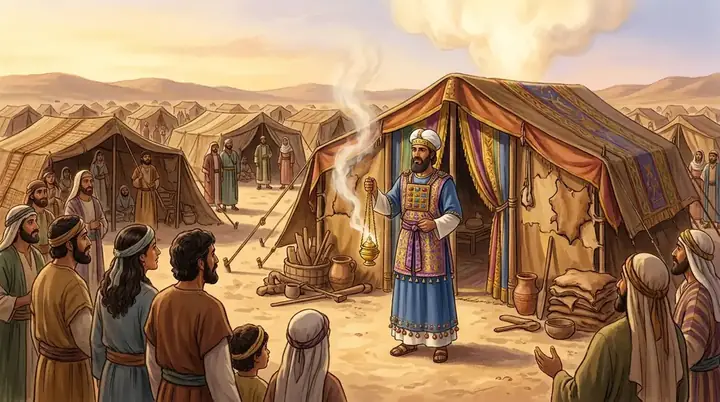
God chose Aaron and his sons to be Israel's priests, and Aaron to be the chief of them (Exodus 28:1). The office passed from father to son, for life. The high priest was anointed with holy oil, held to stricter rules than other priests (Leviticus 21:10–15), and wore clothes that no one else wore: the richly woven ephod with an onyx stone on each shoulder, the breastplate with twelve jewels bearing the names of the tribes, the blue robe with bells and pomegranates round its hem, and a linen turban with a gold plate reading "Holiness to the LORD" (Exodus 28). He carried the people on his shoulders and over his heart whenever he went in before God.
His work
Priests offered the daily sacrifices and taught the law, but one duty was the high priest's alone. Once a year, on the Day of Atonement, he laid aside his splendid robes, dressed in plain linen, and went through the veil into the Most Holy Place with the blood of a bull for his own sins and of a goat for the people's, sprinkling it on the mercy seat (Leviticus 16). Through the Urim and Thummim in his breastplate he could ask God for guidance. A person who had killed by accident was safe in a city of refuge until the high priest died (Numbers 35:25).
In the New Testament
By Jesus' day the office had become political. Herod and then the Roman governors appointed and removed high priests at will, and the families who held it were rich and worldly. Annas, deposed by Rome, still pulled the strings while his son-in-law Caiaphas held the title. It was Caiaphas who said that it was expedient for one man to die for the people (John 11:49–50) and who presided over Jesus' night trial and condemned him for blasphemy (Matthew 26:57–66).
Points to Christ
The letter to the Hebrews says that all of this was a shadow of Jesus. He is a priest not by birth but by God's oath, "after the order of Melchizedek" (Hebrews 7:21). Earthly high priests were sinners who died and had to be replaced; he is holy and lives for ever. They went in once a year with the blood of animals; he went into heaven itself "by his own blood", once for all (Hebrews 9:12). Because he lives to pray for his people, believers can "come boldly unto the throne of grace" (Hebrews 4:16).
Key verses
- Exodus 28:1
And take thou unto thee Aaron thy brother, and his sons with him, from among the children of Israel, that he may minister unto me in the priest’s office, even Aaron, Nadab and Abihu, Eleazar and Ithamar, Aaron’s sons.
- Leviticus 16:32–34
And the priest, whom he shall anoint, and whom he shall consecrate to minister in the priest’s office in his father’s stead, shall make the atonement, and shall put on the linen clothes, even the holy garments: And he shall make an atonement for the holy sanctuary, and he shall make an atonement for the tabernacle of the congregation, and for the altar, and he shall make an atonement for the priests, and for all the people of the congregation. And this shall be an everlasting statute unto you, to make an atonement for the children of Israel for all their sins once a year. And he did as the Lord commanded Moses.
- Matthew 26:57
And they that had laid hold on Jesus led him away to Caiaphas the high priest, where the scribes and the elders were assembled.
- Hebrews 4:14–16
Seeing then that we have a great high priest, that is passed into the heavens, Jesus the Son of God, let us hold fast our profession. For we have not an high priest which cannot be touched with the feeling of our infirmities; but was in all points tempted like as we are, yet without sin. Let us therefore come boldly unto the throne of grace, that we may obtain mercy, and find grace to help in time of need.
- Hebrews 7:26–27
For such an high priest became us, who is holy, harmless, undefiled, separate from sinners, and made higher than the heavens; Who needeth not daily, as those high priests, to offer up sacrifice, first for his own sins, and then for the people’s: for this he did once, when he offered up himself.
- Hebrews 9:11–12
But Christ being come an high priest of good things to come, by a greater and more perfect tabernacle, not made with hands, that is to say, not of this building; Neither by the blood of goats and calves, but by his own blood he entered in once into the holy place, having obtained eternal redemption for us.
Read next
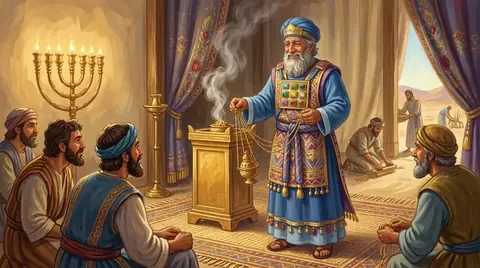 PersonAaronMoses' older brother and Israel's first high priest. He spoke for Moses before Pharaoh and served God at the tabernacle…
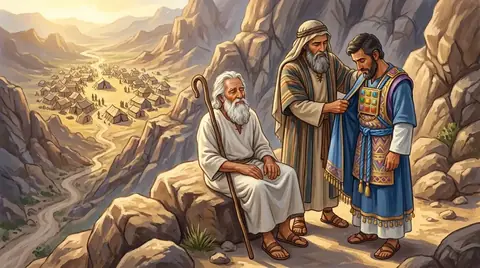 PersonEleazarAaron's third son, who became Israel's second high priest when his father died on Mount Hor. He served through the…
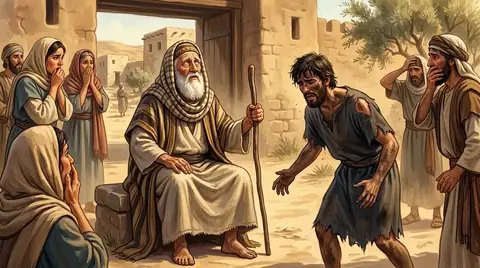 PersonEliThe old high priest at Shiloh who raised the boy Samuel. A kind man, he failed to restrain his wicked sons, and died…
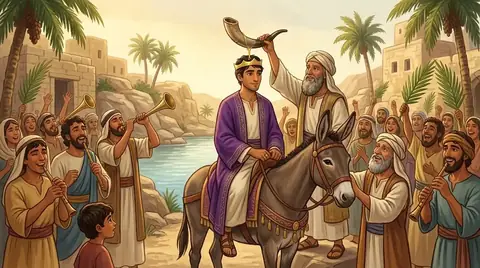 PersonZadokThe priest who stayed loyal to David through Absalom's revolt and anointed Solomon king. Solomon made him sole high…
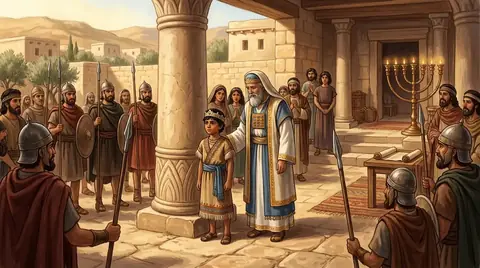 PersonJehoiadaThe high priest who hid the baby prince Joash from Queen Athaliah for six years, then crowned him king in the temple.…
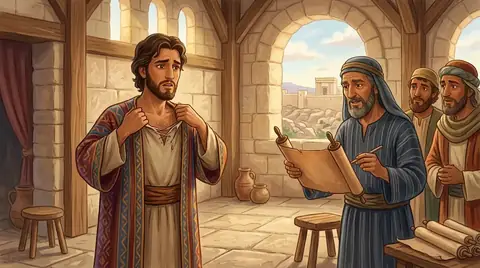 Person · PriestHilkiahThe high priest who found the lost Book of the Law while the temple was being repaired in King Josiah's reign. Its…Thing · WorshipEphodA sleeveless vest worn by priests. The high priest's ephod was richly woven with gold and colours; other priests wore a…
 ThingBreastplateArmour that covered a soldier's chest, and the KJV's name for the high priest's jewelled breastpiece. Paul tells…
Written for this app in its own words, from the Bible, with the facts checked against Bible dictionaries and encyclopedias: Easton's, Smith's, Fausset's, ISBE, Holman, the New Bible Dictionary, Vine's and the Thompson Chain topics. Also: Edersheim, The Temple: Its Ministry and Services.
