
Symbol · Animal
Sheep
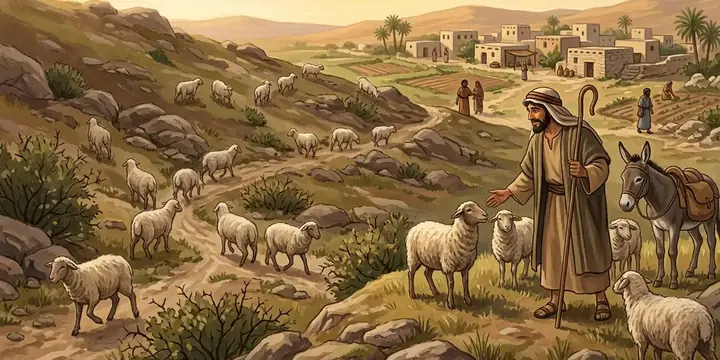
The commonest animal in the Bible, kept for wool, milk, meat and sacrifice. Sheep stand for God's people: prone to wander, helpless without a shepherd, known and cared for by him.
- Kept for
- Wool, milk, meat, skins; the main animal of sacrifice
- Stands for
- God's people; the lost; the righteous at the judgment
- See also
- The shepherd, The sheepfold, Sheep and goats
The animal
The sheep of Bible lands is the broad-tailed kind, whose fat tail can weigh many pounds; the "rump" burned on the altar was this tail (Leviticus 3:9). Sheep gave wool for clothing, milk and cheese, meat for feasts, and skins. Flocks were the wealth of the patriarchs; Job ended with fourteen thousand (Job 42:12). Sheep-shearing was a holiday, with feasting and sometimes trouble (1 Samuel 25; 2 Samuel 13:23–28). Above all, the lamb was the animal of sacrifice: Abel's offering, the Passover lamb, the lamb offered every morning and evening at the temple.
A sheep is not clever. It wanders, cannot find its way home, cannot defend itself, and panics. It lives only because someone looks after it. That is why the Bible uses it as it does.
God's people
"We are his people, and the sheep of his pasture" (Psalms 100:3; Psalms 95:7). David, once a shepherd, sang "The LORD is my shepherd" (Psalms 23:1). The prophets grieved over sheep that had no shepherd, or bad ones: the leaders of Israel fed themselves and let the flock scatter (Ezekiel 34). Isaiah confessed for all of us, "All we like sheep have gone astray" (Isaiah 53:6), and the Lamb of God bore the penalty.
Jesus looked at the crowds and saw "sheep having no shepherd" (Matthew 9:36). He told of a shepherd who left ninety-nine to find one that was lost and carried it home rejoicing (Luke 15:4–7). He called himself the good shepherd who knows his sheep by name and lays down his life for them (John 10:11–15), and sent his disciples out "as sheep in the midst of wolves" (Matthew 10:16). After his resurrection he told Peter three times, "Feed my sheep" (John 21:15–17).
For us
A sheep's safety is in its shepherd, not in itself. Peter says we were straying sheep but have now returned to the Shepherd and Bishop of our souls (1 Peter 2:25).
Key verses
- Psalms 23:1
A Psalm of David. The Lord is my shepherd; I shall not want.
- Psalms 100:3
Know ye that the Lord he is God: it is he that hath made us, and not we ourselves; we are his people, and the sheep of his pasture.
- Isaiah 53:6
All we like sheep have gone astray; we have turned every one to his own way; and the Lord hath laid on him the iniquity of us all.
- Matthew 9:36
But when he saw the multitudes, he was moved with compassion on them, because they fainted, and were scattered abroad, as sheep having no shepherd.
- John 10:11
I am the good shepherd: the good shepherd giveth his life for the sheep.
- John 21:15–17
So when they had dined, Jesus saith to Simon Peter, Simon, son of Jonas, lovest thou me more than these? He saith unto him, Yea, Lord; thou knowest that I love thee. He saith unto him, Feed my lambs. He saith to him again the second time, Simon, son of Jonas, lovest thou me? He saith unto him, Yea, Lord; thou knowest that I love thee. He saith unto him, Feed my sheep. He saith unto him the third time, Simon, son of Jonas, lovest thou me? Peter was grieved because he said unto him the third time, Lovest thou me? And he said unto him, Lord, thou knowest all things; thou knowest that I love thee. Jesus saith unto him, Feed my sheep.
Read next
 SymbolThe shepherdOne who leads, feeds, guards and seeks out the sheep. The Bible calls God the shepherd of his people, calls kings and…
 Custom · Daily lifeThe sheepfoldA walled pen, open to the sky, where flocks spent the night in safety, with a single gateway that the shepherd guarded…
 Symbol · ParableSheep and goatsJesus' picture of the final judgment: the Son of man separates all nations as a shepherd parts his sheep from his…
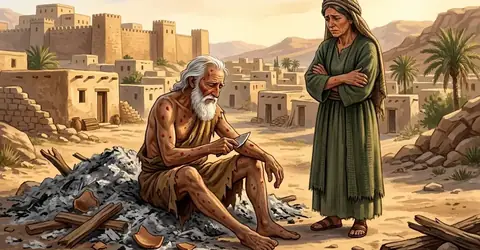 PersonJobA rich and godly man who lost his children, his wealth and his health in a single stroke, and would not curse God. His…
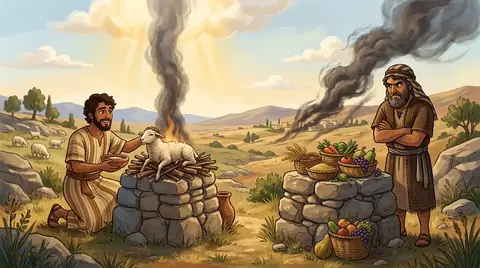 PersonAbelThe second son of Adam and Eve, a shepherd whose offering God accepted. His jealous brother Cain murdered him, making…
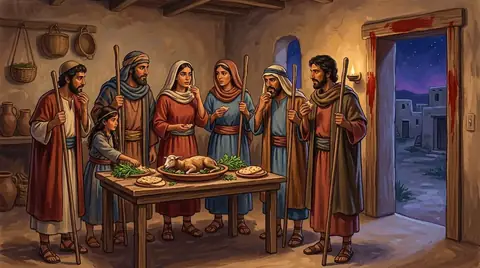 FeastPassoverThe yearly feast remembering the night God rescued Israel from Egypt, when death passed over every house marked with a…Name of ChristThe Shepherd and Bishop of Your SoulsPeter's name for Jesus: we were straying sheep, but have come back to the one who feeds, guides and watches over us.…
Written for this app in its own words, from the Bible, with the facts checked against Bible dictionaries and encyclopedias: Easton's, Smith's, Fausset's, ISBE, Holman, the New Bible Dictionary, Vine's and the Thompson Chain topics.
