
Plant
Oil-tree
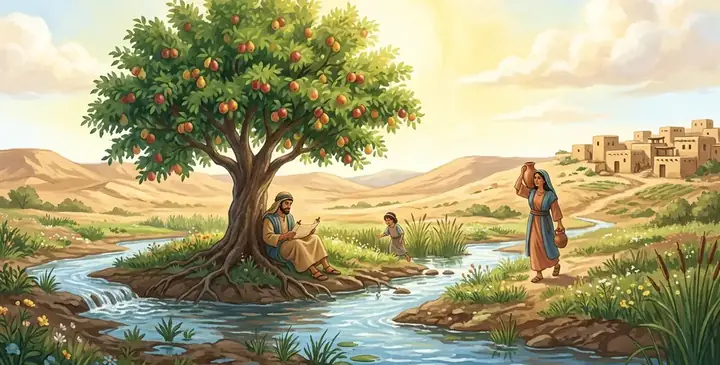
A tree Isaiah names among those God will plant in the desert. Its Hebrew name means "tree of oil"; it was probably the oleaster or wild olive, a hardy tree with fine wood. Its wood was carved for the cherubim in Solomon's temple.
- Verses
- Isaiah 41:19; 1 Kings 6:23; Nehemiah 8:15
- Probably
- The oleaster, a shrubby tree like the olive
The Hebrew is "tree of oil". It seems to have been a tree distinct from the true olive, most likely the oleaster, which grows wild over much of the land and has silvery leaves like an olive's, hard wood and small oily fruit. Isaiah heard God promise to make the dry wilderness bloom for his people: "I will plant in the wilderness the cedar, the shittah tree, and the myrtle, and the oil tree" (Isaiah 41:19). The two cherubim in the Most Holy Place of Solomon's temple, and its doors, were carved from this wood, which the KJV calls "olive tree" (1 Kings 6:23; 1 Kings 6:31–33). In Nehemiah's day the people fetched its branches, with olive, myrtle and palm, to build booths for the Feast of Tabernacles (Nehemiah 8:15).
Key verses
- Isaiah 41:19
I will plant in the wilderness the cedar, the shittah tree, and the myrtle, and the oil tree; I will set in the desert the fir tree, and the pine, and the box tree together:
- 1 Kings 6:23
And within the oracle he made two cherubims of olive tree, each ten cubits high.
- Nehemiah 8:15
And that they should publish and proclaim in all their cities, and in Jerusalem, saying, Go forth unto the mount, and fetch olive branches, and pine branches, and myrtle branches, and palm branches, and branches of thick trees, to make booths, as it is written.
Read next
 Person · ProphetIsaiahThe prophet of Jerusalem who served four kings, saw the LORD on his throne, and foretold the virgin's son, the…
 Group · HeavenCherubim and seraphimWinged beings close to God's throne. Cherubim guard his holiness and carry his glory, and their golden figures covered…
 PersonNehemiahThe king of Persia's cupbearer who got leave to go to Jerusalem and rebuilt its broken walls in fifty-two days, despite…
Written for this app in its own words, from the Bible, with the facts checked against Bible dictionaries and encyclopedias: Easton's, Smith's, Fausset's, ISBE, Holman, the New Bible Dictionary, Vine's and the Thompson Chain topics.
