
Nature · Sky
Moon
The lesser light God made to rule the night and mark the seasons. Israel counted its months by it and kept the new moon as a holy day, but was forbidden ever to worship it.
- Made
- On the fourth day, "the lesser light to rule the night" (Genesis 1:16)
- Hebrew
- yareah; also lebanah, "the white one"
- Known for
- The new moon feasts; standing still over Aijalon; darkened in the day of the LORD
In creation
God set the sun and moon in the sky "for signs, and for seasons, and for days, and years" (Genesis 1:14). The psalmist looks up at "the moon and the stars, which thou hast ordained" and wonders that God should care for man at all (Psalms 8:3–4). The moon marks out the months: "He appointed the moon for seasons" (Psalms 104:19). God promised that his covenant with David would last as long as the moon, "a faithful witness in heaven" (Psalms 89:36–37).
In Israel's life
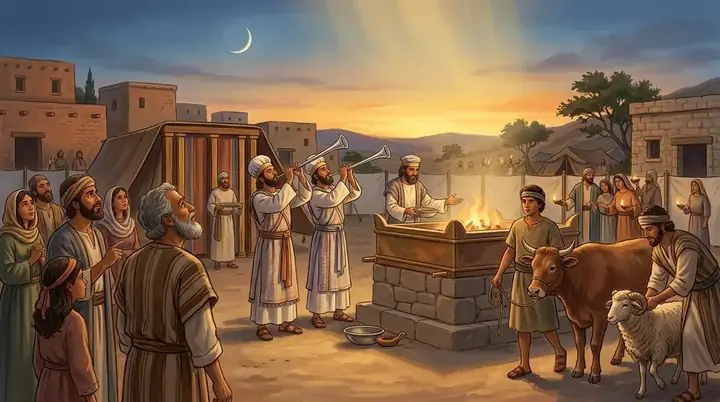
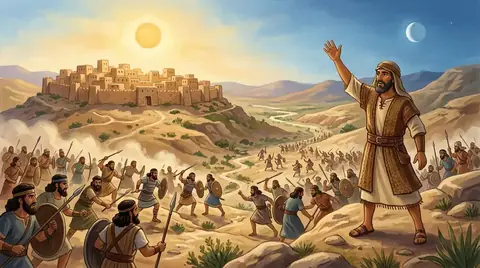
Each month began at the new moon, greeted with trumpet blasts and extra sacrifices (Numbers 10:10; Numbers 28:11–15). Shops closed, and greedy traders longed for the day to be over (Amos 8:5). People visited the prophets on new moons (2 Kings 4:23). When Joshua needed daylight to finish a battle, the sun stood still over Gibeon and the moon over the valley of Aijalon (Joshua 10:12–13).
A warning
The nations around Israel worshipped the moon, and the Law warned the people not to be drawn to bow to "the sun, or the moon, or any of the host of heaven" (Deuteronomy 4:19; Deuteronomy 17:3). They fell anyway: kings of Judah burned incense to the moon, and women in Jeremiah's day baked cakes for the "queen of heaven" (2 Kings 23:5; Jeremiah 7:18). Job knew that even a secret kiss of the hand toward the moon would be a sin against God (Job 31:26–28). The moon is a creature, not a god.
The last days
The prophets and Jesus say the moon will be darkened, or turned to blood, before the day of the LORD (Joel 2:31; Matthew 24:29). In the new Jerusalem there is no need of the moon at all, for the glory of God is its light (Revelation 21:23).
Key verses
- Genesis 1:16
And God made two great lights; the greater light to rule the day, and the lesser light to rule the night: he made the stars also.
- Psalms 8:3
When I consider thy heavens, the work of thy fingers, the moon and the stars, which thou hast ordained;
- Psalms 104:19
He appointed the moon for seasons: the sun knoweth his going down.
- Deuteronomy 4:19
And lest thou lift up thine eyes unto heaven, and when thou seest the sun, and the moon, and the stars, even all the host of heaven, shouldest be driven to worship them, and serve them, which the Lord thy God hath divided unto all nations under the whole heaven.
- Joshua 10:12–13
Then spake Joshua to the Lord in the day when the Lord delivered up the Amorites before the children of Israel, and he said in the sight of Israel, Sun, stand thou still upon Gibeon; and thou, Moon, in the valley of Ajalon. And the sun stood still, and the moon stayed, until the people had avenged themselves upon their enemies. Is not this written in the book of Jasher? So the sun stood still in the midst of heaven, and hasted not to go down about a whole day.
- Revelation 21:23
And the city had no need of the sun, neither of the moon, to shine in it: for the glory of God did lighten it, and the Lamb is the light thereof.
Read next
 Person · KingDavidThe shepherd boy who killed Goliath and became Israel's greatest king, "a man after God's own heart". He wrote many…Custom · TimeMonthThe Hebrew month began with the new moon and lasted 29 or 30 days. Twelve made a year, with a thirteenth added now and…
 PersonJoshuaMoses' helper who took over from him and led Israel across the Jordan into the Promised Land. He fought the wars of…
 Place · CityGibeonThe Hivite city whose people fooled Joshua into a treaty, and where the sun stood still over the battle that followed.…PlaceAijalonA town and valley in the low hills west of Jerusalem, on the main way up from the coast. Here Joshua prayed, "Moon, in…
 PersonJobA rich and godly man who lost his children, his wealth and his health in a single stroke, and would not curse God. His…
Written for this app in its own words, from the Bible, with the facts checked against Bible dictionaries and encyclopedias: Easton's, Smith's, Fausset's, ISBE, Holman, the New Bible Dictionary, Vine's and the Thompson Chain topics.
